Anti-Zionism in the Haggadah

By Lucia Pizzaro
(permission granted for publication)
Jewish Liberation Theology Institute
Are you attending or hosting a Seder tomorrow?

The Seder is a festive ritual meal. “Seder” is a Hebrew word that means “order.” The ritual meal is called the “Seder” because it is done in a certain order. The Seder is central to the celebration of the Passover holiday.

Central to the Seder is the book we know of as the “Haggadah,” which translates as “the telling.” And it means to direct us on what we are meant to do around that table. Last week I began to tell you that, even though the Haggadah professes to be the telling of the story of the Exodus, almost none of the verses from the story of the Exodus as recounted in the Torah, actually appear in it. In fact, the re-telling that the Haggadah facilitates is based on another re-telling. So I wanted to give you a closer look at the actual verses that the Haggadah picked to re-tell the story.

According to the Haggadah, the Seder follows these prescribed 14 steps:

Kaddesh (the Kiddush)
Ur’chatz (“washing” of the hands)
Karpas (eating the “herbs” dipped in saltwater)
Yachatz (“dividing” the middle matzah)
Maggid (the “narration”)
Rachtzah (“washing” the hands for the meal)
Motzi Matzah (the “benediction” over the matzah)
Maror (eating the “bitter herbs”)
Korech (eating “bitter herbs with matzah”)
Shulchan Orech (the “meal”)
Tzafun (eating of the afikoman – the “last matzah”)
Bareich (“Grace after Meals”)
Hallel (songs of praise)
Nirtzah (the closing formula)

Maggid (the “narration”) is the centerpiece of the entire ritual. Maggid is a Hebrew word that translates into “narration,” and it is the heart of the Haggadah; the main storytelling portion of the Seder.

The Maggid section is filled with many many biblical verses, and it is often difficult to understand in which way the Maggid is enriching us. But the central text that the rabbis of the Mishnah chose to re-tell the story of the Exodus in the Maggid section is a short formula that was used when the Israelites went up to Jerusalem for the presentation of their first fruits:

And the priest shall take the basket from your hand and lay it down before the altar of the LORD your God. And you shall speak out and say before the LORD your God: “My father was an Aramean about to perish, and he went down to Egypt, and he sojourned there with a few people, and he became there a great and mighty and multitudinous nation. And the Egyptians did evil to us and abused us and set upon us hard labor. And we cried out to the LORD God of our fathers, and the LORD heard our voice and saw our abuse and our trouble and our oppression. And the LORD brought us out from Egypt with a strong hand and with an outstretched arm and with great terror and with signs and with portents. And He brought us to this place and gave us this land, a land flowing with milk and honey. And now, look, I have brought the first yield of the fruit of the soil that You gave me, LORD.” And you shall lay it down before the LORD your God, and you shall bow before the LORD your God (Deuteronomy 26:4-10).

I have highlighted the actual formula to be recited when the Israelites went up to Jerusalem for the presentation of their first fruits. When the rabbis chose these verses to be the basis of the re-telling of the story of Exodus at the Seder, the Israelites were no longer bringing their first fruits to the Temple, because the Temple had been destroyed.

By now you may be wondering: Why did the rabbis choose Deuteronomy 26 as the central text of the Seder? Why this text and not any other? Why not use the stories themselves from Exodus?

As is often the case. We don’t have answers. However, we can embark on a few guesses:

These verses are the shortest version in the Torah of the Exodus story; they express gratitude to God for liberating our ancestors from Egypt; it could also be out of an attempt to remember the past (IF indeed this is what happened in the past).

Our Haggadah follows the practice of the Pumbedita and Sura academies of Babylon and it was adopted by all the Jewish communities in the Diaspora. This Haggadah completely superseded the ancient Palestinian version which differed from it in certain respects. There are some Haggadot that were found in Geniza, that follow the Palestinian version, but this tradition eventually disappeared.

So, the Mishnah prescribes that we must recite the formula found in Deuteronomy 26 for bringing our first fruits to the Temple, and the ancient Haggadot that followed the Palestinian tradition included verse 9, “And He brought us to this place and gave us this land, a land flowing with milk and honey,“ but our traditional (Babylonian) Haggadah ends the story with verse 8: “And the LORD brought us out from Egypt with a strong hand and with an outstretched arm and with great terror and with signs and with portents.”

This is how the Mishnah introduces the prescription that we must recite the formula found in Deuteronomy 26 for bringing our first fruits to the Temple: “He begins with disgrace and ends with praise. And they expound upon “My father was a wandering Aramean” until he finishes the whole portion” (Mishnah Pesachim 10:4). The whole portion!

The Haggadah that we have been using for more than a thousand years leaves out the verse that gives thanks for God giving us “this land.” And that’s not all. The Haggadot that followed the Palestinian tradition interpret the opening word “Aramean” as referring to “our father Jacob.” And thus the disgrace that the Mishnah talks about in its prescription is leaving the land and going to Egypt. And by including verse 9, “And God brought us to this place and gave us this land,” the praise that the MIshnah talks about in its prescription is returning to the land.

On the other hand, however, the Babylonian tradition, which is the tradition that we inherited, and the one that our Haggadot follow, leaves out verse 9 and reinterprets the word “Aramean” to mean not Jacob but Lavan (Jacob’s father in law), so that the formula becomes “Lavan sought to destroy our father Jacob”! In this way, the disgrace is no longer leaving the land of Israel. Rather than a story about leaving the land and coming back to the land, our Haggadah puts forward a story in which slavery and oppression become the disgrace, and liberation the praise. Our Haggadah tells a story from slavery and oppression to liberation. In this way, our Haggadah is an affirmation of Diaspora Judaism.

Passover–More than a Memory!

As we look at the things that were commanded in the ancient past of the religion of Israel and compare it to what is done today, we find major differences. Whether they are acceptable or “off the derech” is up to the individual to sort out. But let me ask a few questions of you!

We are currently at the time of Passover and there are a lot of things that don’t line up when reading the passages in the Tenakh that define what was commanded to be done and what was done in the original instance. 

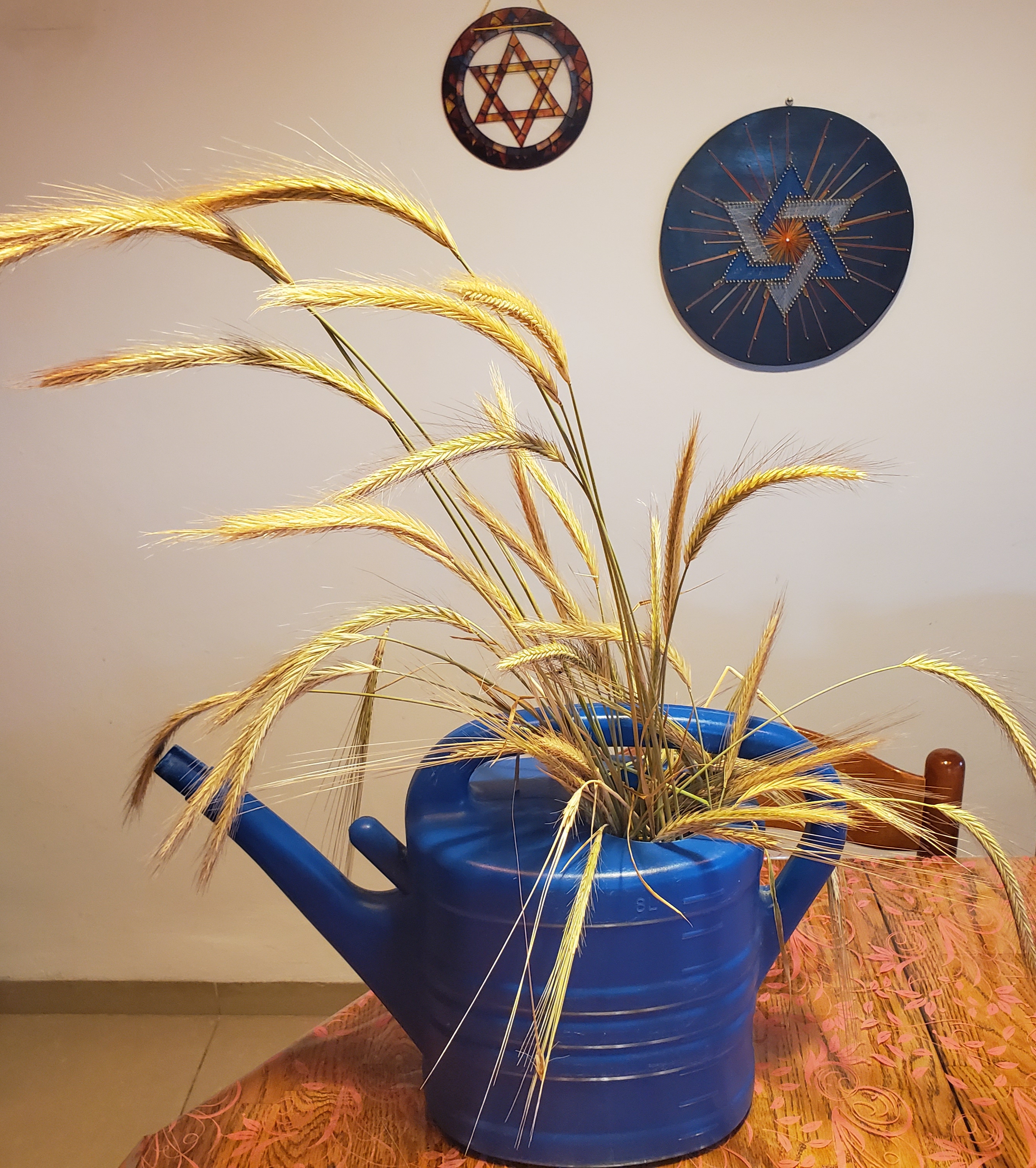
The past few days I have been thinking about several of these things. I wrote an article about leaven, arranged a wave sheaf on the dining table as a reminder of what was required on the first day of unleavened bread. My husband gathered wild barley from an open field near us here in Israel. We will plan to wave it and break off some of the grains. 

Some would say, but there is no Temple, so you can’t do this! But a close look at the passages concerning Passover show that the barley sheaf which was only to be gathered “in the land” was not connected to the temple. 

The article I wrote was mainly about leaven vs fermentation (see it here). When a follower on my website, commented that there was more to look at, for example, the lamb sacrifice, I did a retake.  

The lamb sacrifice was originally done in Egypt without a Temple. It was done by individual families and did not require a priest to officiate! Correct! But the excuse we have heard for years is that we don’t do any of this without a Temple. Maybe we have been wrong about this!

What would happen if families got together and sacrificed a lamb on the 14th day of Aviv (Nissan)? That is a scary thought! What does the lamb sacrifice mean anyway? Does it have anything to do with killing the abomination of the Egyptians, which is idolatry? Does it mean that we are to cleanse out all idolatry before taking part in Passover? And what is Passover anyway, other than a commemoration of the leaving of Egypt? What about the call to leave Babylon? –the galute? Or do we even consider that the Jews (Israelites) should have abandoned all these places long ago? 

From my contemplation of the lamb sacrifice, what seems to appear is that its purpose was to rid ourselves of the idolatry imposed upon us by Egypt (the nations), actually bringing us to a cleansing. Why do many Jews prefer to live in other nations? Do they/we love the way the nations live? Why were so many rules about Halakha created to keep Jews as a separate and often strange people, allowing us to continue outside the land? Basically, why do the nations not respect us? Is it because we have added so much to the law of our God that we are unrecognizable as a pure and holy nation? Would we be able to continue in the diaspora if we only accepted the laws given on Sinai? Except for one thing, you can’t really follow Torah outside the land. Many of those laws aresignificant only in Israel. I mean how can you enforce the rule to not eat fruit from your trees until the fourth year when you buy fruit from a big supermarket in Europe or America? How do you know it has been harvested correctly? How do you wave the barley sheaf when it is clearly an Israeli harvest which is specified? But again, these laws and many others were for Jews in their homeland–Israel!

But back to Passover and the lamb…

What if we began to sacrifice a lamb on Passover? That is a scary thought, but with the Temple out of the picture, what prevents it as a command which should be practiced? I can’t imagine the pain it would cause me if I had to kill an innocent lamb! If people had to do this every year, would it make them think? And consider what it means to get rid of the leavening before the 7 days of the week of Unleavened Bread. Yeast is that which inflates, changes the nature (the truth) about the kernel of the grain used for bread baking. Is it possible that the yeast is what has happened to the Word of YHVH in changing it to an inflated law that requires years of Yeshiva to study and learn it? So the requirements of Passover and Unleavened Bread may be a way to get back to the real Torah of YHVH, and more than just a memorial!

Happy Peshach and Unleavened Bread!

Ezekiel 11:17: “Therefore say, Thus saith the Lord YHVH: I will gather you from the peoples, and assemble you out of the countries where ye have been scattered, and I will give you the land of Israel.”

Ariella

A Simple Pesach–What is the Bottom Line?

Since I still subscribe to individual thinking based on personal study, I don’t condemn those who don’t see things as I do. I take the Bible literally. Some say that is not enough. Well, good for them, but it works for my simple anal mindset. I look long and hard at custom and tradition and if it goes along with what I have learned from my Torah studies, great! If not, I let it go, or at least don’t go on a guilt trip if I can’t pull it all together!

So about Pesach, or Passover, whichever you call it, the rules are pretty simple. 

  1. The time for the Passover is in the spring after the equinox and then the count to the 14th is started when the first crescent new moon is sighted. A third requisite is that there must be barley ready to harvest (in the land of Israel) in order to have a wave sheaf which is to be waved after the Sabbath of Pesach. 
  2. The major requirements for Passover are in Exodus 12:1-27. From this passage, we gather the following:

    a. The month of Pesach is the first month of the year. As we see above, this is the importance of recognizing the first new moon after the Spring Equinox. This is the first of Aviv (the name known today is Nissan). 

    b. The harvest and presentation of the wave sheaf is to be done only in the land of Israel. See Leviticus 23:10.

    c. Also in Leviticus 23, we see that none but those who are of the 12 tribes can participate in Passover unless the men have done the circumcision, and it is not for gentiles unless they are joined to Israel. 

    d. Because there is no temple, we will skip over the lamb sacrifice. However, there is nothing that forbids us from eating lamb on the night of the 14th in remembrance of that first night long ago! The lamb sacrifice has been substituted with the Passover meal, which includes the bitter herbs and matzah required in the passage. We usually add other things to sweeten the meal and make it meaningful. I see nothing wrong with a festive meal commemorating our exit from Mitzraim (Egypt). However, most of the traditional foods are not required, though meaningful! Most Seders have a plate of hard-boiled eggs (often browned on the outside) that are dipped in salt water. Though not required, the toughening of our people through hard trials and the salty tears are aptly represented this way.

    e. There is the requirement to tell the story to our children–the story of the deliverance from Egypt. 


    Tradition:
    Six things are usually arranged on an individual plate or the seder table:
    Maror and Chazeret (bitter herbs and horse radish): representing the harshness of slavery.
    Charoset: A sweet brown mixture of (apples, raisins, cinnamon, red wine) representing the mortar with which they built Egyptian structures. 
    Karpas: (fresh parsley, or lettuce) which is dipped in salt water, representing the hope of deliverance seasoned with the tears shed in desiring freedom. 
    Zeroah: A lamb shank bone (or other bone) which is not eaten but represents the sacrifice. (We are still waiting for the temple).
    Beitza: Hard boiled egg. (As mentioned above, some set a separate plate of these.)
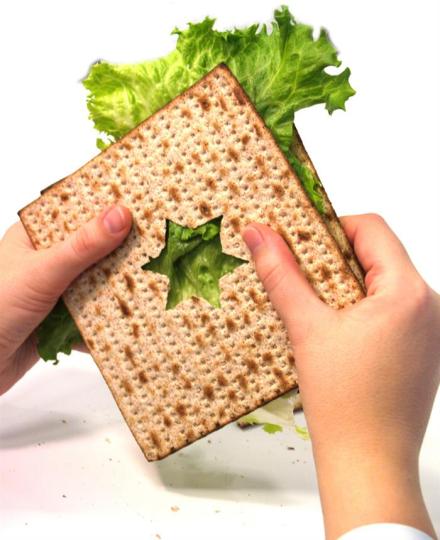
    Matzah: Unleavened bread

The Feast of Unleavened Bread: (Matzah). This week begins and ends with a Holy Day, but it is not a Shabbat, unless of course it falls on Shabbat. These two days are required to have a holy convocation (gathering). Unleavened bread is to be eaten for 7 days.

Before the 14th at evening, all leaven (Chametz) is to be removed from our individual homes. By the way, the Bible says nothing about owning it. I cannot, biblically, sell my leaven, so that it is owned by a gentile, and keep it in the house. I used to do this, but it really doesn’t follow the biblical requirement. Leaven is to be removed from the house. 

What is leaven (Chametz)? Where we find this is in the story of the dough that was not yet leavened. It became flatbread. It was not the flour that was to be discarded. It was the yeast starter, which today we call the madre masa, or yeast or sour dough starter. That was not added at the time because of the urgency of leaving Egypt. No time to make proper bread. The women wrapped up the dough and carried it, wet like it was but without the yeast starter. That dough evidently fermented, for it stayed in dough form until they camped and made fires to cook it. It had nothing to do with fermentation. It had everything to do with leavening. So yeast, sourdough starter, baking soda. These are basically what is to be discarded or at least removed from the house. Pretty simple, really!

Fermented foods are not included in leavening. Some groups condemn vinegar, wine, pickles, mayonnaise, mustard and anything that may be fermented. This is not required. And to prove this, we see that the sacrifice that was done was to be accompanied by an offering of fine flour mixed with oil and a certain amount of wine (see Leviticus 23). So again, let’s not forbid that which is not forbidden! And I might mention that nowhere is matzah required to be created in 18 minutes (the women carried it wet for days before baking it) and it may be made with oil and nothing prohibits the use of salt and spices if desired. From the biblical description of the flour offering, which was obviously kosher for Pesach, the unleavened bread probably tasted a bit like pie crust or at least crackers. 

So happy preparing for Passover! Let’s keep it simple this year. Discard the yeast and throw out left over bread and bread crumbs. Sweep out the house and clean the refrigerator and oven. Shake the crumbs out of the toaster or put it in the garage and wipe down the counters and table where bread has been eaten. I personally don’t use beer during this time either because of the combination of yeast and wheat, and it does rise when you pour it! 

Chag Sameah and Shabbat Shalom!

Ariella