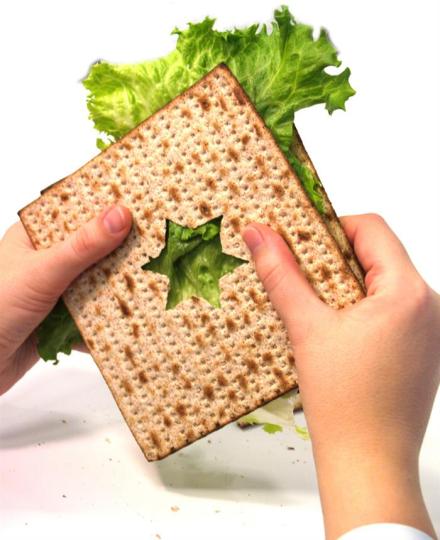
Since I still subscribe to individual thinking based on personal study, I don’t condemn those who don’t see things as I do. I take the Bible literally. Some say that is not enough. Well, good for them, but it works for my simple anal mindset. I look long and hard at custom and tradition and if it goes along with what I have learned from my Torah studies, great! If not, I let it go, or at least don’t go on a guilt trip if I can’t pull it all together!
So about Pesach, or Passover, whichever you call it, the rules are pretty simple.

- The time for the Passover is in the spring after the equinox and then the count to the 14th is started when the first crescent new moon is sighted. A third requisite is that there must be barley ready to harvest (in the land of Israel) in order to have a wave sheaf which is to be waved after the Sabbath of Pesach.
- The major requirements for Passover are in Exodus 12:1-27. From this passage, we gather the following:
a. The month of Pesach is the first month of the year. As we see above, this is the importance of recognizing the first new moon after the Spring Equinox. This is the first of Aviv (the name known today is Nissan).
b. The harvest and presentation of the wave sheaf is to be done only in the land of Israel. See Leviticus 23:10.
c. Also in Leviticus 23, we see that none but those who are of the 12 tribes can participate in Passover unless the men have done the circumcision, and it is not for gentiles unless they are joined to Israel.
d. Because there is no temple, we will skip over the lamb sacrifice. However, there is nothing that forbids us from eating lamb on the night of the 14th in remembrance of that first night long ago! The lamb sacrifice has been substituted with the Passover meal, which includes the bitter herbs and matzah required in the passage. We usually add other things to sweeten the meal and make it meaningful. I see nothing wrong with a festive meal commemorating our exit from Mitzraim (Egypt). However, most of the traditional foods are not required, though meaningful! Most Seders have a plate of hard-boiled eggs (often browned on the outside) that are dipped in salt water. Though not required, the toughening of our people through hard trials and the salty tears are aptly represented this way.
e. There is the requirement to tell the story to our children–the story of the deliverance from Egypt.
Tradition:
Six things are usually arranged on an individual plate or the seder table:
Maror and Chazeret (bitter herbs and horse radish): representing the harshness of slavery.
Charoset: A sweet brown mixture of (apples, raisins, cinnamon, red wine) representing the mortar with which they built Egyptian structures.
Karpas: (fresh parsley, or lettuce) which is dipped in salt water, representing the hope of deliverance seasoned with the tears shed in desiring freedom.
Zeroah: A lamb shank bone (or other bone) which is not eaten but represents the sacrifice. (We are still waiting for the temple).
Beitza: Hard boiled egg. (As mentioned above, some set a separate plate of these.)
Matzah: Unleavened bread
The Feast of Unleavened Bread: (Matzah). This week begins and ends with a Holy Day, but it is not a Shabbat, unless of course it falls on Shabbat. These two days are required to have a holy convocation (gathering). Unleavened bread is to be eaten for 7 days.
Before the 14th at evening, all leaven (Chametz) is to be removed from our individual homes. By the way, the Bible says nothing about owning it. I cannot, biblically, sell my leaven, so that it is owned by a gentile, and keep it in the house. I used to do this, but it really doesn’t follow the biblical requirement. Leaven is to be removed from the house.
What is leaven (Chametz)? Where we find this is in the story of the dough that was not yet leavened. It became flatbread. It was not the flour that was to be discarded. It was the yeast starter, which today we call the madre masa, or yeast or sour dough starter. That was not added at the time because of the urgency of leaving Egypt. No time to make proper bread. The women wrapped up the dough and carried it, wet like it was but without the yeast starter. That dough evidently fermented, for it stayed in dough form until they camped and made fires to cook it. It had nothing to do with fermentation. It had everything to do with leavening. So yeast, sourdough starter, baking soda. These are basically what is to be discarded or at least removed from the house. Pretty simple, really!
Fermented foods are not included in leavening. Some groups condemn vinegar, wine, pickles, mayonnaise, mustard and anything that may be fermented. This is not required. And to prove this, we see that the sacrifice that was done was to be accompanied by an offering of fine flour mixed with oil and a certain amount of wine (see Leviticus 23). So again, let’s not forbid that which is not forbidden! And I might mention that nowhere is matzah required to be created in 18 minutes (the women carried it wet for days before baking it) and it may be made with oil and nothing prohibits the use of salt and spices if desired. From the biblical description of the flour offering, which was obviously kosher for Pesach, the unleavened bread probably tasted a bit like pie crust or at least crackers.
So happy preparing for Passover! Let’s keep it simple this year. Discard the yeast and throw out left over bread and bread crumbs. Sweep out the house and clean the refrigerator and oven. Shake the crumbs out of the toaster or put it in the garage and wipe down the counters and table where bread has been eaten. I personally don’t use beer during this time either because of the combination of yeast and wheat, and it does rise when you pour it!
Chag Sameah and Shabbat Shalom!
Ariella
Discover more from Take Hold the Tzitzit
Subscribe to get the latest posts sent to your email.

I’m certain that the rabbi’s have massive shares in Alcoa, the American aluminum company. Absolutely nowhere does it say that you have to cover every surface in the kitchen, the sofa and who knows what else with aluminum foil.
KISS keep it simple stupid. Do what the Torah tells you to do. Get the leaven out of your DWELLINGS, not out of your camel parking tent or your potting tent. Your DWELLINGS!
One of the main ingredients for the Pesach offering is – that’s right – FLOUR. So why are we throwing away flour? Maybe the rabbi’s have shares in Pillsbury as well 🤔
Pesach is a marvelous time of joy and celebration at our deliverance from Mitzraim. Stop making into yet another chore that everyone dreads and fears.
הג פסק שמח.
LikeLike
Awesome, thank you for your input
LikeLiked by 1 person
There was no temple on the night of the passover when the lamb was sacrificed and the firstborn of Egypt were slain. That was built by Solomon. There was no mishkan either. That was built from instructions given at Sinai. The lamb was slain at homes, eaten in homes. It was one of the plagues. Before the Red Sea. So it needs to be part of Pesach. No matter what. All you need is a building, a door, a lamb, a fire, and a knife. Am I wrong about this?
LikeLike
The passover lamb is not a priestly sacrifice. It was eaten. Very few of the priestly sacrifices were eaten. Only the tresspass offering. Am I right? It preceded but was not superceded by the priestly sacrifices. Am I right?
LikeLike
I believe you are right! Thank you for your input😀
LikeLiked by 1 person
Yes
LikeLike
Pingback: Passover–More than a Memory! | Take Hold the Tzitzit