A Hard Look at Women’s Mitzvot
Earth’s ancient history tells that there were feminine and masculine gods worshiped by many different peoples. Mythology cites the stories of the wars and affairs of these powerful gods, or at least the beliefs that held their worshipers spellbound or shaking in fear. These deities were so revered that parents would sacrifice their own children to them to assure them favor with these gods. In the Bible, the prophets warned Israel about these gods and those who followed them. These people were to be eradicated from the land of Israel. It was Divinely mandated ethnic cleansing, if you will. Of course, none in the liberal “free world” today support ethnic cleansing especially not if you are speaking of the Jewish right to possess the land of Israel. In many Middle Eastern and North African countries, parents train and send out their children to die as martyrs as they cleanse the world of Jews and Christians. These religions are death cults, just as in the ancient past when babies were burned in the arms of their gods, Astarte and Molech.

What I want to examine today is a subject that has bothered me for some time–the worship of the Queen of Heaven mentioned by the prophet Jeremiah. Who was she, and what customs were common in those who worshiped her? And are there roots of these customs in today’s major religions? The Israelites were originally exiled because of their worship of false gods. Can there be any evidence that has survived from these pagan practices today?
Of course, there is Mary worship (often called the Queen of Heaven by dedicated Catholics), which is just an extension of the ancient pagan worship of female fertility goddesses such as Ashtoreth, Isis, Ishtar, or Semiramis, just to mention a few.
But what about the customs of the Chosen People–the practices of Judaism? Is there anything that would suggest that we have remnants of pagan worship practices relating to the female goddess (Ashtoreth), mentioned in 1 Kings and Jeremiah?
1Ki 11:5, 33: “5 For Solomon went after Ashtoreth the goddess of the Zidonians, and after Milcom the abomination of the Ammonites. … 33 Because that they have forsaken me, and have worshiped Ashtoreth the goddess of the Zidonians, Chemosh the god of the Moabites, and Milcom the god of the children of Ammon, and have not walked in my ways, to do that which is right in mine eyes, and to keep my statutes and my judgments, as did David his father.”
Jer. 44:”17 But we will certainly perform every word that is gone forth out of our mouth, to burn incense unto the queen of heaven, and to pour out drink-offerings unto her, as we have done, we and our fathers, our kings and our princes, in the cities of Judah, and in the streets of Jerusalem; for then had we plenty of victuals, and were well, and saw no evil. 18 But since we left off burning incense to the queen of heaven, and pouring out drink-offerings unto her, we have wanted all things, and have been consumed by the sword and by the famine. … 21 The incense that ye burned in the cities of Judah, and in the streets of Jerusalem, ye and your fathers, your kings and your princes, and the people of the land, did not YHVH remember them, and came it not into his mind?”
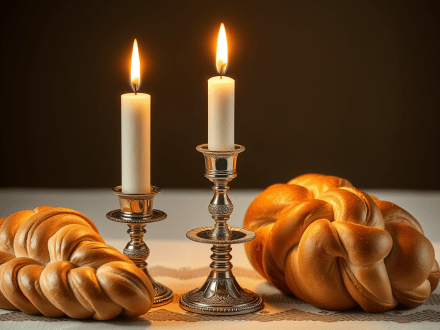
So, without further ado! Where does the lighting of candles for many things in Jewish practice come from? What about lighting Shabbat candles? Many of us question the claim that the Eternal commanded this mitzvah. Here is the English version of the candle blessing:.
“Blessed are You, oh Lord our God, who has sanctified us by His commandments and has commanded us to kindle the light of Shabbat.”
This is blessing is not found anywhere in Tanakh. Nor in the written Torah. It is clearly a command created by the rabbis. What else is wrong here? The sages claimed there was a curse that would come upon women who didn’t fulfill it. The following quote is From Mishna Shabbat 2:6
“On [account of] three transgressions women die in childbirth: because they are not careful with nidda, with challah, or with candle-lighting.” Below is the Hebrew from Sefaria:
“על שלש עברות נשים מתות בשעת לדתן. על שאינן זהירות בנדה ובחלה ובהדלקת הנר:”
So the making of Challah, observance of Nidda (the separation from the husband during menstruation), and the lighting of the Shabbat Candles are what compose women’s most important mitzvot? I think anyone would agree that the making of Challah and Shabbat Candles, though pleasant in themselves, are rabbinic mitzvot. So how is it that God is going to punish us for not following the rabbinic commandments? Is the Creator somehow now subject to the decisions of the leadership? Who is in charge anyway?
Here are some more modern quotes, embracing the idea of punishment for women who do not follow the three mitzvot:
1. “For three transgressions woman die during childbirth: for being careless regarding (the laws of) menstruation, the tithe from dough, and kindling the (Sabbath) light.” The Complete Art Scroll Siddur. Second edition, Page 327.
2. “For three transgressions do women die in childbirth: because they have not been heedful in regard to their menstruation, in the separation of the priest’s share of the dough, and in the kindling of the lamp.” Mishnayoth Volume 2 page 30 Second Edition Judaica Press, Ltd. Gateshead 1983.
Page3. “Because of three sins women die in childbirth; for not being careful with niddah, with hallah, and with lighting the lamp.” Sephardic Siddur with Linear Translation and English translation for Shabbat page 79 Congregation Shaare Rahamim Publication Series 5766.
4. Rabbi Jonathan Sacks translates the Hebrew into English slightly different “For three transgressions woman may die in childbirth: for being careless in observing the laws of menstruation, separating challah (dough – offering), and lighting the Sabbath light “The Koren Siddur page 374. 2010 Edition. I would like you to notice that the word may, that is in this translation, casts a doubt on whether this will happen.
In this discussion I will evaluate only the kindling of the Sabbath light (maybe later we might consider the other two sins). Let us look at the prayer that is said when the Sabbath lights are lit: “Blessed are you, HASHEM, our God, King of the universe, Who sanctified us with His commandments, and has commanded us to kindle the light of the Sabbath.” The Complete Artscroll Siddur, (second edition 1989) page 297.
History tells us that the formal practice of lighting Shabbat Candles was an attempt by the rabbis to overthrow the Karaites ( 9th century CE) and to direct their followers to place their esteem upon the Oral Torah, thus assuring Rabbinic control over the Jewish people. (https://pathoftorah.com/2014/01/26/mitzvah-that-wasnt/)
“The great Sa’adia Gaon (882-942) worked tirelessly to counter Karaite Judaism, and the Rambam even credits him with saving Rabbinic Judaism at the time. Not surprisingly, then, it is in the 9th century Siddur of Rav Amram Gaon (d. 875) where we first see the text of a Shabbat candle-lighting berakhah. To reaffirm and strengthen the Oral Torah at a time when it was under attack, the sages and rabbis of the 9th century instituted a formal blessing—modelled on the Chanukah blessing—to be recited when lighting Shabbat candles. This made it clear that it was God who kideshanu v’tzivanu, sanctified us and commanded us, to do so. People needed to know that this ancient practice was no rabbinic invention! Indeed, when we look into more mystical sources, we find that lighting Shabbat candles goes way back—all the way to the Garden of Eden.” Link
But those who know their Bibles realize that Shabbat Candle lighting was never commanded by the Torah and history shows us that it never gained true importance in Rabbinic Judaism until the 9th century, CE.
And by the way, the use of modern candles in the form we have today, began to be developed in the 5th century when Rome began to dip wicks in animal fat called tallow, (Link).
Anciently, however, there were wicks that burned in oil pots as far back as early Egypt. Many religions have used them in the worship of their gods and as a means to communicate with Heaven and even to send their dead loved ones on their way to the afterlife. (Link )
What actually does the lighting of Shabbat candles symbolize? Could it stem from the practice of burning of incense? Do Jews use candles in their service for the dead? Clearly they do. Every Yahrzeit is accompanied by candle burning. What does it mean?
What about the baking of Challah and cutting off the portion which is supposed to be burned? Jeremiah cries out against the women who baked bread for the Queen of Heaven:
“The children gather wood, and the fathers kindle the fire, and the women knead the dough, to make cakes for the queen of heaven, and to pour out drink-offerings unto other gods, that they may provoke me to anger.” – Jer 7:18
I wonder about the part requiring the cutting off a portion of the dough, even though it stems from the biblical command to separate (Challa) a part of a sacrifice or meal offering, for YHVH. Numbers 15:18-21. But how does burning it have anything to do with separating a part for YHVH? Actually this sacrifice was not a weekly offering and it was only to be done in the Land of Israel:
“18 Speak unto the children of Israel, and say unto them, When ye come into the land whither I bring you, 19 then it shall be, that, when ye eat of the bread of the land, ye shall offer up a heave-offering unto Jehovah. 20 Of the first of your dough ye shall offer up a cake for a heave-offering: as the heave-offering of the threshing-floor, so shall ye heave it. 21 Of the first of your dough ye shall give unto Jehovah a heave-offering throughout your generations.” – Num 15:18-21.
Perhaps it is a little far-fetched to associate the making of Challah and the lighting of Shabbat Candles with service to the Queen of Heaven so loudly renounced by the prophet Jeremiah, or is it? And why is there a curse on women who do not perform these Mitzvot?
Paganism aside, how have practices taken from the priestly service in the Temple come to establish a new type of service where every family has their own home temple with strange symbolic services that somehow connect us to the Torah? Can it be an attempt to justify living in the diaspora? The thought seems to be everywhere that, “isn’t the service at the home table and the Synagogue enough?”So why do we need a temple if we can do it all at home?
How about the custom of opening the door to the Shabbat Queen during Kabbalat Shabbat? The song Lecha Dodi (come my beloved) is sung on Friday nights in the synagogue, and when the final stanza is sung, the door to the synagogue is opened and the entire congregation turns around and bows to the left and right welcoming the Shabbat Queen which brings the divine presence to the assembly.
Were we ever commanded to worship the Sabbath itself? And what is this mystical presence that is being worshiped, if it is a queen? Much is said about the Shekinah being the feminine presence of God. Yet the word Shekinah is not in the Scriptures.
“The word comes from a transliteration of the Hebrew word, shākan. It means ‘the one who dwells’ or “‘that which dwells.’ The term “Shekinah” was first used in rabbinic targums.” (Link)
So the justification of worshiping the female presence of God is established, fully trusted because almost everyone believes the Bible supports it. It doesn’t and though we could get into great and lengthy discussions of the male vs female nature of the Eternal, we must abstain. This is forbidden ground. God is not a man, see Number’s 23:19. And even Moses was not allowed to fully view the Creator. He must remain a mystery to humankind. If we could see Him, we might try to make an image of Him, right?
I know that I have only touched the tip of the iceberg showing the roots of things that have accompanied the Jewish religion for thousands of years. Dear friends, we must come clean! We must repent of that which blindly accepted as God’s commands, many times brainwashed into us as little children. It is not going to be easy.
Ariella Golani
Discover more from Take Hold the Tzitzit
Subscribe to get the latest posts sent to your email.

Great article and about time that the custom of candles is bought into the light!
As you so rightly say, it is not a heaven sent commandment it is so clearly another rabbinical intrusion using paganism as a means to build another golden alf.
LikeLike
Thank you Ben
LikeLike
המילים האלה הן כל כך יפות. תודה אחותי.
LikeLike
תודה רבה אחי
LikeLike