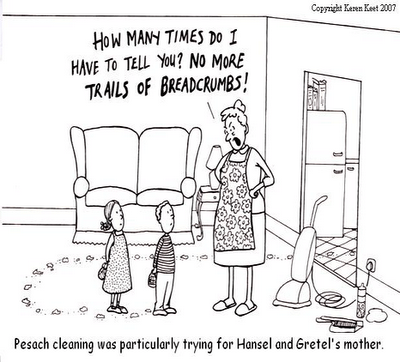
Today we find ourselves just a week before Pesach and most of my Jewish friends are feverishly cleaning every crack and cranny of everything that can be imagined to be Chametz. All of their dishes are stored away and Kosher for Pesach plates and utensils are brought out of where they have been kept free of contamination for the past year! (If you don’t know the word Chametz, See Here). I personally am just starting, one item a day for the next few days. And no, I do not separate my plates and utensils for the holiday. After washing them, I can’t imagine them to have Chametz smeared on them! Today I cleaned the fridge. Tomorrow I will clean the stove…
(Cartoon above is sourced from here)
(Be sure to check out the Karaite Matzah recipe at the end of this article!)
Well, tomorrow is here and I cleaned both of my ovens and as I cleaned them, I realized that if you cause leaven to be rendered unusable, you destroy it. And that means that it has no more power to leaven anything. Therefore, if you clean the oven with chemicals or heat it to a high temperature, there is no chance that leavening will remain in any kind of active form. So I cleaned it well, but I could not get every dark spot off of the roof of the oven and I am not worried.
In regards to cleaning for Pesach, again we see where fence upon fence has been placed to protect what was given at Sinai. In fact some of these fences have become walls so high you cannot see past them to what was originally given, nor can we understand why. We probably should crash through some of those fences so we can catch a glimpse of the original Torah!
One of these multi-fenced laws that have been built around Sinai is found in the strict observance of Pesach.
I have been in homes that cover everything including the sofas with aluminum foil. I ask myself, so do they think that Hashem does not see through tin foil? Good grief! Every bit of flour, every one of the five grains listed by, no not the Torah, but you guessed it, the Rabbinic books must be taken out of the house or sold to a jewish organization who will sell it on to some gentile we don’t even know.
And this is the loophole. Just put everything in a closed room or cupboard and sell it to your rabbi. That is, pay to Chabad or any other Orthodox group to have them sell it to a gentile and then buy it back after Pesach. Seems like a great-get rich quick plan, if the proceeds at $25 plus per Jewish person in the world goes into the pockets of the Orthodox institutions. How much would it come to, if the estimated 10 million Jews in the world earn even $10 each to sell their people’s Chametz? That comes to 10 million dollars!
But of course, IF the Torah commands it, we had better pay for it. But does it?
Actually the Torah makes no allowance to sell the Chametz. It is to be discarded or taken out of one’s’ property. And also we must see that something has been overlooked. All of the Gerim in the land were to clean for Pesach as well! Look closely at the following verse from Exodus 12:
“…for if any one eats what is leavened, that person shall be cut off from the congregation of Israel, whether he is a sojourner (Ger) or a native of the land. Exodus 12:19”
Let’s look at the Hebrew:
שִׁבְעַת יָמִים שְׂאֹר לֹא יִמָּצֵא בְּבָתֵּיכֶם כִּי כָּל־אֹכֵל מַחְמֶצֶת וְנִכְרְתָה הַנֶּפֶשׁ הַהִוא מֵעֲדַת יִשְׂרָאֵל בַּגֵּר וּבְאֶזְרַח הָאָרֶץ׃
So there is a place for the gentile in the Land of Israel, but they are not legitimate buyers of Chametz! Perhaps later we need to study who is the Ger, but the Ger is not a homeborn Jew. And certainly not a convert. I choose to see them as the workers who come to Israel to support the farming and caregiving that is required. They also are to keep many of the laws of Torah.
Also we need to see that a lot of things that are not Chametz that are claimed to be. One is the five grains. The following is claimed by the Orthodox Union:
“If one of the five grains – wheat, barley, rye, oats and spelt – sits in water for more than 18 minutes it becomes chametz, and one may not eat, derive benefit from or own it on Pesach. In addition, Ashkenazim don’t eat kitniyot – a group of foods which includes (among other things) rice, corn, soy and their derivatives – but are allowed to own kitniyot foods on Pesach.” From OUKosher, see here.
But what does the Torah actually say?
Leviticus 23:5-6: “In the first month, on the fourteenth day of the month in the evening, is YHVH’s passover. And on the fifteenth day of the same month is the feast of unleavened bread to YHVH; seven days you shall eat unleavened bread.”
Exodus 12:15-20: ”Seven days you shall eat unleavened bread; on the first day you shall put away leaven out of your houses, for if any one eats what is leavened, from the first day until the seventh day, that person shall be cut off from Israel.On the first day you shall hold a holy assembly, and on the seventh day a holy assembly; no work shall be done on those days; but what every one must eat, that only may be prepared by you. And you shall observe the feast of unleavened bread, for on this very day I brought your hosts out of the land of Egypt: therefore you shall observe this day, throughout your generations, as an ordinance for ever.
In the first month, on the fourteenth day of the month at evening, you shall eat unleavened bread, and so until the twenty-first day of the month at evening. For seven days no leaven shall be found in your houses; for if any one eats what is leavened, that person shall be cut off from the congregation of Israel, whether he is a sojourner or a native of the land. You shall eat nothing leavened; in all your dwellings you shall eat unleavened bread.”
Let’s look at the underlying principle. “You shall eat nothing leavened.” It does NOT say that things that might ferment, like the five grains, must be discarded or what they call Kitniyot (rice, corn, soy). How can you even imagine that soybeans will create leavening so that they become edible just by becoming damp? It is true that they increase in size when you soak and cook them, but this is not leavening–this is normal expansion. Leaven is that which causes flour to rise and create leavened bread. The simple rule is to not leaven the flour of any type of grain. Get rid of the leavening (the yeast). Now what was the original leavening process? Sourdough was the way bread was leavened in Egypt. Modern activated dry yeast was unknown at the time. However it does qualify as leavening for works the same way. So concerning the ancient Egyptian leavening process:
“Because sourdough consists of a spontaneous fermentation process, it can undoubtedly be considered the primordial form of bread leavening. It is believed that the use of sourdough in bread leavening developed in ancient Egypt in approximately 3000 BC and from there spread gradually to Europe, throughout ancient Greece and the Roman Empire until the present.
Wheat and other grains cultivated in the Nile River Valley were used in ancient Egypt to manufacture leavened breads on a large scale—enough to feed thousands of people per day; this is supported by the discovery of desiccated bread and numerous wall pictures of the bread making process in ancient tombs.” From Science Direct. See Here.
So all of one’s sourdough starter must be discarded, which is a bit inconvenient because you then wait until after Pesach to start a new batch. Otherwise the starter would have to be placed outside your property and not attended until after the week of Passover.
What about beer?
Now some think this is debatable.. But beer is made with yeast. And if you have ever eaten beer bread, you will agree that it leavens the dough. So beer is definitely out. No we don’t eat beer, but people drink it which is basically ingesting it which is what you do when you eat food. Also the brewer’s yeast which is a by product after the making of beer, is questionable. It is a yeast, though it does not serve to leaven bread.
There are other things that are listed by the OU as no-nos for those who keep passover. Vinegar is listed because it is fermented. But vinegar is not leaven, nor is it used to raise dough.
And fermentation is not leavening. Only in the case of when fermentation of flour actually creates yeast as in the process of making sourdough bread.
So it sounds pretty simple, just don’t eat anything with leavening agents. No yeast, no sour dough starter, and no baking soda or baking powder. This means no bread, cakes or cookies, nor beer. There are a lot of leavening agents used in chips and crackers. Be sure to read the ingredients. And looking at all the ingredients labels in Hebrew may take an extra day for me!
But, beyond food, there is more to be done. There should be no leavening found in the house, nor in one’s personal property, be it your office downtown or the garage where you park your car.
Now, before we go crazy cleaning out from under the refrigerator, or tipping over the sofa to see what is down inside the cracks, let’s remember that the Torah stresses several times that it is about not eating leaven. You would never eat the crumbs that you would find under the furniture. And though I would suggest cleaning the fridge from all bread and cake remnants and crumbs and doing a deep clean on the oven and grill, you can avoid the month long scrutiny and the purchase of new utensils and plates just used for Pesach. The basic cleaning needed for Pesach and the Week of Unleavened Bread should not take that long. After all, it really is NOT rocket science!
And the making of Matzoh, since when did we need the rule of 18 minutes before the flour would start to ferment (again it isn’t about fermentation, it is about leavening)? So what we learned earlier about sourdough– that it takes time to create yeast, is actually when the flour and water mixture creates yeast which is more than a couple of days. By the 3rd or 4th day, the sourdough may work, but usually up to a week of feeding it is required to create the yeast that raises the bread. It will not raise your dough during the first few days after mixing the flour with water. So let’s let go of the idea of fermented dough being leavened. Fermentation is not the same as leavening unless it creates a type of bacteria that turns into yeast, which happens after a long period as in the case of sourdough.
The Israelites carried their dough wrapped up to their first encampment where they cooked their unleavened bread during that first week of unleavened bread. It may have soured but it was not leavened. Because of this example, we can be sure that the 18 minute rule for Matzoh is just a created rabbinic frustration for Jews.
So here we are coming up to Pesach and the week of Unleavened Bread. Let’s Keep it Simple Stupid–no heavy duty cleaning inside the pockets of your husband’s favorite winter jacket!
Just don’t leave anything leavened on the property, don’t sell it nor buy it back– Really!!
And here is the promised link to Karaite Matzah! Enjoy!
https://www.nehemiaswall.com/karaite-matzah-recipe
Please help support my channel by liking, sharing, commenting and following me!
Thanks,
Ariella
Follow Take Hold the Tzitzit on WordPress.com