Kosher Jewish Astrology says that we must learn about the alignment of the planets and how to overcome our weaknesses and tone down our wild strengths. At least that is what they were teaching yesterday, when I went to a Rosh Hodesh gathering of women in our town in Israel. The speaker actually said: “The planets will bless you.”
All the red alerts in my head started going off and I knew I was either going to vomit or walk out. I wanted to say: “That’s witchcraft and you are a witch.”
But I sat there quietly and finished my decorative vase that the craft teacher generously helped us with. There were about a dozen women there and most agreed happily with the theme of the woman who was teaching. I was astounded at the level of brainwashing that I saw but I realized that all of this has been believed for a very long time. But does that make it right? And does something that is believed for a long time make it more right? Do real thinkers not exist today?
This Jewish Astrologist (Let’s call her Diva) said things like, “we are above the calendar, and it is up to us to establish the date for Rosh Hodesh.” So what does the Bible say about that? Who ordained the signs in the heavens to guide us?
“God said, “Let there be lights in the expanse of the sky to separate day from night; they shall serve as signs for the set times—the days and the years;” (Genesis 1:14, JPS translation).
Notice the word “moedim” in Hebrew, highlighted in the verse above. This word refers to the set times that the Creator established for the people of Israel. “Set times” is another way to express the Biblical Festivals. “Moed” (part of the word moedim) is used for sacred meetings. The “ohel moed” for example means “tent of meeting” referring to where these gatherings were held. Originally we had the Mishkan (tabernacle or tent of meeting) that traveled with the Israelites in the wilderness and was set up by Joshua in the land after they crossed the Jordan.
So the Jewish people can decide when the festivals occur? Who is on first? Who appointed the signs to frame the year for us? So now then, can we change what God has said? Who is on first anyway? Is God still God or do we place ourselves on the throne?
Does the Creator give the Jews the right to change His laws? Or more specifically, can the Chosen People be Holy if they do not obey the Covenant?
“Now then, if you will obey Me faithfully and keep My covenant, you shall be My treasured possession among all the peoples. Indeed, all the earth is Mine.” (Exodus 19:5 JPS translation).
So which covenant are we talking about? The Covenant that was spoken of in the Torah is the Torah itself and this was given to our forefathers; Abraham, Isaac and Jacob. And yet mankind likes to alter what was set up as a blessing for us!
How is it that “the planets will bless you?” How can an inanimate object, be it a stone or a planet have the ability to bless us? Are these somehow elevated to the level of gods?
I was recently chatting with a woman about the bombs and the ongoing war in Israel. I mentioned someone who goes out even when the alerts go off. She told me that the Jews have to protect themselves. Does that mean that the Almighty no longer protects us? It is true that common sense dictates that we exercise a bit of self preservation in these times, but is our protection only in our own hands? Is it possible that by ignoring the rules that the Creator set up in the very beginning, we somehow feel that this is our universe and that there is little if any protection coming from Hashem?
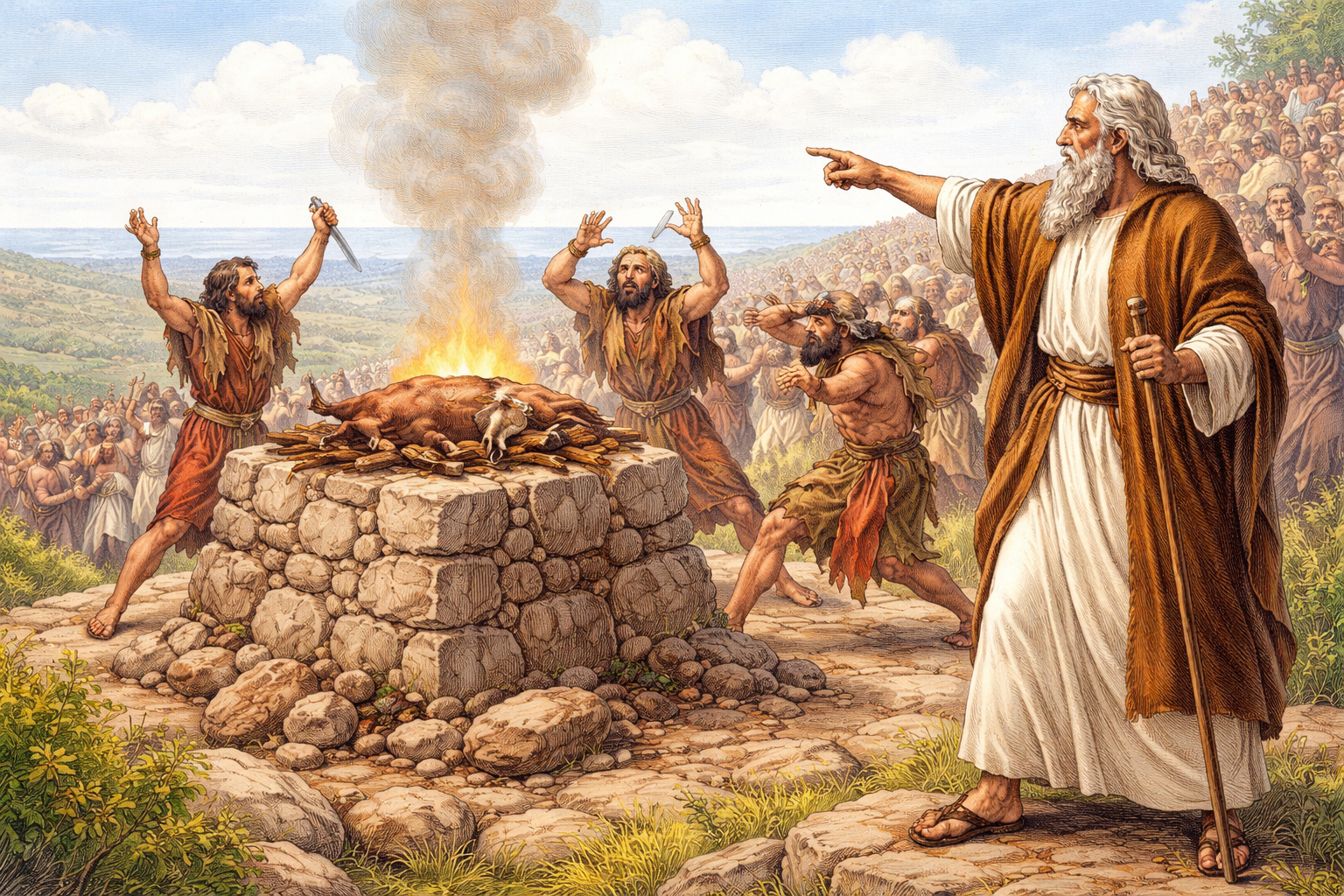
Has God taken a long journey and somehow does not hear us? This reminds me of the prophet Elijah on Mount Carmel (a place a couple of hours from us here). What did he tell the people when the prophets of Baal were dancing around their altar?
“When noon came, Elijah mocked them, saying, ‘Shout louder! After all, he is a god. But he may be in conversation, he may be detained, or he may be on a journey, or perhaps he is asleep and will wake up.’” (1 Kings 18:27, JPS Translation). Read the entire story in 1 Kings.
Elijah challenged the people of Israel with these words:
“‘How long halt ye between two opinions? If YHVH be God, follow Him; but if Baal, follow him.’” (Ibid, verse 2
How do we discern truth? By having an individual understanding of the simple words of Torah. How often does the embellishment provided by our modern and ancient sages cloud the truth?–Could they actually be prophets of Baal? The same ones Elijah rebuked the people for?
Let’s get back to the study of what the Biblical prophets handed down to us without adding or subtracting!
Someone raised the question in a chat group last week: if God has all knowledge and knows the future, how can we truly have free will? This query has been asked over and over for time immemorial. What is the answer? Is it even important for us to know? Or is it even possible to know? There are at least two views of this subject.
Power of Choice after the Tree
Does the fact that God knows everything mean that He predestines us to make the decisions that we make? Does it mean that He somehow directs for bad or for good, where we end up?
The excuse: “The devil made me do it.” Is not far off from “God made me do it.” So do we have free will? And is it possible that the devil, or as some say, the evil inclination made me do it? If so, does mankind truly have free will? Is it possible to resist the evil inclination that is bound up in our DNA…Something that started after Eve and Adam ate the apple?
Does the Eternal work with our weaknesses? Is He there to give us wisdom and strength to choose the right path?
When our first parents chose to eat of the tree, they accepted the fate of two natures ruling their flesh. Unfortunately our inclination to evil is amplified unto the third and fourth generation and so we seem destined to do evil at times. But this is not as some religions explain, original sin and we can choose our way out of it!
The idea that the Eternal knows everything and has a divine plan…does that mean that God controls us against our will and makes us mere automatons on a chess board? I don’t like that idea.
The Bible says that God “knows the way that I take” (Job 23:10). It also shows the disaster of doing things the way we feel inclined. David followed his inclination with Bathsheba and his repentance is recorded for us: David’s decision, albeit a wrong decision which produced grave consequences, worked out in the end because the Eternal knows the way we take and guides and directs even after wrong decisions have been made. But, there are always consequences! But if we broaden the view, what effect do my actions have on the lives of others?…choices they may not have made but consequences that included them?
Was it the will of Hashem to direct David to take Bathsheba? Absolutely not! But did he work out something regardless? Obviously many of their descendants, including King Solomon would never have been born. Here is David’s sincere confession:
Psa 51:”3 For I know my transgressions; And my sin is ever before me. 4 Against thee, thee only, have I sinned, And done that which is evil in thy sight; That thou mayest be justified when thou speakest, And be clear when thou judgest. 5 Behold, I was brought forth in iniquity; And in sin did my mother conceive me. 6 Behold, thou desirest truth in the inward parts; And in the hidden part thou wilt make me to know wisdom. 7 Purify me with hyssop, and I shall be clean: Wash me, and I shall be whiter than snow. “
What about the sale of Joseph by his brothers? Did the Eternal plan that? Not exactly! Did they all suffer for it! Of course! From Joseph’s point of view, he was the innocent bystander affected by the decision of his brothers. Clearly not his fault. So was this all engineered by the Master of our Fate?
The tragedy of Joseph’s sale to Egypt did save many people as he later told his brothers. Yes! We don’t know what would have been if Joseph had not been sold, but something else could have happened because the Omnipotence of God is above all of our simple human logic.
If our DNA includes tendencies to good and to evil, then is it possible to choose good and the path of life and to resist evil? We can, but we do not always do so. So there has to be a plan B, which God already knows about before it happens. If we choose correctly the first time, we might not have so many paths and tunnels in the maze of life. Again, we don’t know and there is much wisdom in saying we do not know the mind of the Eternal.
Deu 30: “19 This day I call the heavens and the earth as witnesses against you that I have set before you life and death, blessings and curses. Now choose life, so that you and your children may live 20 and that you may love the LORD your God, listen to his voice, and hold fast to him. For the LORD is your life, and he will give you many years in the land he swore to give to your fathers, Abraham, Isaac and Jacob.”
All of us have made bad choices and some of us see that those very choices have brought about learning experiences and actually positioned us to be where we can affect and receive good in this world. How do you bring good out of bad? Well only Hashem knows! But it happens. Job asked the very same question:
Job 14:4: Who can bring a clean thing out of an unclean?
I can’t quit believing that God has a plan, regardless of all the stuff we wade through, and it will all work out, with or without us but hopefully with us as we straighten our steps under His guidance!
Pro 4: 26 “Ponder the path of thy feet, and let all thy ways be established.
Prov 4: 27 “Turn not to the right hand nor to the left: remove thy foot from evil.”
On the Other Hand
But what happens when our path is clearly guided to something we had nothing to do with, like Job when all he held dear was destroyed? This had nothing to do with his choices. Sometimes this happens and then what? How can we say he had free will? How can the Eternal be just and throw something like this upon any human being? We know that Job was recompensed in the long run and yet it seems he had no choice in the matter. So what? Was he chosen? And for what?
Chosen–The Chosen People
“I know, I know. We are your chosen People. But, once in a while can’t you choose someone else?” Tevye from Fiddler on the Roof.
It seems the Jews are chosen to suffer from time immemorial and was there a reason for this suffering? Individually it appears very vague. Do we suffer for the sins of our ancestors? Apparently! And yet we have the promise that the son is not punished for the sins of the father. (Deut 24:16). Strange, seemingly unmerited consequences. Is there ever a way out?
Right, so yes, there are instances when people are apparently chosen as guinea pigs, as in the case of Job above. We don’t know at the time and may never know but these things happen and it seems we have no choice in the matter which puts the eternal question back in place: “If we truly have free will, then why do these things happen to me? And if God is the engineer of the world’s fate then how do I fit in and can I really direct my own life?
A young hostage, locked in a tunnel in Gaza did not know or remember the daily prayers required for all good Jews. He started talking directly to God as to a friend. He soon felt he was surrounded by light and warmth even in the darkness. When he was rescued, what happened? He was brought into the company of religious Jews and “shown the way.” But was this really “the way” when he had already felt the presence of the Eternal personally? I wonder if he will still feel the warm arms of the Eternal about him?
Did the repetition of pre-written, daily prayers save Jews during the Holocaust? Did the increase in numbers of attendance at synagogues, where prayers are the main subject actually bring an end to the ongoing October 7 war?
Perhaps the more one feels the persecution of Antisemites, the more he or she prays! But what are these prayers anyway? Do memorizing the frequently repeated prayers actually bring Heaven to the rescue? Maybe, maybe not. What seems to happen is that praying together unites Jews to a common cause, but is the strength merely the strength of the community or is it God-given strength and blessing? And where did this all start? I call these Exile prayers.
What is prayer? Do we think that a cleverly and beautifully written prayer will somehow impress the Eternal when all He wants is the expression of the humble and contrite heart? Go ahead! Read someone else’s poems to me to impress me. Will this win my heart?
Psa 51: “17 My sacrifice, O God, is a broken spirit; a broken and contrite heart you, God, will not despise.”
Isa 66: “2 For all those things hath mine hand made, and all those things have been, saith the LORD: but to this man will I look, even to him that is poor and of a contrite spirit, and trembleth at my word.”
But what about memorized prayers? Do we have examples in the Bible of those who read memorized prayers and were actually heard? I don’t find any!
What did the forefathers and the prophets say to God when they prayed? Didn’t they simply ask God for wisdom or to help them? Where in the Bible is there an example of the poetic memorized prayers that are used in today’s religions? There aren’t any. What did Moses say to YHVH when he was afraid to return to Egypt?
When Moses was told to go and speak to Pharaoh, he complained that he was a man of slow speech. He pleaded to get out of the mission. Exo. 4:10
When Elijah felt he was the only one left in the land who didn’t worship the Baals, what did he say? “Even I only am left…” 1 Kings 19:10.
I don’t find anywhere a prayer where someone in the Bible quoted the prayers of another person.
Is prayer about real communication with the Creator or is it about flattering God to get what we want? Are we somehow doing our duty when we repeat the nicely-worded prayers thrice daily? Does it even matter? Was anyone ever chosen by God who relied on the communication of someone else?
In rereading what I have said it appears that I condemn all the communal prayers. Let me say, to the contrary, I believe that the Almighty hears the individual cry behind these prayers. He feels the need of the heart that drives people together. But should not our individual prayers be more about the expression of our own needs and thoughts rather than the thoughts of others? And if we prayed more in this way, would not our public gatherings see more of the blessing of Heaven?
I am not saying that it is wrong to use Psalms and other Bible verses to frame our worship and Shabbat meals. These verses set a framework around the special family time of coming together to enjoy that special time of welcoming of the Shabbat. We read the 23rd Psalm, Exodus 31, Exodus 20 and parts of Isaiah 56. It is even better if you understand the Hebrew so that the words mean something to you. Yet, how much beyond this do we need to go? When does private prayer lose it’s significance? Is God really impressed by our knowledge of how to read a prayer in a foreign tongue? Or would he rather hear us a loving parent hears their children speak to them?
Does the the victim mentality of many Jews perhaps come from not knowing the Almighty on a personal level? Why were we destined to Exile for 2000 years? When we got caught up in following paganism we were not listening on an individual level to the Eternal, so He sent us out of our land. Did we ever learn otherwise than to follow someone else’s ways and teachings? Can we learn to be thinkers rather than mere reflectors of what our great leaders have said?”
Do we know God only vicariously through the words of sages and others or is God a God that is available to all of us? Is he merely there when we are under the authority of wise men and sages? Will He indeed hear the prayer of the contrite and humble heart? Do we have that kind of Emunah (faith) and Bitachon (trust) that clings to the Eternal in the darkness, not willing to let go until we find the blessing.
Jacob clung to the one who fought with him just before dawn when he realized it was a divine being, He said: “I will not let you go unless you bless me.” Can we have that kind of Hutzpah with Hashem?
When a Biblical commentator or modern prophet writes about his understanding of the Bible, is it possible to evaluate what he/she says? And by what means? What are we to tie to as an unmovable anchor?
Originally the Bible was the measure of truth. (Still is IMHO).
Specifically the Torah. There are several laws in the Torah itself as well as verses in the Tanakh that claim that all truth must be founded first of all on the principles of Torah–That we must not add to nor take from. So how can that be applied in light of an Oral Torah?
So the big question that puts things in focus is whether or not those who came after Moses and the prophets were/are allowed to write stories about the meaning of what is recorded in the sacred writings of the Tanakh. And if we answer yes, then how will those stories be measured as to what is truth? Is it by a qualifying credential from a school of higher learning, be it a yeshiva, or a university? Or do we boil it down the the same thing–Torah as the only Anchor? Basically, does a rabbinic degree allow departure from the written Torah? And how is Oral Torah measured? Midrash? If there is no basic guide other than being an esteemed sage or rabbi, then public reverence is all that is needed to establish truth and if this is the case then we might as well follow the majority, be it in religious matters or politics. And what was that verse that is so badly taken out of context about following the majority? Hey let me get back to that!
I would not argue that scholars from these institutions have nothing to teach us. But what I take exception to is the often clear stepping aside to redefine the laws of the Torah of Moses–Adding to or taking from as is clearly forbidden by the text of Torah itself. Here is what the Bible says it:
Deu 4: “2 Ye shall not add to the word which I command you, neither shall ye take from it, that ye may keep the commandments of YHVH your God which I command you.”
Deu 12:”32 Everything that I command you, ye shall take heed to do it; thou shalt not add thereto, nor take from it.”
Jos 1: “7 Only be strong and very courageous, that thou mayest take heed to do according to all the law that Moses my servant commanded thee. Turn not from it to the right or to the left, that thou mayest prosper whithersoever thou goest.”
Pro 30:”6 Add thou not unto his words, lest he reprove thee, and thou be found a liar.”
Let’s take as an example, a well-known midrash. It is about Joshua the high priest who was to officiate in the second temple. The story is found in Zechariah 3:1-7:
Zec 3:”1 And he shewed me Joshua the high priest standing before the Angel of YHVH, and Satan standing at his right hand to resist him. 2 And YHVH said unto Satan, YHVH rebuke thee, O Satan! Yea, YHVH that hath chosen Jerusalem rebuke thee! Is not this a brand plucked out of the fire? 3 And Joshua was clothed with filthy garments, and stood before the Angel. 4 And he spoke and said unto those that stood before him, saying, Take away the filthy garments from off him. And unto him he said, See, I have caused thine iniquity to pass from thee, and I clothe thee with festival-robes. 5 And I said, Let them set a pure turban upon his head. And they set the pure turban upon his head, and clothed him with garments; and the Angel of YHVH stood by. 6 And the Angel of YHVH protested unto Joshua, saying, 7 Thus saith YHVH of hosts: If thou wilt walk in my ways, and if thou wilt keep my charge, then thou shalt also judge my house, and shalt also keep my courts; and I will give thee a place to walk among these that stand by.”
So what were the filthy garments that the attendants that stood by removed? Here is something from the internet:
“Intermarriage of Sons: The most prominent Midrashic explanation (found in Talmud Sanhedrin 93b and cited by Rashi) is that Joshua’s sons had married foreign women who were forbidden to the priesthood. The garments were “filthy” because Joshua did not protest or prevent these marriages.” Link
The filthy garments, according to midrash had to be removed, meaning the sons had to divorce their wives and abandon their children. In the story, the sons actually did this and then Joshua was acquitted (the filthy garments removed).
What the Torah says: a father is not held accountable for the sins of his sons. (this would of course be after the age of accountability).
Deu 24:”16 The fathers shall not be put to death for the sons, neither shall the sons be put to death for the fathers: every man shall be put to death for his own sin.”
So according to Torah, this midrash does not line up. The filthy garments were Joshua’s own sins and his own defilement, apparently things that he absorbed from the exile in Babylon. Now to be cleansed of these things it took the work of divine beings, (those who stood by were commanded to remove the filthy garments from Joshua) perhaps giving him enlightenment. It was like a day of atonement. Yom Kippur?
If we are looking for another example from the Bible, let us look at the law about the rebellious son and what the parents were to do.
Deu 21: “18 If a man have an unmanageable and rebellious son, who hearkeneth not unto the voice of his father, nor unto the voice of his mother, and they have chastened him, but he hearkeneth not unto them; 19 then shall his father and his mother lay hold on him, and bring him out unto the elders of his city, and unto the gate of his place; 20 and they shall say unto the elders of his city, This our son is unmanageable and rebellious, he hearkeneth not unto our voice; he is a profligate and a drunkard. 21 And all the men of his city shall stone him with stones, that he die. And thou shalt put evil away from thy midst; and all Israel shall hear and fear.”
If parents are ultimately responsible for the sins of their children, then the parents would have also been stoned in this example.
The prophet Ezekiel speaks to this principle:
Eze 18: “20 The soul that sinneth, it shall die. The son shall not bear the iniquity of the father, neither shall the father bear the iniquity of the son; the righteousness of the righteous shall be upon him, and the wickedness of the wicked shall be upon him.”
Since the prophet goes along with the commandment in Deuteronomy, we can include it. What happens if a prophet does not speak according to the commandment?
Deu 13: “4 Ye shall walk after YHVH your God, and ye shall fear him, and his commandments shall ye keep, and his voice shall ye hear; and ye shall serve him, and unto him shall ye cleave. 5 And that prophet, or that dreamer of dreams, shall be put to death; for he hath spoken revolt against YHVH your God who brought you out of the land of Egypt, and redeemed you out of the house of bondage, — to draw thee out of the way that YHVH thy God commanded thee to walk in; and thou shalt put evil away from thy midst.”
So if the things a prophet says do not align with what God commanded us in the Torah, then we are not to listen to him. Actually in the instructions for Israel, that prophet was to be put to death.
Isa 8:”20 To Torah and testimony: if they speak not according to this word, it is because light has not dawned in them.”
What we need to ask is what was the influence of the Exile in Babylon that brought about the condition of “filthy garments” ? And what was the remedy? What will happen today when Jews return from the exile? From what do they need to be cleansed? Is the story of Joshua the high priest actually a prophecy for end time return from the exile? I believe it is!
So what about following the majority?
Orthodox Judaism claims that Jews must follow the majority of the collected rabbinic views on Halakhah. There is very little individual freedom to decide what a text means.
Where did this idea of following the majority come from? Only one verse in the Torah!
Exodus 23:”2 Thou shalt not follow the multitude for evil; neither shalt thou answer in a cause, to go after the multitude to pervert judgment.”
This verse has been expanded by Oral Torah scholars to mean the following: (And I clearly do not see how this can be accepted by any thinking mind! )
Jewish Virtual Library:
“MAJORITY RULE, deciding a matter according to the majority opinion. In the field of the halakhah this rule is applied in three principal instances:
(a) determination of the binding law according to (the view of) the majority of halakhic scholars;
(b) adjudication of dispute by the majority decision of the courts’ judges; and
(c) imposition by majority decision of the community, or its representatives, of a communal enactment (see *Takkanot ha-Kahal), binding on all members of the community. The basis for the majority rule is to be found in the exegesis of the scriptural phrase, aḥarei rabbim le-hattot (to “follow a multitude…” Ex. 23:2).” Link.
So what this does is to negate individual understanding of the Torah and place it outside in a rabbinic courtroom. Now the Torah becomes complicated and the individual becomes subservient to the leadership. Makes me think of some Catholics I knew in Mexico. They claimed they needed a priest to explain the Bible because it wasn’t written for the common man or woman!
But the Torah was given in simple form so that each person can understand it without scholastic interpretation:
Deu 30:”11 For this commandment which I command thee this day is not too wonderful for thee, neither is it far off. 12 It is not in the heavens, that thou shouldest say, Who shall go up for us to the heavens, and bring it to us, that we should hear it and do it? 13 And it is not beyond the sea, that thou shouldest say, Who shall go over the sea for us, and bring it to us, that we should hear it and do it? 14 For the word is very near to thee, in thy mouth and in thy heart, that thou mayest do it.”
And what about needing numerous fences around the Torah? This is often used to justify why there are so many Halakhic rules for Torah commandments. Do we really believe that God will punish us for somehow not understanding the simple words of the commandments? After all, thou shalt not steal, thou shalt not bow to an image, thou shalt not kill, thou shalt not make God’s name of none effect…all these as well as the rest need no elaboration.
Let’s take a deep dive into the lives of Abraham vs Noah. In case you did not see the first article about Noah, check it out (here).
To quote from that article...“The Bible does not say that Abraham walked with the Eternal, but rather that he was told to walk…”
“And when Abram was ninety-nine years old, YHVH appeared to Abram, and said to him, I am the Almighty God; walk before Me, and be perfect.” Genesis 17:1
The Bible mentions that Adam, Noah and Enoch walked with God, but note that in the description of the beginning of Abraham’s life God told him to walk before Him. Is there a difference? There is no record of God instructing Noah or Enoch to walk with Him. Some Jewish sages elevate Abraham as more righteous than Noah. But how so, if Abraham was commanded to walk but of Noah it is stated that he “walked with God?” Maybe this is a very small point but as mankind descended from the original created “Image of God man.”
How would Abraham know what it means to walk with God? Was anyone alive to instruct him? Adam died before the flood-actually from the Biblical timeline, 126 years before Noah was born!
All the righteous lineage of the family of Adam, from Seth down, died before the flood, EXCEPT Noah and his three sons and their wives. And Noah died in the year 2006 from Creation– which was 350 years after the flood (1656) which is 58 years after Abram is born.
Genealogy of Abram/Abraham
How many of the descendants of Adam knew Noah? According to the biblical timeline of the years counted to the birth and death of Methuselah, Adam was still alive during Methusaleh’s life. Methuselah was born 687 years after creation and died the year of the flood (1656) Though Noah did not know Adam, Methuselah did– for Adam was alive for 247 years of Methuselah’s life. Adam’s influence must have affected him. Methuselah also knew Enoch, though Enoch was “taken” some 69 years before Noah was born, so Methuselah served as a bridge between Adam, Enoch and Noah, who all are reported in the Torah as having walked with YHVH. Adam and Noah both were coexistent with Methuselah. And then Noah lived until Abram was 58 years old. But Shem was alive during the entire life of Abram/Abraham. So we see Adam, Methuselah, Noah, Shem, Abram– A short father to son line to pass on the word of mouth story of the creation, the temptation in the garden, Adam’s, Methuselah’s, and Noah’s walk with God–all this before God commanded Abram to walk with Him. So maybe Abram knew a little already of the walk that his ancestors had lived out?! Now Shem, born 98 years before the flood (see Genesis 11:10 where it states that Shem was 100 years old two years after the flood) and lived another 500 years after the birth of Arphaxad places his death from the year of creation (hereafter referred to as anno mundo, a.m.) at 2158 a.m.
For calculating the birth of Abraham (70 years into Terah’s life—Genesis 11:26, Terah being born 1878 a.m.) would make the birth of Abram to be in the year 1948 if, indeed he was the son born in Terah’s 70th year; This is based on:
1). Abram is mentioned first in the verse recording the births of the three sons of Terah
2). Abram was the only notable spiritual character in the story. See Gen 12:4. From a clear stating of Terah’s birth in 1878 plus 70 years for the birth of Abram would give us the year 1948. Check out this chart:
There is a common teaching that Abram stayed in Haran until his father’s death, but the timing does not line up with future events. Terah died at 205 years of age. Abram was born in Terah’s 70th year but left Haran when he was 75. Let’s see more on this:
In Genesis 12:1 Abraham is told by YHVH:
“Get thee out of thy country, and from thy kindred, and from thy father’s house, unto a land that I will show thee;”
Did Abram tarry long after the call for his father to die? He obviously would not have waited many years to leave. Why does the text mention his father’s house if his father had passed away? If his father was dead, then it would not have been a test for Abram to leave–his father would no longer have been there to detain him. And why, later, in sending his servant to seek a wife for Isaac, did Abraham mention that he had left his father’s house and his kindred as God had instructed him? Since he left both his father’s house and kindred, neither his father nor his kindred were dead at that time. Later, when Abraham sent his servant to find a wife for Isaac he tells him:
Gen 24:7 “The LORD God of heaven, which took me from my father’s house, and from the land of my kindred, and which spake unto me, and that sware unto me, saying, Unto thy seed will I give this land; he shall send his angel before thee, and thou shalt take a wife unto my son from thence.”
And when we think of why Abraham did not go back himself to find a wife for Isaac, we remember that he had been told to leave that land, his father’s house AND his kindred. So he did not return there in obedience to YHVH’s original command, and now, he could only send his servant there, and under strict orders to not take Isaac to Haran. His descendants were not to return to the place where he had been told to leave.
Gen 24:6 “And Abraham said unto him, Beware thou that thou bring not my son thither again.”
So, to restate what we have found so far: Abram was born when Terah was 70 and he was 75 when he left Haran; we find that Noah and Shem were both still alive. Abram being born in 1948 a.m. indicates that Noah died 58 years later in 2006 a.m. while Abram is still in Haran and before the call of YHVH to leave. Abraham dies in 2123. Shem dies in 2158 outliving Abraham by 34 years! So he had a lot of time to teach him about the Creator, 175 years of his life and 105 years after he left his father’s house and kindred. Does the Bible refer to Shem anywhere in relation to Abraham? Whether Noah and Shem lived near Abram in his journeyings we have little to go on, but later we see Shem appear in Abram’s life.
Shem was Melchizedek. How so?
1) Shem was the only one left of the royal line from Adam and then Seth, 2) Noah placed a special spiritual blessing on Shem at the time he and Japheth walked backwards to cover Noah’s nakedness (Genesis 9:26:27). He was exalted above both Japheth and Ham at this time.
3). Melchizedek was king of Salem, which seems to be Jerusalem–Salem being the place God chose to place His name.
4). Melchizedek was a righteous king according to the Hebrew meaning of his name, and 4) is declared “priest of the Most High God”.
5). Abram paid tithes to him after the battle of the kings. (When the Bible uses, El Elyon (Most High God), it is not talking of just any god that is worshiped. Elyon is used here for the One and only God. Check out my other article on Abraham and Melchizedek here.
So as I stated at the beginning, Abram, later called Abraham, had to learn to walk with YHVH: (We remember that Noah is mentioned as having walked with God and likely taught Abram a thing or two, which would mean that Abram had an idea of what YHVH meant when he was commanded to walk before God and be perfect.)
“And when Abram was ninety-nine years old, YHVH appeared to Abram, and said to him, I am the Almighty God; walk before Me, and be perfect.” Genesis 17:1
And this is fitting for the father of all those who are sons of Abraham–The walk has to be learned! Since Noah and Shem were still alive during the life of Abram, he would have learned from them even before God spoke to him and guided him directly.
As I said in my first article: (see here):, the obedience levels of Noah and Abraham were different. By no means did Noah cause the flood as some commentators suggest, (because he did not wrestle with God for the salvation of the wicked preflood world.) On the other hand, Abraham clearly had trouble believing the Eternal’s promises several times in his walk with YHVH. He gave his wife away twice out of fear, he took Hagar at Sarah’s suggestion to create a son. Which even today haunts the People of the Book! Even so, his walk in Emunah was growing, as the Torah records:
“And he believed in YHVH; and he counted it to him for righteousness.” Gen 15:6
Still later, he argued with God about the destruction of Sodom. Yes it was noble that Abraham tried to intercede for Sodom, but perhaps he still lacked trust that God knew what He was doing. Perhaps he had heard the horror stories of the flood and didn’t want this to happen to anyone ever! But ultimately the Almighty taught Abraham to trust, and the rest is history!