And what about Human Mediation?
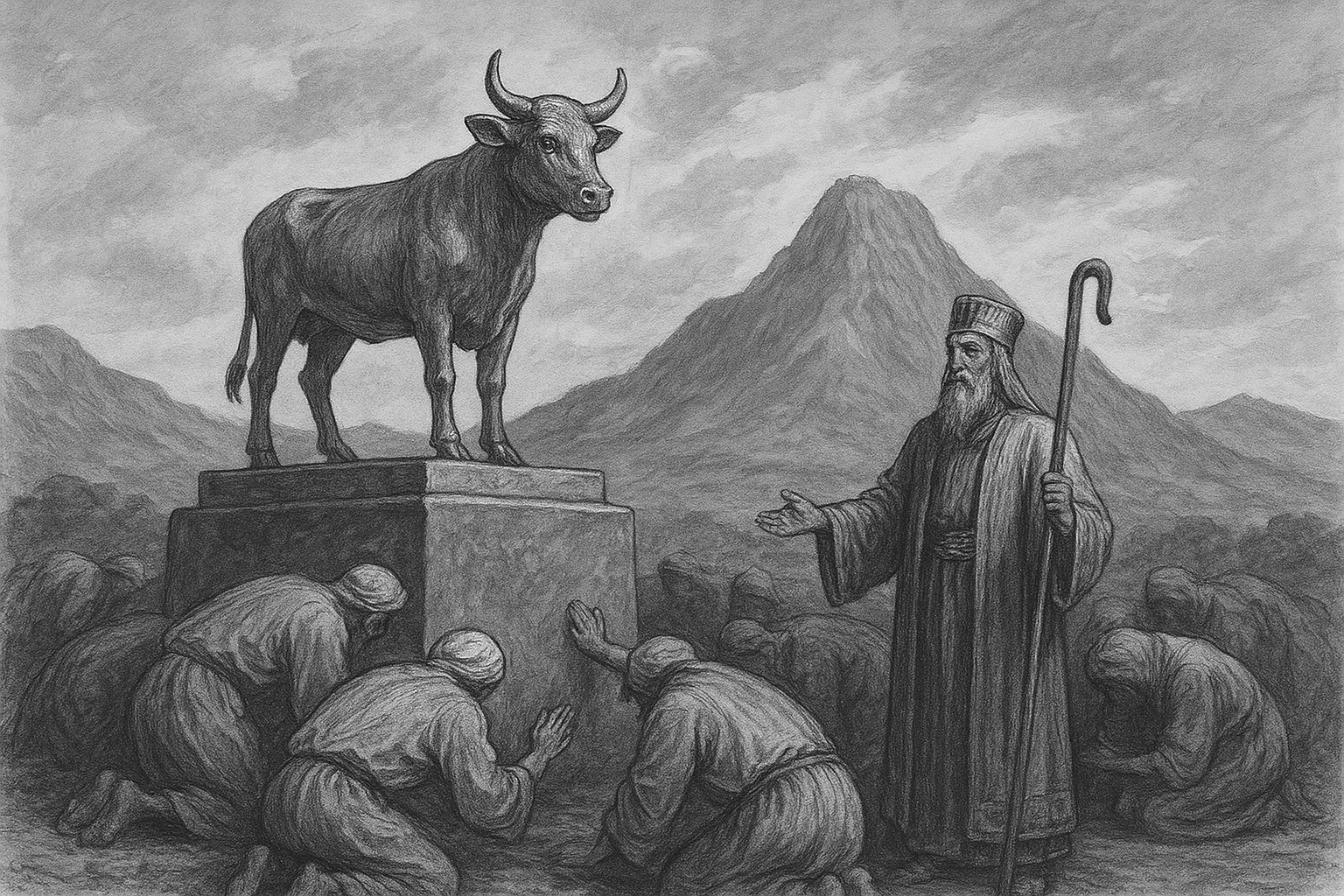
In Exodus 32 we find the children of Israel pleading with Aaron to make them “gods” to go before them. They had been waiting for Moses to come down from the Mountain of God (Sinai) for several weeks and had grown tired of waiting. Their faith in what they had experienced seeing the lightning and hearing the thunderous voice of God was now weak, and apparently they were accustomed to having a visible, tangible god that they could experience in human terms. We see the same humanistic need for a touchable, feel-able God today in many religions. The idea of a God that is beyond comprehension is outside the scope of people’s understanding, it always has been. I want to get back to this idea, but first let us examine something that most versions of the Bible have wrong to my understanding.
In verse 4, in the passage where Aaron has made the requested golden calf, we see words that the majority of Bible translations claim to say: “These are your gods, O Israel, who brought you up from the land of Egypt.”
But it was not two or more calves. It was a single golden calf, so why is it referred to in the plural? Maybe a good look at the Hebrew will help us:
וַיִּקַּ֣ח מִיָּדָ֗ם וַיָּ֤צַר אֹתוֹ֙ בַּחֶ֔רֶט וַֽיַּעֲשֵׂ֖הוּ עֵ֣גֶל מַסֵּכָ֑ה וַיֹּ֣אמְר֔וּ אֵ֤לֶּה אֱלֹהֶ֙יךָ֙ יִשְׂרָאֵ֔ל אֲשֶׁ֥ר הֶעֱל֖וּךָ מֵאֶ֥רֶץ מִצְרָֽיִם׃
For those who do not read Hebrew, the highlighted words אֵ֤לֶּה אֱלֹהֶ֙יךָ֙ can be translated as singular or plural. The first word “ele” is a participle that defines the word that follows, and can mean either “these” or “this” in English. The world “Elohim” is plural and is rendered “Elohecha” in this case, which is still plural but shows possession by adding the “cha” on the end. But why would something that is clearly singular in nature (a golden calf) be called “gods” rather than “god”? This stems from the use of the word “Elohim” and a common misunderstanding of what it means. When used for the God of the Universe, it is often understood in Christianity to refer to the “Triune Godhead.” But in the case of the Golden Calf, it is clearly one object. So does this lead to the idea that the calf was really more than one calf? Or does it help us to understand that the Eternal YHVH who is also called Elohim is not several entities, but One Entity with many aspects? I won’t go into defining God here, He is beyond comprehension to our human minds. But we do know that He is everywhere, He is all knowing, No secrets can be hidden from Him. He hears, sees, speaks, loves, judges….just to specify a few aspects.
It is true that in the Bible there are times when Elohim is used to indicate human judges, leaders, or false gods. But in the case of the golden calf, it is clearly used in the singular as well as in the case of the Creator and His dealings. By the way, in Genesis 1:1 Christians claim that Elohim was all three persons creating mankind. But if you understand Hebrew and do not go to the English for understanding, you will see the following:
בְּרֵאשִׁ֖ית בָּרָ֣א אֱלֹהִ֑ים אֵ֥ת הַשָּׁמַ֖יִם וְאֵ֥ת הָאָֽרֶץ׃
“In the beginning, Elohim (God) created the heavens and the earth.”
(The words “in the beginning, are also misunderstood, but that is for another time since we need to focus on the highlighted words)
In Hebrew, biblical or modern, the words that accompany the noun, in this case “Elohim” must show whether it is expressed as singular or plural and feminine or masculine. In this instance, the word that precedes Elohim is bara בָּרָ֣א: “He created” or brought forth (masculine singular).
To say that Jesus was in the beginning with God creating the universe, as is declared in John 1;1-3, does not fly when you look deeply into what is really said in the original Hebrew text of Genesis.
If we look at other verses where Elohim is used in the plural, maybe we will see that the verbs, adjectives, participles, etc. verify the plurality of these verses. Here is one example:
Psa 97:7 “Confounded be all they that serve graven images, that boast themselves of idols: worship him, all ye gods.” In Hebrew:
יֵבֹשׁוּ כָּל־עֹבְדֵי פֶסֶל הַמִּתְהַלְלִים בָּאֱלִילִים הִשְׁתַּחֲווּ־לוֹ כָּל־אֱלֹהִים׃
The highlighted words say “worship him all ye elohim” referring to the false gods mentioned in the verse. Note the obvious plural in the English rendition. (Above) And to help simplify the words הִשְׁתַּחֲווּ־לוֹ where (Hishtavu), the masculine plural is used in qualifying the word “elohim” which is used for the idols or false gods.
There are several more examples in the Bible where Elohim is used for angels, leaders, judges, wicked or righteous leaders, etc.
I promised in the first paragraph that we would touch on the unfathomable nature of the Divine. Really there are no words other than what the Bible itself says. When Moses asked Yehovah to reveal Himself, Elohim told him a few things about himself:
Exo 34:6-7: ” And YHVH passed by before him, and proclaimed, YHVH, YHVH, a God merciful and gracious, slow to anger, and abundant in loving-kindness and truth, 7 keeping loving-kindness for thousands, forgiving iniquity and transgression and sin; and that will by no means clear the guilty, visiting the iniquity of the fathers upon the children, and upon the children’s children, upon the third and upon the fourth generation.”
Basically that is all that was given for a definition as far a character goes. Perhaps that is enough for humanity other than knowing all the other things that describe the activity of the Almighty as revealed in Scripture. Can it be enough? It has to be!
Let us not raise another golden calf and claim that these be our god’s that have led us or saved us from the wrath of the Eternal! Or that these are the ones who deserve to lead us because they are like us, and we can understand them, and God forbid we claim that God needed a human to help him understand what people need! No! There is no one standing beside the Eternal in Heaven telling Him what humanity needs, nor is there (like some in Judaism claim) a famous Rabbi who has an office next to God in Heaven–someone who answers emails when we need instruction!
May I ask what science people study that denies the Bibles clear instructions to not communicate with the dead? The belief in communication with the supernatural and out-of-body experiences comes from ancient pagan cults and is with us today in many religions including, sadly, some sects of Judaism.
Kabbalah goes against much of what the Bible says, it includes spiritualistic practices including communication with the dead. See the following statement from Kabbalahexperience.com:
“It has long been decided in Jewish law that talking with the dead (by oneself or through a medium) is only prohibited if you think that the dead body is in itself the conduit to the discussion. If one is communicating with the soul of the deceased, it is permissible.” But what does the Bible say?
Deu 18:10 “There shall not be found among you, he that makes his son or his daughter to pass through the fire, that uses divination, that uses auguries, or an enchanter, or a sorcerer, 11 or a charmer, or one that inquires of a spirit of Python, or a soothsayer, or one that consults the dead. 12 For every one that does these things is an abomination to Yehovah, and because of these abominations Yehovah thy God doth dispossess them (the nations) from before thee.”
If, as I am asserting, our Creator is all knowing and all compassionate, forgiving and just and does not allow evil into his Kingdom, then why do we need human mediation? After all, He is the one with the manufacturer’s warranty on the universe!
For an unshakable faith,
Ariella
