Who’s on First?

Parshat Balak

By Ariella Golani

President Trump has been nominated by Netanyahu for the Nobel Peace Prize, hmmm!– but should all the hullabaloo really be about Trump? Is there no God in Israel? Are we courting the nations again? 

For some, Trump holds a position almost as if he is a Messiah. I don’t argue that it was an awesome thing to come alongside and help Israel slow down Iran’s nuclear development, but what else is on the back burner? We hear creeping suggestions of ceasefire and some even voice ideas that a two-state solution might be waiting in the wings, Really? Right when Israel is set to regain sovereignty over the black holes (those places that for time immemorial have fomented hatred for Jews, continually attacking and killing us while chanting “Palestine will be free, from the river to the sea”–the slogan behind pushing us into the Mediterranean!

But lest we get terribly stressed at what is going on in the political world, let’s ask our selves something.  Do we not know what the Bible says? — That YHVH raises up kings to do His will, and when they no longer do that will they fade from view. Let’s take a look at the verse: 

“20 … Blessed be the name of God for ever and ever; for wisdom and might are his. 21 And he changes the times and the seasons; he removes kings, and sets up kings; he gives wisdom unto the wise, and knowledge to them that have understanding;” Dan 2:20-21.

Are we truly in God’s mind? Sometimes it doesn’t seem like it, but Inspiration says:  “He who keeps Israel will neither slumber nor sleep.” Psa 121:4.

Maybe we will be surprised if we see things happen that take away some of Trump’s pomposity. King Nebuchadnezzar of ancient history, succeeded until he came to the point of boasting about all that he had done, shortly afterward he was found wandering around eating grass like a beast.

“30 The king spake and said, Is not this great Babylon, which I have built for the royal dwelling-place, by the might of my power and for the glory of my majesty? 31 While the word was in the king’s mouth, there fell a voice from heaven, saying, O king Nebuchadnezzar, to thee it is spoken: The kingdom is departed from thee: 32 and thou shalt be driven from men; and thy dwelling shall be with the beasts of the field; thou shalt be made to eat grass as oxen; and seven times shall pass over thee; until thou know that the Most High rules in the kingdom of men, and gives it to whomsoever he will.” 

Dan 4:30-32. 

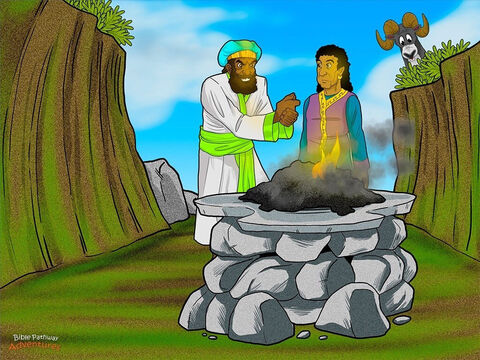
In Parshat Balak we have the prophecy of Balaam who endeavors to curse Israel. Balaam’s donkey speaks to him which he strangely doesn’t find odd. Balaam’s was warned by the Angel of YHVH that he must speak only what he is given, and he stubbornly continues on his journey.  He was not able to curse Israel even after three attempts, each time blessing them instead. In his final attempt, the Spirit of God spoke through him about Israel in end times.

“17 I see him, but not now; I behold him, but not nigh: a star shall come forth out of Jacob, and a scepter shall rise out of Israel; it shall crush the forehead of Moab, and break down all the sons of Sheth. 18 Edom shall be dispossessed, Seir also, his enemies, shall be dispossessed, while Israel does valiantly. 19 By Jacob shall dominion be exercised, and the survivors of cities be destroyed!” 20 Then he looked on Amalek, and took up his discourse, and said, “Amalek was the first of the nations, but in the end he shall come to destruction.” Num 24:17-20 

Does the Eternal have a hand in what is going on right now? What are the signs? Has Israel become like a lion, as it says in verses 8- 9:

“8 God brings him out of Egypt; he has as it were the horns of the wild ox, he shall eat up the nations his adversaries, and shall break their bones in pieces, and pierce them through with his arrows. 9 He couched, he lay down like a lion, and like a lioness; who will rouse him up? Blessed be every one who blesses you, and cursed be every one who curses you.” Num 24:8-9.

So, the secret of our strength is not about alliances with Nobel Prize candidates, but in humbling ourselves under the direction of the mighty God of Abraham Isaac and Jacob. No man should be held up as Savior of Israel. 

YHVH made Balaam do his will and say what he wanted to be said. The same will happen today. Just let us place our focus where it should be! This is the point of the Parsha, that none can curse or bless Israel unless they are given the power to do so. Our destiny lies in the hands of YHVH, the Eternal God of His people! 

When we are tempted to complain about what’s going on, maybe there is something behind the scenes that will soon come into focus! I have to believe that, for God does not lie, and He keeps covenant with His people even when they fall short. 

Let’s keep hanging on! Despite all the craziness going on, it will all work out in the end!
Parshat Balak,  July 20, 2024

The Blessings and Curses of Balaam–A Magician with a Divided Heart

By Ariella Casey

Parshat Balak is chock-full of ideas and truths from which can be extracted important lessons. Here we will look at a few blessings and the wayward Balaam. 

Balaam

We have a pagan magician, Balaam, who apparently realizes that Israel’s God must be consulted before he can get away with pocketing the money from a bribe offered for cursing the people who have passed into the land of Moab. We note that Balak, the Midianite king, sends all the way to the Euphrates river to find Balaam and bring him to solve his problem–the problem of the Israelites (Hebrews at that time) who were in his land. Balaam was obviously a well known prophet, for the passage claims that he had fame of success in cursing or blessing whomever he wished. See Numbers 22:6.

But, realizing he could do nothing without some kind of spiritual permission, Balaam asks the messengers of Balak to wait until he spoke to God about it. At this time Balaam does the right thing, and we see him refuse the visitors and send them off the next morning. Balak sends other more important messengers with promises of riches and glory. This time he wavers, though he says he must ask permission, he already knows the answer, but he insists on asking Elohim for the right to go with the men. We see how greed works on his resolution to do what the Eternal told him at the beginning. 

Here is a fine example of when people rationalize that what God said really isn’t what He meant–That we can change things by excusing ourselves to Him.

 “Could I just have a little change in the rules? After all you know how I like those things!” Take a look at Lot after the destruction of Sodom when he pled with the Almighty to let him go to the small town of Zoar even though the instruction was to flee clear out of there. Lot ended up in a cave with his two daughters, and this is what engendered the people of Moab–the same ones we are talking about here. So Balaam made excuses so that he might find a way to get the money and fame. He became hardened in his path, playing both sides of the coin. And we see it as the story develops. 

Next is the episode of the ass and the angel. Balaam makes excuses to the Angel that he finally sees standing over him–excuses about beating his donkey. The beast was keeping him from going on to collect his reward. He is sternly warned by the Angel, but he continues in the way of his already corrupted heart. 

When he finds Balak, he tells him he can only say what is placed in his mouth. Numbers 22:38. Another excuse. In other words, “You see, I have come all this way and I really want to do this for you, but there is a Power greater than me that will not let me out of his control. I will do my best to please you!”

After eating a sumptuous steak dinner from the sacrifices Balak offers to his gods, Balaam goes to different places at the suggestion of Balak, thinking perhaps that the location may be hidden from the Eternal, and he can get away with cursing Israel. YHVH makes him into a laughingstock time after time because of his greed and unwillingness to walk away from temptation. After several sacrifices of seven bullocks and seven rams and efforts to curse Israel from different places, Balaam ends up blessing Israel to the extent that Balak orders him to go home! All he accomplished was to bless, which was the opposite of what was asked of him. 

Blessings

There were several significant blessings that Balaam pronounced upon Israel. And finally, a promise of a Redeemer that should arise at end times as a deliverer. 

Balaam said to Balak: How shall I curse whom God hath not cursed? or how shall I denounce whom YHVH doth not denounce? For from the top of the rocks I see him, and from the hills I behold him:”
“Lo, it is a people that shall dwell alone and shall not be reckoned among the nations.”

This utterance was given as advice for Israel, advice which has rarely been followed: “not to be reckoned among the nations”. And we see the result time after time when Israel compromises to keep peace with the nations. We see it even now!

See (Num 23:5-12)

The next set of blessings were even stronger, and we think how wonderful it would have been if we had remained true to our covenant!

“He hath not beheld iniquity in Jacob, neither hath he seen wrong in Israel; YHVH his God is with him, and the shout of a king is in his midst. God brought him out of Egypt; he hath as it were the strength of a buffalo. For there is no enchantment against Jacob, neither is there any divination against Israel. At this time it shall be said of Jacob and of Israel, What hath God wrought! Lo, the people will rise up as a lioness, and lift himself up as a lion. He shall not lie down until he have eaten the prey and drunk the blood of the slain.” (Num 23:21-24)

And:

“How goodly are thy tents, Jacob, and thy tabernacles, Israel! Like valleys are they spread forth, like gardens by the riverside, Like aloe-trees whichYHVH hath planted, like cedars beside the waters. Water shall flow out of his buckets, and his seed shall be in great waters, And his king shall be higher than Agag, and his kingdom shall be exalted. God brought him out of Egypt; he hath as it were the strength of a buffalo. He shall consume the nations his enemies, and break their bones, and with his arrows shall smite them in pieces. He stooped, he lay down like a lion, and like a lioness: who will stir him up? Blessed is he that blesseth thee, and cursed is he that curseth thee.” (Num 24:5-9)

So Balak becomes angry and orders Balaam to leave.

“And Balaam said to Balak, Did I not also speak to thy messengers whom thou sentest to me, saying, If Balak gave me his house full of silver and gold, I could not go beyond the commandment of YHVH to do good or bad out of my heart: what YHVH shall say, that will I speak?” (Num 24:12-13)

Before Balaam leaves, he asks for Balak to listen one more time as he gives an end-time prophecy about Israel, one that we also should take to heart! Listen:

“I shall see him, but not now; I shall behold him, but not nigh: There cometh a Star out of Jacob, and a Sceptre shall rise out of Israel, and he shall cut in pieces the corners of Moab, and destroy all the sons of tumult. And Edom shall be a possession, and Seir a possession, — they, his enemies; but Israel will do valiantly. And one out of Jacob shall have dominion, and will destroy out of the city what remaineth. And he saw Amalek, and took up his parable, and said, Amalek is the first of the nations, but his latter end shall be for destruction. And he saw the Kenites, and took up his parable, and said, Firm is thy dwelling-place, and thy nest fixed in the rock; But the Kenite shall be consumed, until Asshur shall carry thee away captive. And he took up his parable, and said, Alas! Who shall live when God doeth this? And ships shall come from the coast of Chittim, and afflict Asshur, and afflict Eber, and he also shall be for destruction.” (Num 24:17-24).

In Summary, it appears that Balaam was of a divided heart. He wanted money and fame, but at the same time he was swayed by the words of Elohim. When under the power of Elohim, he did well, but when the Spirit was lifted from him, he was another person all together. 

After that, even though Balaam is not mentioned in the connecting story, it was he who suggested that the Midianite girls go into the camp of Israel to seduce the men and induce them to worship their gods. This is born out later in the battle against Midian when Moses declared:

“Lo, these, through the counsel of Balaam, caused the children of Israel to commit sin against YHVH in the matter of Peor, and there was a plague on the assembly of YHVH.” (Num 31:16)

I can imagine that Balaam got his money after all! But the reward did not last long, for he was killed in the ensuing battle with Midian. 

Stay tuned! Next week we shall learn about Pinchas who killed a tribal leader who took one of these girls into a tent!

Parsha Korach — 6 July 2024

The Rebellion of Korach (Numbers 16:1-18:32)

The book of Numbers, whether it reveals events given in actual sequence or not, reveals several rebellions of the people of Israel while still in the desert. There is the complaining about lack of water, then murmuring for “substantial” food other than the manna; there is Miriam’s doubting of Moses’ authority and her subsequent seven-day separation from the camp. There is the man who clearly gathered wood to build a fire on the Sabbath. Then follows the story of the evil report of the 10 spies and the consequent rebellion. Now we see another catastrophic uprising and revolt. Several Levites, cousins of Aaron’s sons, are offended that they should be excluded from the priesthood, and we see how this again stirs up the entire people of Israel. We see the way YHWH handles the rebellion, completely destroying those who instigated the chaos and their followers; Korach, Dathan and Abiram and 250 more who were leading men of the congregation. Afterward, a plague starts among the people and 14,700 more are destroyed. 

As I examine the accounts of these rebellions written one after the other, I see that Israel has a problem following their divinely-appointed leadership. One would wonder how any could become involved in revolt after so many years of slavery in Egypt, where under the whip, they took orders from evil task masters, and followed them precisely? Where, if they disobeyed, the result was death?  When, after a miraculous salvation from the hand of Pharaoh, they relax in an atmosphere of God’s mercy and protection and are led by His designated leader, Moses, who himself was willing to die for the people, they take on the attitude of spoiled, entitled children (much like society today) and rebel at whatever they assume has trampled their rights. They now refuse discipline, they are a stiff-necked people. What has made them this way is a mystery and continues in our world today. Why would anyone rebel when you have everything going for you? You were delivered from Pharaoh at the Sea of Reeds, you have food provided daily, you have protection from the sun and the cold by a cloud that follows you on your travels, you have a ready-made place of worship. You are given protection from Egypt and the other nations. Perhaps the only thing you do not have is hard labor. Maybe that is the problem or part of it. When they were slaves, they had no time to think, no time to grumble and complain. Maybe this is the reason for the Sabbath commandment that declares: “six days you shall labor,” which may be the secret of real rest. They had too much time on their hands and spent that time in doubting and complaining rather than building up their society. Bad choices lead to disaster. 

In today’s story, Korach a cousin of Aaron, and his two friends, Dathan and Abiram and On who were Reubenites, rebel.

“Now Korach, the son of Izhar, the son of Kohath, the son of Levi, and Dathan and Abiram, the sons of Eliab, and On, the son of Peleth, sons of Reuben, took men: And they rose up before Moses, with certain of the children of Israel, two hundred and fifty princes of the assembly, famous in the congregation, men of renown:” (Num 16:1-2)

“And they gathered themselves together against Moses and against Aaron, and said unto them, Ye take too much upon you, seeing all the congregation are holy, every one of them, and YHWH is among them: wherefore then lift ye up yourselves above the congregation of YHWH? And when Moses heard it, he fell upon his face:” (Num 16:3-4)

The rebellion is swiftly dealt with, resulting in the death of not only Korach and his two friends, but the 250 others who were ordered to burn incense in fire pans. The ground itself opened up and swallowed the three ringleaders and all that they owned, including wives,, children and belongings. The 250 supporters were consumed by a fire from YHWH. 

It is easy to say that maybe the punishment was too harsh. How would we deal with it today, when almost every country has done away with the death penalty? Treason used to carry the death penalty. Maybe this is why the world has gone mad today! Let’s be kind to those who rebel, after all, their feelings matter too! But this was not the way God handled things–perhaps we’ve wandered a long way from God’s ways of dealing in this world. 

What really is surprising about this story, is that the rest of the people, with their history of rebelling, i.e., the manna, the report of the spies, and the rebellion of Korach, they staged a revolt, claiming that Moses and Aaron had killed the people of YHWH. 

“But on the morrow all the congregation of the children of Israel murmured against Moses and against Aaron, saying, Ye have killed the people of YHWH. And it came to pass, when the congregation was gathered against Moses and against Aaron, that they looked toward the tabernacle of the congregation: and, behold, the cloud covered it, and the glory of YHWH appeared.” (Num 16:41-42)

How could anyone believe that the killing of the three ringleaders and their 250 cohorts was a maneuver trumped-up by Moses and Aaron to maintain their leadership? Were the people completely mad? How would Moses have made the ground open and swallow these ringleaders? How about the fire that came and burned up the 250? Where did that come from? Did they think Moses was a magician and that by rebelling they could get what they wanted and replace him? 

At this point, a plague began among the people and Moses commanded Aaron to intervene, going out among the people with his fire pan and incense. And the plague stopped after 14,700 had died. 

To finally show the leadership of Aaron the Cohen Gadol and his direct descendants, YHWH gives a sign. He tells Moses:

“Speak unto the children of Israel, and take of every one of them a rod according to the house of their fathers, of all their princes according to the house of their fathers twelve rods: write thou every man’s name upon his rod. And thou shalt write Aaron’s name upon the rod of Levi: for one rod shall be for the head of the house of their fathers. And thou shalt lay them up in the tabernacle of the congregation before the testimony, where I will meet with you. And it shall come to pass, that the man’s rod, whom I shall choose, shall blossom: and I will make to cease from me the murmurings of the children of Israel, whereby they murmur against you.” (Num 17:2-5)

“And it came to pass, that on the morrow Moses went into the tabernacle of witness; and, behold, the rod of Aaron for the house of Levi was budded, and brought forth buds, and bloomed blossoms, and yielded almonds. … And the LORD said unto Moses, Bring Aaron’s rod again before the testimony, to be kept for a token against the rebels; and thou shalt quite take away their murmurings from me, that they die not.” (Num 17: 8, 10).

But what do we see today? We have no holy temple, we have only synagogues. The majority of religious Jews have not truly accepted the Torah of Moses, but rather their own substitution, which they call Torah. Is this not again a Korach like movement to dethrone Moses and the God of the Universe? I believe the whole case of persecution of Jews ever since the destruction of the Temple has to do with a Babylonian learned Oral Torah and a rejection of the one true religion established at Sinai. But few know about what happened in Babylon and few, if any, care. Perhaps we need some earthquakes to open the ground again!