Calendario Bíblico, ¿Equinoccio o Luna Nueva?

Por Ariella Casey

HUELLAS DEL CULTO AL SOL EN EL EQUINOCCIO

IMG_256

Oblaciones a una diosa vaca

Mientras estuvieron en Egipto, la vida de los hebreos estaba estructurada según el calendario egipcio. Durante este tiempo (varios cientos de años), estuvieron expuestos a la idolatría del culto al sol a través del dios egipcio Ra y la diosa Hathor. Parece que la adoración del Becerro de Oro en el Sinaí estaba relacionada con la adoración del Sol. ¿Cómo es eso? ¿Y por qué, si acababan de escuchar la voz del Todopoderoso hablando desde Har Sinaí, volverían a la práctica de adoración de la cultura religiosa egipcia? Recordamos no habían transcurrido mucho tiempo que los hebreos salieron en el Éxodo en este momento. Sería natural para ellos mirar a los dioses egipcios cuando se encontraban en circunstancias extremas, es decir, su líder había desaparecido en la montaña de fuego y se había retrasado casi 6 semanas. Por eso no es de extrañar que exigieran un becerro de oro para guiarlos. Aquí hay una representación de un dios becerro egipcio.

En el Instituto Armstrong de Arqueología Bíblica se muestra la conexión entre el culto al sol y el Becerro de Oro que se adoraba en el Sinaí. El incidente en el Sinaí, si no se entiende desde una perspectiva cultural erudita, podría ser un poco confuso, ya que sucedió justo después de que la voz de YHWH diera los diez mandamientos. ¿Por qué debería suceder esto en el pueblo elegido? ¿De alguna manera no lo entendieron? Quiero decir, ¿por qué adorarían a un becerro de todos modos? ¿Existe evidencia de que los hebreos en Egipto participaban en el culto al sol? ¿Existe alguna conexión con el calendario egipcio, que en ese momento era un calendario solar? Los historiadores afirman que este calendario fue establecido durante la primera mitad del tercer milenio a.C. “Los egipcios parecen haber sido los primero en desarrollar un sistema de calendario solar, utilizando como punto fijo la reaparición anual al amanecer de la estrella Sirio, o Sothis en el cielo oriental, que coincidía con la inundación anual del río Nilo.

Del Museo Nacional de Dinamarca: “Se cree que había cuatro sacrificios blót (sangre) fijos al año en las siguientes épocas: solsticio de invierno, equinoccio de primavera, solsticio de verano y equinoccio de otoño. Los vikingos también realizaban sacrificios blót adicionales, por ejemplo, si surgía una crisis que requería la ayuda de los dioses”.

IMG_257

Aunque históricamente Egipto fue el primero en utilizar el calendario basado en el equinoccio solar, no estuvo solo. Muchas culturas antiguas utilizaban el equinoccio como parte de su culto religioso, entre ellas se encuentran los druidas de Inglaterra (Stonehenge), los celtas, la India, Persia y ahora Irán, los mayas de México, los aztecas de América del Sur. Las ruinas de las pirámides en América Latina revelan la medida de los viajes del sol por el cielo, lo que les permite marcar el inicio de su año solar en el equinoccio. Las piedras estaban alineadas para proyectar los rayos del sol hacia una cámara exactamente en la mañana del equinoccio. En estos días las ceremonias paganas se volvían locas con fiestas, bailes, festines y, en algunas tradiciones de culto, había un sacrificio humano al dios. 

IMG_259
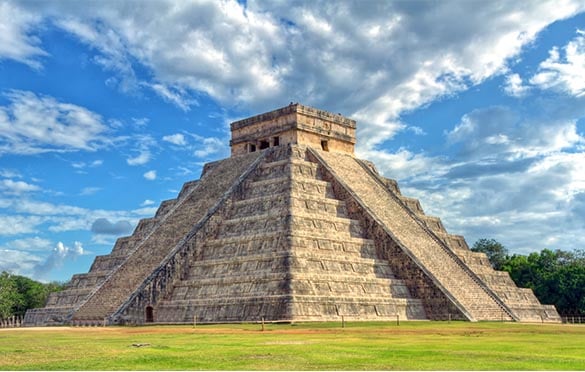
El Equinoccio de Chichen Itza


“El equinoccio era muy importante para las civilizaciones mayas ya que marcaba el comienzo de la temporada de siembra. Mientras se preparaban para construir el Templo de Kukulkán, siguieron el movimiento del sol. Utilizando su asombrosa comprensión de la geometría y la astronomía, construyeron el templo, también conocido como ‘El Castillo’ o ‘El Castillo’ o ‘La Pirámide de Kukulkán’, para producir un maravilloso espectáculo de luces en cada equinoccio”.Personalmente visité este sitio cerca de Cancún, México, y vi dónde los cuerpos de los asesinados en los sacrificios humanos que se ofrecían en este lugar fueron arrojados a un pozo. Preguntémonos ahora, ¿Eran todos los hebreos adoradores del sol en aquella época? Según la lectura de la Toráh del incidente, la tribu de Leví evitó la adoración del becerro. Ellos fueron los únicos que, como tribu, se negaron a bailar alrededor del becerro de oro. (Ver Éxodo 32: 26-27).

Shavuot no´fue la Ley de Sinaí
Si utilizamos el entendimiento común de los sabios judíos que señalan Shavuot, el día de la celebración de las semanas, que ocurre 7 semanas y un día después del Shabat de Pesaj, podemos aceptarlo como una línea de tiempo. La tradición es que ese día se dio la ley desde el Sinaí. Sin embargo, los sabios judíos no están de acuerdo y ciertamente la Biblia no está de acuerdo, ya que el tiempo desde el Shabat de Pesaj hasta Shavuot, aunque consistente, generalmente no coincide en el tiempo de Shavuot. ¿Cómo es eso? La variabilidad del Shabat de Pesaj un año no es la misma el año siguiente. Shabat se desarrolla según un horario diferente. Por supuesto, la tradición rabínica es que el “Shabbat” de Pesaj no es realmente un Shabat, sino el último día santo de Pesaj, que podría caer en cualquier día. Sin embargo, ninguno de los días santos, excepto Yom Kipur, se denomina Shabat.

Hay problemas para asociar otros días santos con Shabat porque la Torá permite cocinar en esos días, pero no en el Shabat semanal ni en Yom Kipur. Así que nuestros amigos ortodoxos, al declarar estos días Shabat, no realizarán ningún tipo de trabajo en ninguno de estos días. No encienden luces ni usan el horno ni la encimera. En estos días, la Torá exige abstenerse de ir a un trabajo o “trabajo de sirviente”.¡Suspiro al pensar en cuánta esclavitud se genera al exaltar a los rabinos y seguir sus hábilmente tejidas redes de sumisión!

Pero, y volviendo al relato bíblico, incluso si la fecha del Sinaí es diferente del cálculo rabínico, podemos estar seguros de que los hebreos sabían muy poco de los caminos del Eterno cuando llegaron al Sinaí. ¿Cuándo fue realmente? De acuerdo a Éxodo 19:1, era “el tercer mes… ese mismo día”. (Eso es casi siempre unos días diferentes a Shavuot). ¿YHWH falsifica el tiempo? ¡Yo creo que no!

Una cosa por la que debo darle crédito al calendario rabínico es comenzar los meses del calendario hebreo con la Luna Nueva. Sin embargo, dicho esto, las Lunas Nuevas en el calendario rabínico rara vez ocurren cuando se ve la Luna Nueva. Por lo tanto, suelen tener uno o dos días de descanso cada mes. ¿Hay alguna razón para esto aparte de la conveniencia y el deseo de mantener a todos los judíos en el mismo calendario y los mismos días santos? Personas con mentalidad científica han argumentado que el calendario real debería basarse en el equinoccio porque su posición en la medición del tiempo es clara. Sin embargo, después de ver los horribles festivales paganos y los sacrificios humanos realizados en el equinoccio, que incluso entonces se entendían científicamente hasta cierto punto, quiero decir, ¿cómo construyeron estructuras masivas como Stone Henge y Chichén Itzá para medir los movimientos del sol, si fueran piedras? ¿Y qué pasa con las Líneas de Nazca en Perú? Este no fue un trabajo de mala calidad. Entonces, ¿qué estaba pensando el Creador cuando estableció el tiempo de la Cebada de Aviv como indicador de la próxima Luna Nueva, la que comenzaría el ciclo festivo de los Días Santos Bíblicos? ¿No parece un poco “anticientífico”?

Yo diría, dejando la ciencia a un lado, la gente del Libro estuvo extremadamente influenciada por las naciones a lo largo de la historia. ¿Y es esa una buena razón? ¿Y qué dice Dios?

“Esto dice el SEÑOR: “No aprendáis los caminos de las naciones ni os aterroricéis por las señales del cielo, aunque las naciones estén aterrorizadas por ellas. Porque las prácticas de los pueblos son inútiles…” – Jeremías 10:2-3

Entonces, para proteger a Su pueblo de las costumbres de los paganos circundantes, YHVH especificó una forma diferente de contar el tiempo y comenzar el año. Y por cierto, esto realmente no es descabellado porque la Cebada de Aviv en Israel ocurre justo en el momento para mantener el calendario en equilibrio, a veces, como este año, fue un mes más tarde, permitiendo un mes extra para que el El año no está fuera de balance. Y por cierto, el Calendario Rabínico hizo lo mismo este año, pero basándose en su tiempo y no en el tiempo especificado bíblicamente.

ENTONCES, ¿QUÉ DICE LA BIBLIA?

Génesis 1:14-18:

וַיֹּאמֶר אֱלֹהִים יְהִי מְאֹרֹת בִּרְקִיעַ הַשָּׁמַיִם לְהַבְדִ ы וּלְיָמִים וְשָׁנִים׃

“Y dijo Elohim: Haya lumbreras en el firmamento de los cielos para separar el día de la noche; y sirvan para señales (לְאֹתֹת), y para fiestas (לְמוֹעֲדִים), y para días y años:” – “Y dijo Dios: “Haya lumbreras en la expansión de los cielos para separar el día de la noche. Y sirvan de señales y de estaciones, de días y de años, y sean lumbreras en la expansión de los cielos para alumbrar sobre la tierra. Y así fue. E hizo Dios las dos grandes lumbreras, la lumbrera mayor para regir el día y la lumbrera menor para regir la noche, y las estrellas. Y las puso Dios en la expansión de los cielos para alumbrar sobre la tierra”, “para señorear en el día y en la noche, y para separar la luz de las tinieblas. Y vio Dios que era bueno”. Génesis 1:14-18

Génesis 1:14, cuando se lee solo, no deja claro qué luces hacen qué trabajo. Sin embargo, aquí se mencionan dos luces. La luz mayor, el sol, y la luz menor, la luna. Pero en el contexto de otros versículos de la Biblia vemos una conexión clara.

El significado de Aviv

¿Qué otros versículos de la Biblia ayudan a arrojar luz sobre esto?

עָשָׂה יָרֵחַ לְמוֹעֲדִים שֶׁמֶשׁ יָדַע מְבוֹאוֹ׃

“Él designó la luna para las estaciones (festivales מוֹעֲדִים–): el sol sabe su puesta”. – Salmos 104:19

Historia de la Declaración de la Luna Nueva

¿Cómo sabemos que Moedim, que es lo que establece la luna, está relacionado con las Fiestas y los tiempos señalados? Si observamos el uso de la palabra Moed (Moedim) en todo el Tanaj, podemos ver cómo se aplica contextualmente.

“¿Hay alguna cosa demasiado difícil para YHVH? En el ‘tiempo señalado’ (Moedim), volveré a ti, según el tiempo de la vida, y Sara tendrá un hijo”. – Génesis 18:14

Recordamos que la luna debía establecer las estaciones, fijar tiempos o fiestas.

Hablando de la fiesta de la Pascua: “Y te será como señal sobre tu mano, y como memorial delante de tus ojos, para que la ley de YHVH esté en tu boca; porque con mano fuerte te sacó YHVH de Egipto.” – Éxodo 13:9

וְשָׁמַרְתָּ אֶת־הַחֻקָּה הַזֹּאת לְמוֹעֲדָהּ מִיָּמִים יָמִימָ ה׃

“Por tanto, guardarás esta ordenanza en su tiempo (מוֹעֲדִ) de año en año”. – Éxodo 13:10

“Tocad la trompeta en la luna nueva (Hodesh o mes), en el tiempo señalado (מוֹעֲדִ), en nuestra fiesta solemne”. – Salmos 81:3

Esto parece estar hablando del primer día del séptimo mes llamado Yom Teruah (el día de la trompeta), o Yom Kipur, cuando también debía tocarse el Shofar.

¿El mandamiento en cuanto a la observancia de Yom Teruah?

“Habla a los hijos de Israel y diles: En el mes séptimo, al primero del mes, tendréis shabaton, memorial al son de trompetas, y santa convocación”. – Levítico 23:24

¡Así que parece que tenemos mucha evidencia de que el avistamiento de la Luna Nueva es un indicador del primero del mes!

“Y en el día de la luna nueva habrá un becerro sin defecto, y seis corderos y un carnero: serán sin defecto”. – Ezequiel 46:6

“Habla a los hijos de Israel y diles: En cuanto a las fiestas [Moedim] de Jehová, que proclamaréis como santas convocaciones, estas son mis fiestas. [moedim]” – Levítico 23:2

“Estas son las fiestas [Moedim] de YHVH, santas convocaciones, que proclamaréis en sus tiempos. [modim]”
– Levítico 23:4

“Estas cosas haréis a YHVH en vuestras fiestas solemnes, [moedim] además de vuestros votos y de vuestras ofrendas voluntarias, de vuestros holocaustos, de vuestras ofrendas, de vuestras libaciones y de vuestras ofrendas de paz”. – Números 29:39

“Y después ofreció el holocausto continuo, tanto de las lunas nuevas, como de todas las fiestas solemnes [moedim] de YHVH que estaban consagradas, y de todo aquel que voluntariamente ofreciese ofrenda voluntaria a YHVH”. – Esdras 3:5

“Vuestras lunas nuevas y vuestras fiestas solemnes [moedim] aborrecen mi alma: me son una molestia; Estoy cansado de soportarlos.” – Isaías 1:14

1 Samuel 20 habla de David cuando se esperaba que estuviera en la fiesta de Luna Nueva del rey Saúl. ¿Esta observancia de la luna nueva mensual era algo que se hacía como costumbre, o algo requerido como observancia del comienzo del mes?

“Y David dijo a Jonatán: He aquí, mañana es luna nueva, y no dejaré de sentarme a la mesa con el rey; pero déjame ir, y me esconderé en el campo hasta la tarde del tercer día”. – 1ra Samuel 20:5

Por la forma en que está escrito, era costumbre durante el reinado del rey Saúl observar la Luna Nueva durante dos o tres días. ¿Fue esto porque la luna no siempre se veía el primer día? ¿Por qué tres días? ¿Y esto fue en honor al nuevo mes? Así parece. Entre los primeros mandamientos que recibieron los israelitas ante el Sinaí estaba el de establecer la fecha del primer mes. Este comando se basó en: 

  1. La Cebada de Aviv.
  2. La Luna nueva. 

La Cebada de Aviv estableció que la temporada no seguiría el calendario como lo haría un calendario lunar normal. Significaba que algunos años la hora aparecería más tarde que otros si se midiera por el equinoccio. Este año, en el equinoccio, no se encontró cebada madura en Israel. Esto agregó un mes al calendario. Algunos dicen que esto no es preciso y que el Creador debe ser preciso. Pero si utilizamos la inteligencia humana para establecer la ciencia Divina, entonces estamos estableciendo los cielos como nosotros los diseñamos y no como los diseñó el Creador. En Génesis 1:14, que vimos arriba, con todos los demás textos que corroboran esto, es claro que la Luna debía fijar los tiempos de los eventos sagrados y así con todas las referencias a las lunas nuevas y los acontecimientos durante esos tiempos, la Biblia Está claro que no debemos descartar a la luna como el marcador divinamente designado durante meses.

SEGÚN WIKIPEDIA

“El Libro del Éxodo establece la luna nueva de nisán, que es el primer mes de Aviv, como el comienzo del calendario hebreo: ”Y habló YHVH a Moisés y a Aarón en la tierra de Egipto, diciendo: “Este mes os señalará el principio de los meses; será para vosotros el primero de los meses del año.  Éxodo 12:1-2. En el Libro de números, el Eterno habla de la celebración de la luna nueva a Moisés: “Y en vuestras ocasiones alegres, vuestras fiestas fijas y días de luna nueva, tocaréis las trompetas sobre vuestros holocaustos y vuestros sacrificios de bienestar. Números 10:10. En Salmo 81:4, tanto la luna nueva como la luna llena son mencionadas como un tiempo de reconocimiento por parte de los hebreos: Tocad la bocina en la luna nueva, en la luna llena para nuestra fiesta. En la Biblia, a menudo se hace referencia a Rosh Jodesh simplemente como “Jódesh”, ya que la palabra hebrea “jodesh” puede significar tanto “mes” como “mes nuevo”.

“El judaísmo utiliza un calendario lunisolar, por lo que Rosh Jodesh se celebra en relación con la fecha de la Luna nueva. Originalmente, la fecha de Rosh Jodesh se confirmaba mediante el testimonio de testigos que observaban la luna nueva, procedimiento conocido como kidush hajodesh (santificación del mes). Después el Sanedrín declaraba el Rosh Jodesh por un mes completo (30 días) o defectuoso (29 días), la noticia se comunicaría a lo largo de todo el país de Israel y la diáspora. Este sistema dependía del funcionamiento del Sanedrín para declarar el mes y comunicar este mes a comunidades judías remotas. En el siglo IV EC, esto se volvió imposible y en su lugar se adoptó un calendario fijo de meses de 29 y 30 días que fue instituido por Hilel II. Al final de un mes de 29 días, Rosh Jodesh se celebra durante un día, el primer día del nuevo mes. Al final de un mes de 30 días, Rosh Jodesh se celebra durante dos días: el día 30 del mes anterior y el primer día del mes nuevo.”

“El significado básico de la palabra Aviv es la etapa en el crecimiento del grano cuando las semillas hayan alcanzado su tamaño completo y estén llenas de almidón, pero aún no se hayan secado. Durante la plaga de granizo (Exodo9:31), la cebada Se decía que estaba [en la] [etapa] de Aviv y la linaza[en el] giv`ol. Esto resultó en su destrucción. El mes en el calendario hebreo cuando la cebada ha alcanzado o superado esta etapa se llama Aviv, o el “mes de aviv”. Este mes se considera el primer mes del año civil eclesiástico. Comienza aproximadamente en la época del Equinoccio de marzo (21 de Marzo). Desde el cautiverio babilónico, este mes se ha llamado principalmente nisán. El “día después del Shabat” (el 16 del mes de Nisán según los rabinos, y el primer domingo de Pascua según los caraítas), la cosecha se iniciaba recogiendo una gavilla de cebada para la Ofrenda de Omer.”

Entonces como hemos visto, el Eterno YHWH estructuró Sus Días Santos basándose en Su propio Calendario el cual parece que ninguna de las naciones siguió. Hay mucho que decir acerca de los calendarios paganos que describen los tiempos de las fiestas paganas e incluso llegan al extremo de ofrecer sacrificios humanos a los dioses de esas naciones. Tenemos un Elohim maravilloso que sabe lo que su pueblo elegido necesita y nos dio instrucciones para evitar que observemos los caminos de los paganos. Nos ha protegido cuidadosamente para que no caigamos en sus trampas mediante el uso de tiempos que parecen ilógicos y poco científicos. Pero ¿quiénes somos nosotros para cuestionar los caminos del Dios Todopoderoso de Israel?

Favor de compartir, gustar, comentar, y seguir (follow) mi sitio.

Ariella

Follow Take Hold the Tzitzit on WordPress.com

Biblical Calendar, Equinox or New Moon?

Footprints of Sun Worship in the Equinox

While in Egypt, the life of the Hebrews was structured by the Egyptian Calendar. During this time (several hundred years), they were exposed to the idolatry of sun worship through the Egyptian god, Ra and goddess, Hathor. It seems that the worship of the Golden Calf at Sinai was connected to Sun Worship. How so? And why, if they had just heard the voice of the Almighty speaking from Har Sinai, would they revert to the worship practice of Egyptian religious culture?  We remember that the Hebrews had not been long into the Exodus at this time. It would be natural for them to look to the Egyptian gods when they were in dire circumstances, i.e. their leader has disappeared up into the fiery mountain and has delayed nearly 6 weeks. 

So it is not surprising that they demanded a golden calf to lead them. Here is a depiction of an Egyptian calf god.

Oblations to a Cow-Goddess (See link)

Armstrong Institute of Biblical Archaeology (see link), shows the connection between sun worship and the Golden Calf that was worshiped at Sinai. The incident at Sinai, if not understood from a learned cultural perspective, could be a bit confusing, happening as it did, just after the ten commandments were given by the voice of YHWH. Why should this even happen among the chosen people? Did they somehow not get it?  I mean, why would they worship a calf anyway? Is there evidence that the Hebrews in Egypt were involved in Sun Worship? Is there a connection to the Egyptian calendar, which at the time was a solar calendar? Historians assert (see here) that this calendar was established during the first half of the 3rd millennium BCE. 

“The Egyptians appear to have been the first to develop a solar calendar, using as a fixed point the annual sunrise reappearance of the Dog Star—Sirius, or Sothis—in the eastern sky, which coincided with the annual flooding of the Nile River.” Britannica

From the National Museum of Denmark:

“It is believed that there were four fixed blót (blood) sacrifices a year at the following times: winter solstice, spring equinox, summer solstice and autumn equinox. The Vikings also held additional blót sacrifices, for example, if a crisis arose that required help from the gods.” See Natmus.dk.

Stonehenge–Great Britain

The Vikings
Though historically, Egypt was the first to use the Solar equinox based calendar, they were not alone. Many ancient cultures used the equinox as a part of their religious worship, among them are the Druids of England (Stonehenge), the Celts, India, Persia and now Iran, The Mayan’s of Mexico, Aztecs of South America. The ruins of the pyramids in Latin America reveal the measurement of the sun’s travels through the sky, allowing them to mark the beginning of their solar year at the equinox. The stones were lined up to cast the sun’s rays through into a chamber exactly on the morning of the equinox. On these days the pagan ceremonies would go wild in parties, dancing, feasting and in some cultic traditions, there would be a human sacrifice to the god’s. Check out this article: Nine Spring Equinox Rituals

Nowruz Equinox Fest– Iran

The Chichen Itza Equinox
“The equinox was very important to the Mayan civilizations as it marked the beginning of their planting season. While preparing to build the Temple of Kukulkan, they tracked the movement of the sun. Using their astounding comprehension of geometry and astronomy, they constructed the temple, also known as ‘El Castillo’ or ‘The Castle’ or ‘The Pyramid of Kukulkan,’ to produce a wondrous light show at each equinox.” Read here to discover the human sacrifices offered at this place. I have personally visited this site near Cancun, Mexico and seen where the bodies of the slain were thrown into a pit. 

Chichen Itza

Were all the Hebrews sun worshipers at that time? From the Torah reading of the incident, the tribe of Levi avoided the calf worship.  They were the only ones who, as a tribe, refused to dance around the golden calf. (See Exodus 32: 26-27.)
Shavuot not Sinai
If we use the common understanding of Jewish sages who point to Shavuot, the day of the celebration of weeks, which happens 7 weeks and one day after the Shabbat of Pesach, we may accept that as a timeline. The tradition is that on that day, the law was given from Sinai. However, Jewish sages disagree and certainly the Bible disagrees, for the timing from the Shabbat of Pesach until Shavuot, though consistent, does not usually add up to fall on Shavuot. How so? The variability of the Shabbat of Pesach one year is not the same the next year. Shabbat runs on a different schedule. Of course, Rabbinic tradition is that the “Shabbat” of Pesach is not really a Shabbat, but the last holy day of Pesach, which could fall on any day. However, none of the holy days, except Yom Kippur, are ever referred to as Shabbat. 

There are problems associating other holy days as Shabbats because the Torah allows cooking on those days, but not on the weekly Shabbat and not on Yom Kippur. So our orthodox friends, by declaring these days Shabbat, will not do any type of work on any of these days. They do not turn on lights nor use the oven or cook top. For these days, Torah requires abstaining from going to a job, or “servant’s work!” 

I sigh as I think about how much slavery is generated by exalting the rabbis and following their skillfully woven webs of subservience!

But, and back to the biblical account, even with the date of Sinai being different from Rabbinic calculation, we can be assured that the Hebrews knew very little of the ways of the Eternal when they came to Sinai. When was it actually? According to Exodus 19:1, it was “the third month…on that very day.” (That is almost always a few days different from Shavuot). Does YHWH fudge on time? I think not! 

One thing I must give the rabbinic calendar credit for, is starting the months of the Hebrew calendar with the New Moon. However, that being said, the New Moons on the Rabbinic calendar are rarely when the New Moon is sighted. So they are usually a day or two off each month. Is there a reason for this other than convenience and a desire to keep all Jews on the same calendar and the same holy days?  

Science-minded persons have argued that the real calendar should be based on the equinox because its position in measurement of time is clear. However, after seeing the horrific pagan festivals and human sacrifices performed on the equinox, which even then was understood scientifically to a point–I mean how did they construct massive structures like Stone Henge and Chichen Itza to measure the sun’s movements, if they were Stone Age dummies? And what of the Naza Lines in Peru? This was not shoddy work. So what was the Creator thinking when He set the time of the Aviv Barley as the indicator of the next New Moon–the one that would begin the festal cycle of the Biblical Holy Days? Doesn’t it seem a bit “unscientific”? 

I would say, science aside, the people of the Book were extremely influenced by the nations all through history. And is that a good reason? I say so! And what does G-d say?

“This is what the LORD says: “Do not learn the ways of the nations or be terrified by signs in the heavens, though the nations are terrified by them. For the practices of the peoples are worthless…” – Jer 10:2-3 

So to protect His people from the ways of the surrounding pagans, YHVH specified a different way to count time and begin the year. And by the way, this really is not far-fetched because the Aviv Barley in Israel happens right around the time to keep the calendar in balance, sometimes, like this year, it was a month later, allowing for an extra month so that the year is not off balance. And by the way, the Rabbinic Calendar did the same thing this year, but based on their timing and not the Biblically specified time.  

So what does the Bible say?

Genesis 1:14-18:

  וַיֹּאמֶר אֱלֹהִים יְהִי מְאֹרֹת בִּרְקִיעַ הַשָּׁמַיִם לְהַבְדִּיל בֵּין הַיּוֹם וּבֵין הַלָּיְלָה וְהָיוּ לְאֹתֹת וּלְמוֹעֲדִים וּלְיָמִים וְשָׁנִים׃

“And Elohim said, Let there be lights in the firmament of the heavens to divide the day from the night; and let them be for signs ( לְאֹתֹת), and for festivals (לְמוֹעֲדִים ), and for days, and years:” – “And God said, “Let there be lights in the expanse of the heavens to separate the day from the night. And let them be for signs and for seasons, and for days and years, and let them be lights in the expanse of the heavens to give light upon the earth. And it was so. And God made the two great lights–the greater light to rule the day and the lesser light to rule the night–and the stars. And God set them in the expanse of the heavens to give light on the earth,” “to rule over the day and over the night, and to separate the light from the darkness. And God saw that it was good.” Genesis 1:14-18

Genesis 1:14 when read alone is not clear as to which lights do which job. However, there are two lights mentioned here. The greater light, the sun, and the lesser light–the moon.  But in the context of other verses in the Bible we see a clear connection. Hold on!

What other Bible verses help to shed light on this?

עָשָׂה יָרֵחַ לְמוֹעֲדִים שֶׁמֶשׁ יָדַע מְבוֹאוֹ׃

“He appointed the moon for seasons (festivals מוֹעֲדִים–): the sun knows his going down.” – Psa 104:19 

How do we know that Moedim, which is what the moon establishes, is connected with Festivals and appointed times? If we look at the usage of the word Moed (Moedim) throughout Tanakh, we can see how it is applied contextually.  

“Is any thing too hard for YHVH? At the ‘time appointed’ (Moedim), I will return unto thee, according to the time of life, and Sarah shall have a son.” – Gen 18:14 

We remember that the moon was to establish the seasons, set times or festivals.

Speaking of the Passover festival: “And it shall be for a sign unto thee upon thine hand, and for a memorial between thine eyes, that the LORD’S law may be in thy mouth: for with a strong hand hath the LORD brought thee out of Egypt.” – Exo 13:9

וְשָׁמַרְתָּ אֶת־הַחֻקָּה הַזֹּאת לְמוֹעֲדָהּ מִיָּמִים יָמִימָה׃ 

“Thou shalt therefore keep this ordinance in his season (מוֹעֲדִ) from year to year.” – Exo 13:10 

“Blow up the trumpet in the new moon (Hodesh or month), in the time appointed (מוֹעֲדִ), on our solemn feast day.” – Psa 81:3 

This appears to be speaking of the first day of the seventh month called Yom Teruah (the day of the trumpet), or Yom Kippur when also the Shofar was to be blown. 

The command as to observance of Yom Teruah?

“Speak unto the children of Israel, saying, In the seventh month, in the first day of the month, shall ye have a shabbaton, a memorial of blowing of trumpets, an holy convocation.” – Lev 23:24 

So it seems we have plenty of evidence for the New Moon sighting being an indicator of the first of the month!

“And in the day of the new moon it shall be a young bullock without blemish, and six lambs, and a ram: they shall be without blemish.” – Eze 46:6 

“Speak unto the children of Israel, and say unto them, Concerning the feasts [Moedim] of the LORD, which ye shall proclaim to be holy convocations, even these are my feasts. [moedim]” – Lev 23:2 

“These are the feasts [Moedim] of the LORD, even holy convocations, which ye shall proclaim in their seasons. [moedim]”
– Lev 23:4 

“These things ye shall do unto the LORD in your set feasts, [moedim] beside your vows, and your freewill offerings, for your burnt offerings, and for your meat offerings, and for your drink offerings, and for your peace offerings.” – Num 29:39 

“And afterward offered the continual burnt offering, both of the new moons, and of all the set feasts [moedim] of the LORD that were consecrated, and of every one that willingly offered a freewill offering unto the LORD.” – Ezr 3:5 

“Your new moons and your appointed feasts [moedim] my soul hates: they are a trouble unto me; I am weary to bear them.” – Isa 1:14 

1 Samuel 20 speaks of David when he was expected to be in the New Moon feast of King Saul. 

Was this observance of the monthly new moon something done as custom, or something required as the observance of the beginning of the month? 

“And David said unto Jonathan, Behold, tomorrow is the new moon, and I should not fail to sit with the king at meat: but let me go, that I may hide myself in the field unto the third day at even.” – 1Sa 20:5 

From the way this is written, it was customary during the reign of King Saul to observe the New Moon for two to three days. Was this because the moon was not always spotted the first day? Why three days? And was this in honor of the new month? It seems so. 

Among the first commandments the Israelites received before Sinai was the command to establish the date of the first month. This command was based on: 1. The Aviv Barley and 2. The new Moon. The Aviv Barley established that the season would not roll around the calendar as a normal lunar calendar would. It meant that some years the time would appear later than others when measured by the equinox. This year at the Equinox there was no ripe barley found in Israel. This added a month to the calendar. Some say this is not precise and that the Creator must be precise. But if we use Human intelligence to establish Divine science, then we are setting up the heavens as we design and not as the Creator designed. 

Genesis 1:14, which we saw above, with all the other texts that corroborate this, is clear that the Moon was to set the times of sacred events and thus with all the references to new moons and the happenings during those times, the Bible is clear that we are not to dismiss the moon as the Divinely appointed marker for months. 

From Wikipedia: (Link Here)

“The Book of Exodus establishes the new moon of Nisan, which is the first month of Aviv, as the beginning of the Hebrew calendar:”And the LORD spoke unto Moses and Aaron in the land of Egypt, saying: “This month shall mark for you the beginning of the months; it shall be the first of the months of the year for you.  Exodus 12:1-2[3]. In the Book of Numbers, the Eternal speaks of the celebration of the new moon to Moses: “And on your joyous occasions—your fixed festivals and new moon days—you shall sound the trumpets over your burnt offerings and your sacrifices of well-being. Numbers 10:10. In Psalm 81:4, both new and full moon are mentioned as a time of recognition by the Hebrews:Blow the horn on the new moon, on the full moon for our feast day.[3][4]In the Bible, Rosh Chodesh is often referred to simply as “Chodesh”, as the Hebrew word “chodesh” can mean both “month” and ‘new month’.[5]

History of the Declaration of the New Moon: Wikipedia Link

“Judaism uses a lunisolar calendar, so Rosh Chodesh is celebrated in connection with the date of the new moon. Originally, the date of Rosh Chodesh was confirmed on the testimony of witnesses observing the new moon, a procedure known as kiddush hachodesh (sanctification of the month).[6] After the Sanhedrin declared Rosh Chodesh for either a full (30-day) or defective (29-day) month, news of it would then be communicated throughout Israel and the diaspora. This system was dependent on the functioning of the Sanhedrin to declare the month, and to communicate this month to far-flung Jewish communities. In the 4th century CE, this became impossible and instead a fixed calendar of 29- and 30-day months (see Hebrew calendar for details) was instituted by Hillel II.[7] At the end of a 29-day month, Rosh Chodesh is celebrated for one day, on the first day of the new month. At the end of a 30-day month, Rosh Chodesh is celebrated for two days – the 30th day of the previous month, and the first day of the new month.[2]

The meaning of Aviv: Wikipedia (link)

“The basic meaning of the word Aviv is the stage in the growth of grain when the seeds have reached full size and are filled with starch, but have not dried yet. During the plague of hail (Exodus 9:31), the barley was said to be [in the] aviv [stage] and the flax [in the] giv`ol. This resulted in their destruction.

The month in the Hebrew calendar when the barley has reached or passed this stage is called Aviv, or the “month of the aviv”.[1] This month is considered the first month of the ecclesiastical civil year (see Hebrew calendar#Months).[2] It begins about the time of the March equinox (March 21). Since the Babylonian captivity, this month has mainly been called Nisan.[3] On the “day after the Shabbat” (the 16th of the month of Nissan according to the rabbis, and the first Sunday of Passover according to the Karaites[4]), the harvest was begun by gathering a sheaf of barley for the Omer offering,[5]

So as we have seen, the Eternal YHWH structured His Holy Days based on His own Calendar which it seems that none of the nations followed. There is much to be said about the pagan calendars that outline times for pagan festivals and even go to the extent of offering up human sacrifices to the gods of those nations. We have an awesome Elohim who knows what his chosen people need and provided instructions to keep us from observing the ways of the heathen. He has carefully protected us from falling into their traps through use of times that seem illogical and unscientific. But who are we to question the ways of the Almighty G-d of Israel?

Ariella Casey

Please like, share, comment and follow. This needs to go out to as many as possible!

Follow Take Hold the Tzitzit on WordPress.com

Memorial for Katzrin’s Fallen Soldiers

The black sky formed a domed canopy above the assembly that gathered in the big square next to the community center in Katzrin. It was a night of remembrance. On the stage stood a flag pole and three soldiers. The Israeli flag fluttered in the mild breeze at half-mast. As residents of the community filed in through several guarded entrances, they were visually checked for weapons and where weapons were found, those who held them were sent to an entrance where licenses must be submitted to the authorities. At this time in Israel, there is danger involved in taking chances in groups of this size. Imagine what could happen, if?… But all ifs dissolved last night, with the armed security and soldiers standing guard. 

Amichai, Fallen Soldier from Katzrin — October 7, ’23

Five hundred plus white plastic chairs awaited the expected crowd. Eager, yet serious, the attendees arrived, and soon row after row of family and friends shuffled into the makeshift auditorium under the stars. Many were Jews from different countries of the world, and perhaps even more were native-born Israelis.

Instructions had been given via every local media outlet that there would be a one-minute siren at exactly 8 pm, honoring the fallen soldiers of the past 7 months and especially those from Katzrin who gave their lives fighting Israel. The audience would stand at attention while the siren lasted. Further instructions were given to prepare the group for the eventuality of a bombing raid during the program. If this was to happen, all were to lay on the ground face down with their hands over their heads. Those who were disabled were to bow as low as possible in their seats and cover their heads in the same way. 

As the siren receded, the audience remained standing as Introductory words and dedications were made, including a memorial Kadesh blessing for Hashem honoring those who died. The three soldiers still stood at stiff attention beside the flagpole on the stage that was illuminated by spotlights of different colors. Not a hand movement nor nod of the head was seen. They stood this way for over an hour, erect and solemn in their military attire. 

Yehezkel Fallen Soldier from Katzrin 10/23

During this time, family members, friends, officials of the town d others brought colorful memorial wreaths and placed them by the flagpole in front of the three soldiers. The names of the fallen soldiers were read and pictures of their lives illuminated the giant screens on either side of the stage. Sadly, the first soldier was killed on October 7, the day the war began.  The second soldier died a few days later that week. The third was much later. 

The service had touching eulogies by the family members, two mothers and a father, honoring the boys. Then a talented soldier sang vocal pieces and accompanied himself on a large keyboard. 

Some of us did not know Hebrew well enough to follow the service literally, but the soul of the Israeli people was apparent and the meaning of it all sank deep into our hearts. We know that Israel is about being One People on the land, no matter what happens. 

The thought has been voiced by many, that at this time when the majority of the world wants to destroy our people, when many so-called Jews, even in government positions in the diaspora are happy to give away our land in exchange for making a name for themselves, we must take the position that we are alone–that we stand for the people of Israel and for this God-given land, whatever comes. 

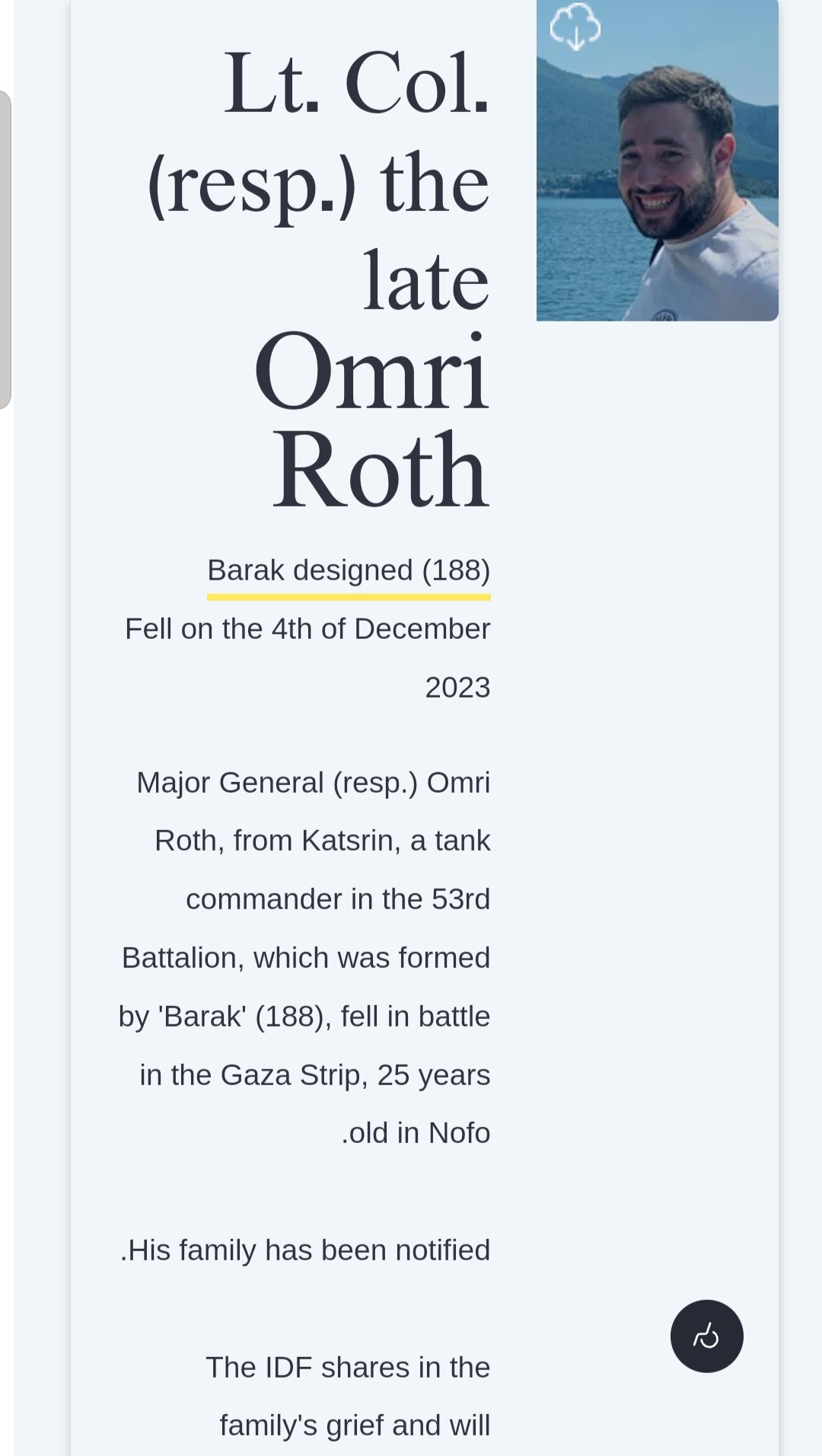
Omri Fallen Soldier from Katzrin Dec ’23

And as always in the past, a remnant will survive and flourish. This must toughen us, come what may. There is no going back. We must strengthen our resolve to stand and not to fall prey to the lies that continue to fall from the mouths of those who hate us, even though many of them are Jews seeking temporal fame and a moment in the limelight. 

Like one seasoned veteran soldier said today concerning Jews that betray the Jewish people. “They are traitors, … and what do you do with traitors…?”

Let him who thinks he is standing take heed lest he fall…

Ariella