Understanding the Fallacy of Grave Worship

Defilement and Grave Worship–Who hears our Prayers?

Most popular religions believe in an ongoing life of some form after death. This belief in an immortal soul has been around at least since Ancient Egypt. Wikipedia. People seem to forget what the Bible says about death and strange as it seems, there is something about it that makes people cling to it even now. Is it more comforting to think a relative is somehow relaxing in Paradise? Perhaps he is somewhere else, God forbid! But what can we find that shows this to be a fallacy? Common logic seems to look at it as lunacy. Perhaps that is why many atheists believe that when it is over, it is over. If we look to the Bible as an unerring source of wisdom there are some strong statements, some in the Psalms, others in the writings of the prophets and some even in the Torah. There is an example of a King of Israel who sought wisdom from the dead and what happened to him. But we will come back to that later. 

To show what one branch of Judaism embraces, look at the following quote from the Breslov site. There are many Jews who make the trip to Rebbe Nachman’s grave in Uman each year on Rosh Hashana. There is a belief that no matter how the person has lived, the Rebbe will rescue them from Hell when they die if they come and recite Psalms at his grave. See following quotes:

“Rebbe Nachman once declared: “Gohr mein zach is Rosh Hashanah . . . My entire mission is Rosh Hashanah.” He was particularly emphatic about his followers coming to him for Rosh Hashanah, and indicated on his last Rosh Hashanah in Uman that we should continue to do so even after his death (Chayei Moharan 403-406; Likkutei Moharan I, 211; ibid. II, 94; Kuntres “Ha-Rosh Hashanah Sheli,” 

“This Chassidic luminary, great-grandson of the Baal Shem Tov, known in his lifetime as a masterful storyteller and source of inspiration, wisdom and comfort, promised before his death that if even the worst sinner would come to his grave and there recite 10 Psalms and give a penny to charity, he would span the length and breadth of the universe to save him from Hell.  Reb Nachman’s unique promise seemed to justify the risks.” From Jewish Action.
So, this sounds as if “holy” rabbis, once dead, can forgive sins or at least mediate to save a sinner from hell! Where else do we find this?

Once a year on lag baomer which is the 33rd day of counting the omer before Shavuot, many thousands of Jews make a pilgrimage journey to Mt. Meron, located a few miles from us here in Northern Israel. Why is this important? And why do they do it?

“The tomb of Shimon bar Yochai (Hebrew: קבר רבי שמעון בר יוחאי), or Kever Rashbi (קבר רשב״י), on Mount Meron is the traditional burial place of the 2nd-century Mishnaic rabbi Shimon bar Yochai. A place of pilgrimage since the late 15th century,[2] it is today the second-most-visited Jewish site in the world after the Western Wall[3] with as many as two million annual visitors.”[4] Wikipedia Link here.

Why do people go to Meron? Basically for the same reason they go to Uman, to visit a dead rabbi and make a place for themselves in the hereafter. Shimon Bar Yochai (known also as the Rashbi) was famous for his writing of the Zohar which is composed of foundational teachings of the mystical Kabbalah. For many of us Kabbalah is witchcraft and strictly forbidden by the Torah.
Please subscribe to my site for upcoming discussions about this and other topics. (You can subscribe at the end of the article, like and comment).

Those who are familiar with Catholicism know about indulgences. These, at least in the past, paid for crimes in advance, crimes which were absolved by the Church. So the above quote infers that a Sage can absolve a sinner and save him from hell. How is this different? The Bible never affirms that any man can forgive sin. Note again what is quoted about Rebbe Nachman: “ even (if) the worst sinner would come to his grave and there recite 10 Psalms and give a penny to charity, he would span the length and breadth of the universe to save him from Hell.”  Only God forgives sin. Or are we becoming like religions that believe in an intercessor, once died and now living in Heaven, to intercede with YHVH for us? How is this idea different from Christianity?

“30 “But every one shall die for his own iniquity; every man who eats the sour grapes, his teeth shall be set on edge.” – Jer 31:30 

When we lived in Tzfat, my husband did a lot of carpentry work for a senior Chabad rabbi who had been a Shaliach for Rebbe Shneerson who had passed away over 30 years ago. He told him that the Rebbe had an office in Heaven and that he had frequent email communication with the Rebbe which guided him. We were shocked about this communication. It was obvious to us that the inference was that the Eternal doesn’t bother to communicate with us so we need a dead rabbi to do so!

Is it natural to think that life goes on even when the body is dead? So if I lose my eyesight, can I still see? If I lose my hearing, becoming deaf, can I still hear?  If we admit that those organs are what make life functional, then how will we use them to function if the body is dead? Is there some kind of soul organ that helps the dead to function? But even when all the body’s organs no longer function, the belief is that those who die, if they are worthy, are able to go to Paradise and talk to God, feel joy, hear angel choirs, and see outstanding beauty. Some even will work to intercede with God for those remaining alive on Earth. And of course there is also the belief that some go to Purgatory until their fate is decided whether Heaven or Hell. 

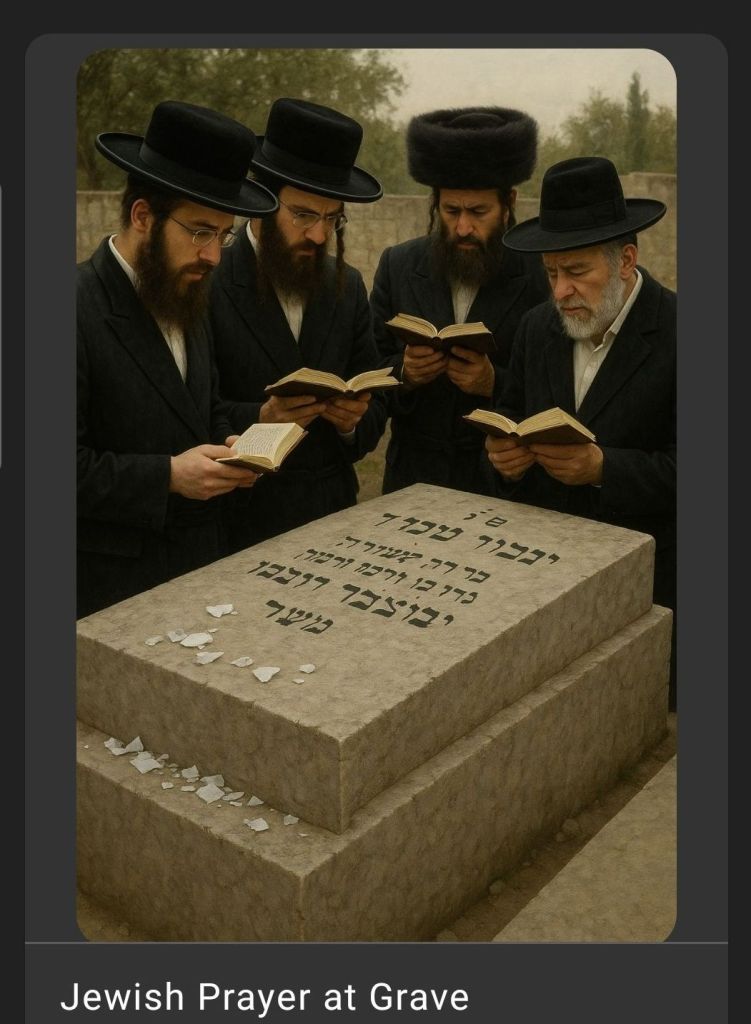
Worshiping at graves is rampant, and especially where prophets and Sages are buried is this practice common. But, if we were forbidden to consult with the dead (see Bible verses following), then how does it even enter our minds to pray at tombs? 

Why was it forbidden for the Cohenim to go to a burial or even be near a grave? These priests of the Most High were set apart with the Holy anointing oil made specifically for the holy things of the Temple and the priests themselves. Their work is holy, and they are not to be defiled by the dead. Ok, so if those who are set apart (the Priests) become defiled by being near the dead, then what is it that is defiling about tombs? And how can the common person think they are receiving a good spirit by praying at graves? There is something there and it is not holy. We must think beyond this logically. If a simple common person believes that they can access some of the spirit of Holy dead sages by worshiping at their tombs,or make requests of them,  then wouldn’t it make sense for a priest to receive even more holiness by being there? But it is forbidden:

“1 And YHVH said to Moses, “Speak to the priests, the sons of Aaron, and say to them: ‘None shall defile himself for the dead among his people, … 4 ‘Otherwise he shall not defile himself, being a chief man among his people, to profane himself. … 6 ‘They shall be holy to their God and not profane the name of their God, for they offer the offerings of YHVH made by fire, and the bread of their God; therefore they shall be holy. … 8 ‘Therefore you shall consecrate him, for he offers the bread of your God. He shall be holy to you, for I, YHVH, who sanctify you, am holy.” – Lev 21:1, 4, 6, 8

So if the priest is made Holy by YHVH only, how can any dead body or corrupted spirit bring him any additional Holiness? Are men Holy and can men transfer holiness, especially after they die? 

When my husband and I first made Aliyah, we lived in Tzfat, Israel, The apartment next to ours had a picture of the Lubavitcher Rebbe (Of Chabad fame) outside our neighbor’s door. She could often be seen pausing to pray by the picture. When asked why she did this, she said she always felt his presence and sometimes the Rebbe would reach out his hands from the picture and bless her.

When she told us this, I shuddered! How can anyone justify this practice when the Bible is so clear about the dead and strongly forbids it? 

I still stand on the principle that the Bible is the foundation of truth, so here are some of the  verses that address this subject. Let’s go to Genesis:

The Creator told Adam:

“16 And YHVH God commanded the man, saying, Of every tree of the garden thou mayest freely eat: 17 but of the tree of the knowledge of good and evil, thou shalt not eat of it: for in the day that thou eatest thereof thou shalt surely die.” – Gen 2:16-17 

The result of eating of the fruit was to be mortality, not immortality and to show this more clearly look at Genesis 3:

“17 And unto Adam he said, Because thou hast hearkened unto the voice of thy wife, and hast eaten of the tree, of which I commanded thee, saying, Thou shalt not eat of it: cursed is the ground for thy sake; in toil shalt thou eat of it all the days of thy life; 18 thorns also and thistles shall it bring forth to thee; and thou shalt eat the herb of the field; 19 in the sweat of thy face shalt thou eat bread, till thou return unto the ground; for out of it wast thou taken: for dust thou art, and unto dust shalt thou return.” – Gen 3:17-19

The Serpent’s Lie

The Serpent in the garden presented a masterful deception to Eve. In this deception, we see the very basis of what many religions believe today–that we really don’t die when we are buried, that some part of us goes on living, sometimes in the presence of God and sometimes in Purgatory or suffering in Hell. 

Are we still letting ourselves be deceived? Look at the lie again as presented in Genesis 3:

“1 Now the serpent was more subtle than any beast of the field which YHVH God had made. And he said unto the woman, Yea, hath God said, Ye shall not eat of any tree of the garden? 2 And the woman said unto the serpent, Of the fruit of the trees of the garden we may eat: 3 but of the fruit of the tree which is in the midst of the garden, God hath said, Ye shall not eat of it, neither shall ye touch it, lest ye die. 4 And the serpent said unto the woman, Ye shall not surely die: 5 for God doth know that in the day ye eat thereof, then your eyes shall be opened, and ye shall be as God, knowing good and evil.” – Gen 3:1-5 

From the quotes above regarding certain leading Rabbis who are dead and buried, we see the same lie. But what does the prophet Isaiah say about intercession before the Eternal Judge of the Earth?  

“15 Yea, truth is lacking; and he that departs from evil makes himself a prey. And YHVH saw it, and it displeased him that there was no justice. 16 And he saw that there was no man, and wondered that there was no intercessor: therefore his own arm brought salvation unto him; and his righteousness, it upheld him. 17 And he put on righteousness as a breastplate, and a helmet of salvation upon his head; and he put on garments of vengeance for clothing, and was clad with zeal as a mantle.” – Isa 59:15-17 

And what about the soul, does it have a thinking, reasoning capacity? Check out these verses:

“5 For in death there is no remembrance of thee: In Sheol who shall give thee thanks? ” – Psa 6:5.

“17 The dead praise not YHVH, Neither any that go down into silence;” Psa 115:17 

“10 Wilt thou show wonders to the dead? Shall they that are deceased arise and praise thee? Selah 11 Shall thy loving-kindness be declared in the grave? Or thy faithfulness in Destruction? ”  Psa 88:10-11

“18 For Sheol cannot praise thee, death cannot celebrate thee: They that go down into the pit cannot hope for thy truth.  19 The living, the living, he shall praise thee, as I do this day: The father to the children shall make known thy truth. “ – Isa 38:18-19

“5 For the living know that they shall die: but the dead know not anything, neither have they any more a reward; for the memory of them is forgotten. 6 As well their love, as their hatred and their envy, is perished long ago; neither have they any more a portion for ever in anything that is done under the sun.” – Ecc 9:5-6 

“10 But man dieth, and is laid low: Yea, man giveth up the ghost, and where is he?  11  As the waters fail from the sea, And the river wasteth and drieth up;  12 So man lieth down and riseth not: Till the heavens be no more, they shall not awake, Nor be roused out of their sleep.  13 Oh that thou wouldest hide me in Sheol, That thou wouldest keep me secret, until thy wrath be past, That thou wouldest appoint me a set time, and remember me!  14 If a man die, shall he live again? All the days of my warfare would I wait, Till my release should come.  … 20 Thou prevailest for ever against him, and he passes; Thou changest his countenance, and sendest him away.  21 His sons come to honor, and he knoweth it not; And they are brought low, but he perceives it not of them. “ – Job 14:10-14, 20-21 

“2 I praise YHVH during my life, I sing praise to my God while I exist. 3 Trust not in princes — in a son of man, For he hath no deliverance. 4 His spirit goes forth, he returns to his earth, In that day have his thoughts perished.” – Psa 146:2-4 

“9 As the cloud is consumed and vanisheth away, So he that goeth down to Sheol shall come up no more.  10 He shall return no more to his house, Neither shall his place know him any more. ” – Job 7:9-10 ASV

“10 There shall not be found among you any one that makes his son or his daughter to pass through the fire, or that uses divination, or an observer of times, or an enchanter, or a witch, 11 Or a charmer, or a consulter with familiar spirits, or a wizard, or a necromancer.” – Deu 18:10-11.

Necromancer in verse 11 means “to consult with the dead.” See below:

 וְחֹבֵר חָבֶר וְשֹׁאֵל אוֹב וְיִדְּעֹנִי וְדֹרֵשׁ אֶל־הַמֵּתִים׃

King Saul goes to a Witch in Endor:

After the prophet Samuel died, King Saul, who already had rejected the truth of Torah found himself without God and without hope, so he went to see a medium who did necromancy. The result was that he was killed on the battlefield the next day. See 1 Samuel 28:3-25.

“19 And when they say to you, “Inquire of the mediums and the necromancers who chirp and mutter,” should not a people inquire of their God? Should they inquire of the dead on behalf of the living?” – Isa 8:19 

What happens when a righteous person dies?

“1 The righteous man perishes, and no one lays it to heart; devout men are taken away, while no one understands. For the righteous man is taken away from calamity; 2 he enters into peace; they rest in their beds who walk in their uprightness.” – Isa 57:1-2 

So, taking the Bible for what it says and avoiding what it condemns, we can stay away from the defilement that comes from communication with the dead. People tell us that they really are not communicating, just praying to God in their merit, but honestly, then why go to a graveside to do it? 

People tell me they feel a presence at the graveside. But is this presence Holy (Tahor or pure) or is it Tamei (impure)? If we receive an unclean spirit by praying near a corpse, how will we know it except to embrace what the Bible says about it and flee from every vestige of this?

Get away from there as soon as possible, renounce the dead spirits and repent and return to YHVH, the only ONE who imparts holiness!

Ariella

Passover–More than a Memory!

As we look at the things that were commanded in the ancient past of the religion of Israel and compare it to what is done today, we find major differences. Whether they are acceptable or “off the derech” is up to the individual to sort out. But let me ask a few questions of you!

We are currently at the time of Passover and there are a lot of things that don’t line up when reading the passages in the Tenakh that define what was commanded to be done and what was done in the original instance. 

The past few days I have been thinking about several of these things. I wrote an article about leaven, arranged a wave sheaf on the dining table as a reminder of what was required on the first day of unleavened bread. My husband gathered wild barley from an open field near us here in Israel. We will plan to wave it and break off some of the grains. 

Some would say, but there is no Temple, so you can’t do this! But a close look at the passages concerning Passover show that the barley sheaf which was only to be gathered “in the land” was not connected to the temple. 

The article I wrote was mainly about leaven vs fermentation (see it here). When a follower on my website, commented that there was more to look at, for example, the lamb sacrifice, I did a retake.  

The lamb sacrifice was originally done in Egypt without a Temple. It was done by individual families and did not require a priest to officiate! Correct! But the excuse we have heard for years is that we don’t do any of this without a Temple. Maybe we have been wrong about this!

What would happen if families got together and sacrificed a lamb on the 14th day of Aviv (Nissan)? That is a scary thought! What does the lamb sacrifice mean anyway? Does it have anything to do with killing the abomination of the Egyptians, which is idolatry? Does it mean that we are to cleanse out all idolatry before taking part in Passover? And what is Passover anyway, other than a commemoration of the leaving of Egypt? What about the call to leave Babylon? –the galute? Or do we even consider that the Jews (Israelites) should have abandoned all these places long ago? 

From my contemplation of the lamb sacrifice, what seems to appear is that its purpose was to rid ourselves of the idolatry imposed upon us by Egypt (the nations), actually bringing us to a cleansing. Why do many Jews prefer to live in other nations? Do they/we love the way the nations live? Why were so many rules about Halakha created to keep Jews as a separate and often strange people, allowing us to continue outside the land? Basically, why do the nations not respect us? Is it because we have added so much to the law of our God that we are unrecognizable as a pure and holy nation? Would we be able to continue in the diaspora if we only accepted the laws given on Sinai? Except for one thing, you can’t really follow Torah outside the land. Many of those laws aresignificant only in Israel. I mean how can you enforce the rule to not eat fruit from your trees until the fourth year when you buy fruit from a big supermarket in Europe or America? How do you know it has been harvested correctly? How do you wave the barley sheaf when it is clearly an Israeli harvest which is specified? But again, these laws and many others were for Jews in their homeland–Israel!

But back to Passover and the lamb…

What if we began to sacrifice a lamb on Passover? That is a scary thought, but with the Temple out of the picture, what prevents it as a command which should be practiced? I can’t imagine the pain it would cause me if I had to kill an innocent lamb! If people had to do this every year, would it make them think? And consider what it means to get rid of the leavening before the 7 days of the week of Unleavened Bread. Yeast is that which inflates, changes the nature (the truth) about the kernel of the grain used for bread baking. Is it possible that the yeast is what has happened to the Word of YHVH in changing it to an inflated law that requires years of Yeshiva to study and learn it? So the requirements of Passover and Unleavened Bread may be a way to get back to the real Torah of YHVH, and more than just a memorial!

Happy Peshach and Unleavened Bread!

Ezekiel 11:17: “Therefore say, Thus saith the Lord YHVH: I will gather you from the peoples, and assemble you out of the countries where ye have been scattered, and I will give you the land of Israel.”

Ariella

What about the Bible? 

Some say the Bible has been tampered with. Lots of voices are saying this. But let me quote something from the Bible itself:

“If the foundations be destroyed, what can the righteous do?” Psalm 11:3

This is a deep concern. I get emails from New Zealand by a couple of Noahides who are taking apart everything but the Moses Scroll (Shapira Scroll), which means that they hold none of Torah or Tenakh as valid, except, what was written by the hand of Moses. (I think I will unsubscribe). There is a book out there called “Who Wrote the Bible” which does the same thing. And it is not just these sources that are trying to rattle the foundations! Sometimes it is more subtle and has been around for a long time!

There are voices everywhere discrediting everything from the Bible. This is what is happening on one side. And among those who profess belief in the Bible, we hear rabbis stating that the only way to understand the Bible is to let them interpret it for you. Where have we heard this before? 

In my relationship with my Jewish friends, I rarely find someone who has read the entire Tenakh, other than listening to Torah readers at Synagogue in Hebrew read the current Portion so quickly, they are virtually not understandable.

On another side of the religious world, Catholics (especially in Spanish-speaking countries) have told me that since the mass is done in Latin, that only the priest can be trusted to know what God wants of them.  How much difference is there in what has been accepted in Judaism for thousands of years? Similarly, only a rabbi can interpret Torah. Really! And why does individual study of the Bible get so little attention? 

So we have our traditions, and often the Minhagim are fine and acceptable if one is really led to be more spiritual and more connected to the Source of all things. But, that being said, the question arises by critics in religious circles, “who can trust where these things came from?” 

And I will ask who can trust academics? We have seen how the colleges of today have gone down the woke path. I saw it beginning in secular colleges in the 90s. I could not believe how things had changed since I first attended college in the mid 70s. If things can change through academics in the political and educational fields, why would they not be influenced by hundreds of generations of teachers, (rabbis or preachers) who claim to know, but that were taught by others who claim to know, and so on ad infinitum, back for a couple of thousand years? Ever played telephone? Ever see how the message changes so much that when the last person receives the whispered sentence, it has nothing to do with the first person’s idea? And that is exactly how the chain of transmission has gone. There are some things that are so far from what the Torah says that you cannot recognize where they came from! So a young man goes to Yeshiva and everyone says “Wow”! And he graduates more confused than ever before. There are always arguments and debates on what the ancient Sages taught, who was right and whom does this would be “rabbi” choose to follow in his future career. Ever think of studying for one’self? Especially if you can learn Biblical Hebrew? 

But perhaps as in the first instance, the most dangerous trend out there is to discredit the Bible entirely, as many have been doing in recent years! As the Psalm says, “what can the righteous do if the foundations are destroyed?” So if we have to throw out the majority of the Tenakh because parts of it were somehow rewritten, then what are we going to use to guide our lives? Is there nothing? Perhaps a somewhat tarnished instrument is better than no instrument at all!

As to the evolutionary theory, I never bought into the idea that man descended from a monkey and such chaos. Perhaps if atheists could experience a living God who created the Universe, One who works in individual lives to bless, guide and strengthen, maybe, just maybe, we would see a different trend in the world. 

But then, there have always been haters of God, defiant of His leadership and law. 

We have several monsters raising their heads in the religious world. Beware of following them!

I would say in conclusion, let’s not “Throw out the Baby with the Bathwater!” 

What could be wrong with thinking for ourselves?

Ariella

Mezuzot

Several years ago, my husband and I made Aliya to the Land of Israel, we lived for a time in Tzfat, which is considered one of the four “holy” cities of Israel. 

During that time, I tripped over an uneven place in the doorway of our  house and broke a bone in my foot. Several observant Orthodox friends told us we needed to have the Mezuzah inspected because it might have a broken letter in the scroll. That seemed pretty weird. Since that time I have had suspicions about man made laws. And to have the mezuzah inspected by a trained person costs money so again the element of making money over rabbinic teachings comes to view. . 

We left Tzfat after a hard struggle with some rabbis. We found a little town that was not so fanatical, a bit more secular, and where people left you alone. 

But the Mezuzah theme never left my mind. If you look at Torah there is nothing said about a box. It says to “write these commandments.” Does it say to buy an expensive parchment scroll, expertly written by a sofer and then hide it away in a box that you kiss when you pass in and out of your house? 

The verse says nothing about putting a scroll in a box. It does command each of us to do our own writing, not to go buy something and hide it away in a box!

Deut 6:4-9: “Hear, O Israel: YHVH our God, YHVH is one.[a] 5 Love Hashem your God with all your heart and with all your soul and with all your strength. 6 These commandments that I give you today are to be on your hearts. 7 Impress them on your children. Talk about them when you sit at home and when you walk along the road, when you lie down and when you get up. 8 Tie them as symbols on your hands and bind them on your foreheads. 9 Write them on the doorframes of your houses and on your gates.”

So the purpose of the Mezuzah, which means door post, is that we might have the commandments embedded, if you will, in our hearts and minds. What a better way than to do the writing ourselves and to place them where we can see them! 

The act of kissing an object is what is done in paganism. People kiss the graves of Saints and Rabbis. People kiss the image of St. Peter in the Cathedral in Rome and other places. Nowhere does the Torah tell us to kiss an object. 

But before we totally dismiss the Mezuzah, we need a new approach to it. How about finding a way to engrave the 10 commandments in a wooden plaque? Paint them, write them, wood burn them and hang them up so you see them and remember them when you go out and when you come in? 

Let’s make the Torah something personal between us and our God! 

Shabbat Shalom
Ariella

¿En estos momentos, por qué nos distraemos?

¿Hay algo real en nuestro mundo?

El mundo ha estado girando fuera de control en un caos loco que nadie entiende realmente. Trump fue investido. Logró algunas cosas alentadoras durante sus primeras horas en el cargo. Todo suena bien. ¿Pero lo es realmente? Algunos de nosotros estamos agotados por preocuparnos por lo que viene después. ¿Trump nos está diciendo la verdad? ¿O esto es propaganda?… ¿Otra vez? ¿Otro gran espectáculo para ganar poder y dinero? ¿Está Donald Trump realmente trabajando para establecer un control global? ¿Quizás el mundo estaba tan debilitado bajo el régimen pasado que ahora, con la espalda y la voluntad destrozadas, por así decirlo, aceptaremos e incluso daremos la bienvenida a un líder que va más allá de los deberes de un presidente de los Estados Unidos? 

No, ¡realmente no puedes culparnos por pensar que lo que vemos no es realmente lo que obtenemos! ¿Y cómo llegamos a ser así? Los que hacemos estas preguntas evidentemente tomamos la pastilla roja, lo que nos hace sospechar de todo. ¿Pero Dios influye en alguna parte? ¿Podemos creer que el Eterno y todopoderoso Maestro del Universo todavía tiene el control? ¿Realmente Él levanta reyes y derriba reyes? (Daniel 2:21), ¿o las promesas en las que hemos confiado en el pasado son nulas y sin cumplimiento? 

¿Tiene Israel realmente un propósito en este mundo para los últimos tiempos? ¿Las gloriosas promesas de la Biblia realmente están destinadas a nosotros hoy, o de alguna manera perdimos el rumbo en el camino? Es fácil preguntarse y quizás no sea correcto pensar de esta manera. Pero es extremadamente triste ver a tantos inocentes asesinados, violados, decapitados, aterrorizados e incluso después de que algunos sean liberados, ¿cuál es la probabilidad de que aquellos que soportaron los últimos 16 meses tengan enfermedades mentales, es decir, si es que sobrevivieron? ? Naturalmente, somos inseguros e incluso dudamos de las razones de nuestra fe. Nos preguntamos si veremos otro mañana.

Tratamos de sacárnoslo de la cabeza, la distracción es un juego al que jugamos y puede ser la única forma de sobrevivir a esta horrenda guerra con algo de cordura. Es difícil no pensar en los rehenes medio enterrados en oscuros agujeros bajo la mugre, violados y odiados. No hay certeza de que alguno de ellos siga vivo. Como seres humanos, nunca podemos estar satisfechos con no saber acerca de algo tan precioso como la vida humana. ¡Y por eso tratamos de evitar pensar en lo impensable! Después de todo, hay mucho que un ser humano puede soportar, y la larga saga de insistir en el destino malvado de estas queridas víctimas (viviendo o quizás incluso preferiblemente muertas en los túneles del miedo helado) es un infierno puro tanto para ellos como para todos. de nosotros que tenemos alma.

Entonces dejamos de pensar porque debemos hacerlo. Y, sin embargo, ¿adónde se ha ido la esperanza? ¿Dónde está Dios en un momento como éste? ¿Hay algunas almas fieles que todavía ven el bien más allá de la tragedia de nuestros tiempos? 

El mundo está siendo pesado en la balanza, siendo Israel la pieza central sobre la que se decide el juicio. 

Llamar al mal bien y al bien mal parece ser el tema de un mundo enloquecido. Que el Todopoderoso vea tal como vio a Israel en los horrores de los pozos de lodo de Egipto cuando llamó a Moisés para liberar a su pueblo.

“Y vio Dios a los hijos de Israel, y supo Dios…” Éxodo 2:25

¿Que quiere decir este pasaje? ¡Que nada pasa con nuestro Creador sin que se oye y se da cuenta!

¿Podemos confiar en eso ahora? 

Por favor comparten sus pensamientos. ¡Realmente me gustaría saber lo que piensen!

Ariella