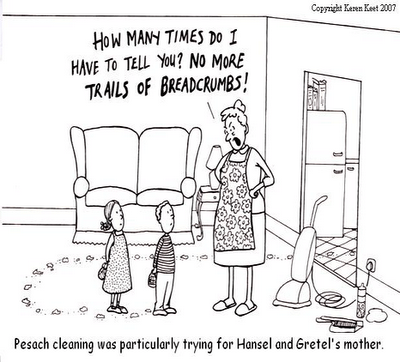
K.I.S.S. Cleaning before Pesach

Today we find ourselves just a week before Pesach and most of my Jewish friends are feverishly cleaning every crack and cranny of everything that can be imagined to be Chametz. All of their dishes are stored away and Kosher for Pesach plates and utensils are brought out of where they have been kept free of contamination for the past year! (If you don’t know the word Chametz, See Here). I personally am just starting, one item a day for the next few days. And no, I do not separate my plates and utensils for the holiday. After washing them, I can’t imagine them to have Chametz smeared on them! Today I cleaned the fridge. Tomorrow I will clean the stove…

Well, tomorrow is here and I cleaned both of my ovens and as I cleaned them, I realized that if you cause leaven to be rendered unusable, you destroy it. And that means that it has no more power to leaven anything. Therefore, if you clean the oven with chemicals or heat it to a high temperature, there is no chance that leavening will remain in any kind of active form. So I cleaned it well, but I could not get every dark spot off of the roof of the oven and I am not worried.

In regards to cleaning for Pesach, again we see where fence upon fence has been placed to protect what was given at Sinai. In fact some of these fences have become walls so high you cannot see past them to what was originally given, nor can we understand why. We probably should crash through some of those fences so we can catch a glimpse of the original Torah!

One of these multi-fenced laws that have been built around Sinai is found in the strict observance of Pesach.

I have been in homes that cover everything including the sofas with aluminum foil. I ask myself, so do they think that Hashem does not see through tin foil? Good grief! Every bit of flour, every one of the five grains listed by, no not the Torah, but you guessed it, the Rabbinic books must be taken out of the house or sold to a jewish organization who will sell it on to some gentile we don’t even know. 

And this is the loophole. Just put everything in a closed room or cupboard and sell it to your rabbi. That is, pay to Chabad or any other Orthodox group to have them sell it to a gentile and then buy it back after Pesach. Seems like a great-get rich quick plan, if the proceeds at $25 plus per Jewish person in the world goes into the pockets of the Orthodox institutions. How much would it come to,  if the estimated 10 million Jews in the world earn even $10 each to sell their people’s Chametz? That comes to 10 million dollars!

But of course, IF the Torah commands it, we had better pay for it. But does it? 

Actually the Torah makes no allowance to sell the Chametz. It is to be discarded or taken out of one’s’ property. And also we must see that something has been overlooked. All of the Gerim in the land were to clean for Pesach as well! Look closely at the following verse from Exodus 12:

“…for if any one eats what is leavened, that person shall be cut off from the congregation of Israel, whether he is a sojourner (Ger) or a native of the land. Exodus 12:19”

Let’s look at the Hebrew:

 שִׁבְעַת יָמִים שְׂאֹר לֹא יִמָּצֵא בְּבָתֵּיכֶם כִּי כָּל־אֹכֵל מַחְמֶצֶת וְנִכְרְתָה הַנֶּפֶשׁ הַהִוא מֵעֲדַת יִשְׂרָאֵל בַּגֵּר וּבְאֶזְרַח הָאָרֶץ׃

 So there is a place for the gentile in the Land of Israel, but they are not legitimate buyers of Chametz! Perhaps later we need to study who is the Ger, but the Ger is not a homeborn Jew. And certainly not a convert. I choose to see them as the workers who come to Israel to support the farming and caregiving that is required. They also are to keep many of the laws of Torah.

Also we need to see that a lot of things that are not Chametz that are claimed to be. One is the five grains. The following is claimed by the Orthodox Union:

“If one of the five grains – wheat, barley, rye, oats and spelt – sits in water for more than 18 minutes it becomes chametz, and one may not eat, derive benefit from or own it on Pesach. In addition, Ashkenazim don’t eat kitniyot – a group of foods which includes (among other things) rice, corn, soy and their derivatives – but are allowed to own kitniyot foods on Pesach.” From OUKosher, see here.

But what does the Torah actually say?

Leviticus 23:5-6: “In the first month, on the fourteenth day of the month in the evening, is YHVH’s passover. And on the fifteenth day of the same month is the feast of unleavened bread to YHVH; seven days you shall eat unleavened bread.”

Exodus 12:15-20: ”Seven days you shall eat unleavened bread; on the first day you shall put away leaven out of your houses, for if any one eats what is leavened, from the first day until the seventh day, that person shall be cut off from Israel.On the first day you shall hold a holy assembly, and on the seventh day a holy assembly; no work shall be done on those days; but what every one must eat, that only may be prepared by you. And you shall observe the feast of unleavened bread, for on this very day I brought your hosts out of the land of Egypt: therefore you shall observe this day, throughout your generations, as an ordinance for ever.

In the first month, on the fourteenth day of the month at evening, you shall eat unleavened bread, and so until the twenty-first day of the month at evening. For seven days no leaven shall be found in your houses; for if any one eats what is leavened, that person shall be cut off from the congregation of Israel, whether he is a sojourner or a native of the land. You shall eat nothing leavened; in all your dwellings you shall eat unleavened bread.”

Let’s look at the underlying principle. “You shall eat nothing leavened.” It does NOT say that things that might ferment, like the five grains, must be discarded or what they call Kitniyot (rice, corn, soy). How can you even imagine that soybeans will create leavening so that they become edible just by becoming damp? It is true that they increase in size when you soak and cook them, but this is not leavening–this is normal expansion. Leaven is that which causes flour to rise and create leavened bread.  The simple rule is to not leaven the flour of any type of grain. Get rid of the leavening (the yeast).  Now what was the original leavening process? Sourdough was the way bread was leavened in Egypt. Modern activated dry yeast was unknown at the time. However it does qualify as leavening for works the same way. So concerning the ancient Egyptian leavening process:

So all of one’s sourdough starter must be discarded, which is a bit inconvenient because you then wait until after Pesach to start a new batch. Otherwise the starter would have to be placed outside your property and not attended until after the week of Passover. 

What about beer?

Now some think this is debatable.. But beer is made with yeast. And if you have ever eaten beer bread, you will agree that it leavens the dough. So beer is definitely out. No we don’t eat beer, but people drink it which is basically ingesting it which is what you do when you eat food. Also the brewer’s yeast which is a by product after the making of beer, is questionable. It is a yeast, though it does not serve to leaven bread. 

There are other things that are listed by the OU as no-nos for those who keep passover. Vinegar is listed because it is fermented. But vinegar is not leaven, nor is it used to raise dough. 

And fermentation is not leavening. Only in the case of when fermentation of flour actually creates yeast as in the process of making sourdough bread. 

So it sounds pretty simple, just don’t eat anything with leavening agents. No yeast, no sour dough starter, and no baking soda or baking powder. This means no bread, cakes or cookies, nor beer.  There are a lot of leavening agents used in chips and crackers. Be sure to read the ingredients. And looking at all the ingredients labels in Hebrew may take an extra day for me!

 But, beyond food, there is more to be done. There should be no leavening found in the house, nor in one’s personal property, be it your office downtown or the garage where you park your car. 

Now, before we go crazy cleaning out from under the refrigerator, or tipping over the sofa to see what is down inside the cracks, let’s remember that the Torah stresses several times that it is about not eating leaven. You would never eat the crumbs that you would find under the furniture. And though I would suggest cleaning the fridge from all bread and cake remnants and crumbs and doing a deep clean on the oven and grill, you can avoid the month long scrutiny and the purchase of new utensils and plates just used for Pesach. The basic cleaning needed for Pesach and the Week of Unleavened Bread should not take that long. After all, it really is NOT rocket science! 

And the making of Matzoh, since when did we need the rule of 18 minutes before the flour would start to ferment (again it isn’t about fermentation, it is about leavening)? So what we learned earlier about sourdough– that it takes time to create yeast, is actually when the flour and water mixture creates yeast which is more than a couple of days. By the 3rd or 4th day, the sourdough may work, but usually up to a week of feeding it is required to create the yeast that raises the bread. It will not raise your dough during the first few days after mixing the flour with water. So let’s let go of the idea of fermented dough being leavened. Fermentation is not the same as leavening unless it creates a type of bacteria that turns into yeast, which happens after a long period as in the case of sourdough.  

The Israelites carried their dough wrapped up to their first encampment where they cooked their unleavened bread during that first week of unleavened bread. It may have soured but it was not leavened. Because of this example, we can be sure that the 18 minute rule for Matzoh is just a created rabbinic frustration for Jews. 

So here we are coming up to Pesach and the week of Unleavened Bread. Let’s Keep it Simple Stupid–no heavy duty cleaning inside the pockets of your husband’s favorite winter jacket!

Just don’t leave anything leavened on the property, don’t sell it nor buy it back– Really!!

And here is the promised link to Karaite Matzah! Enjoy!
https://www.nehemiaswall.com/karaite-matzah-recipe

Please help support my channel by liking, sharing, commenting and following me!

Thanks,

Ariella

Follow Take Hold the Tzitzit on WordPress.com

Strong as a Dead Lion–Then What?

Painting by a Highschooler named Uri in Katzrin, Israel

At the time before there was a king in Israel, Samson arose as a judge and spent his life wiping out the Philistines, one episode after another. After having killed a lion with his bare hands, he later came upon the carcass and it was full of bees which had made honeycomb and was dripping with the sweet honey. From this experience he thought of a riddle with which to trick the Philistines that should attend his wedding to a beautiful Philistine woman.

“…Out of the eater came forth meat, and out of the strong came forth sweetness…” Judges 14:14

Do we remember that the Philistines occupied in part what today is called Gaza? The town of Timnah, where the wedding was to take place, was located a few miles east of what today is Gaza.  

It comes to mind that Judah was called a lion in the blessing given to him by his father, Jacob. Judah was to hold the kingship of Israel and rule like a lion. But what we see today is appearing to be an almost dead lion. What will happen if the lion is killed? What then? Will sweetness come from the carcass? Let’s look a little deeper. 

What we see in modern Israel is a political government that is not concerned with its mandates from its covenant the God of Heaven. This is the lion we see trying to fight with all the worldly power it can muster, trying to satisfy the different nations that supply weapons and yet subjugate themselves to the foreign policy of nations who care nothing for Israel–those who wield world power at the touch of a switch, and we see our nation “going along to get along.” Perhaps this lion will die. Then what?

Could we even imagine that something could happen then to help Israel in its most trying time? Is there Anyone watching this struggle? Anyone in the Heavens who might just be ready to take the reins when all seems lost? Will there yet be a sweetness that exudes from this dead lion? Wouldn’t it be better if we were not looking to might and power but to something else?

“Then he answered and spoke unto me, saying, This is the word of the LORD unto Zerubbabel, saying, Not by might, nor by power, but by my spirit, saith the LORD of hosts.” – Zec 4:6

Few know what it means to depend on El Shaddai, and even those may wring their hands in fear of what is coming upon the world and especially what will happen to those in this land given and  promised to God’s people. It is mandatory that we take heart at this time. 

It will get very ugly before it gets over. Maybe it should get over, the sooner the better. We need to stop being led by those who think like the world thinks, however wise that may seem. What if we had pure faith (Emunah if you will) in YHVH and His great power? Will He let us down? Where are we in the line up of what is happening to bring about the Divine plan for this world? How does Israel play a part in this? Do we fight like the nations, or do we march out with trumpets blowing when we hear a sound in the mulberry trees? 

“And it shall be, when you hear the sound of marching in the tops of the mulberry trees, then you shall advance quickly. For then the LORD will go out before you to strike the camp of the Philistines.” – 2Sa 5:24.

But we are a long way from that type of trust. Why do we tremble? Is it because we have never seen the Hand of Providence guiding our lives? Is it because we remember pogroms, Holocaust, and the Kristanacht? Where was God during those times? Maybe somehow we were in the wrong places or worse yet, that we were not listening to Him? 

Maybe these terrible tragedies should tell us something. Maybe we need to step back and ask who we are following in our religion? Who wrote the instructions? When did we deny our Creator to go after a strange doctrine? 

The way I see it is that we follow the nations because we believe there is more wisdom and skill than that offered by the ONE who made a Covenant with us about land and protection and about raising us up to be a Holy Nation. 

What would happen if we really knew the God of Israel? Would He come alongside and win the war for us so that we could go out with tambourines and march (dance perhaps) to the sound in the myrtle trees?

Judah, “you’ve come a long way, Baby” but maybe in the wrong direction. 

In hopes of a new day after the storm…

Ariella

Please like, share, comment to help promote my efforts.

Follow Take Hold the Tzitzit on WordPress.com

Purim–Queen of Chutzpah–What about Hamas?

Purim 2024! The Middle East war is bombarding us on every side, is there anything significant for us in Purim and the book of Esther? Right or wrong, this time we are handling the sneaky Haman (Hamas) differently. Maybe because we do not have a covert Jewish woman sitting as queen in Iran’s palace. Esther prayed and fasted and knew how to don her most beautiful garments to be attractive enough to break the King’s rules about illegal entrance into the throne room. She had no invitation but she took a chance and went before the king. What Chutzpah! Really? She sounds a lot like a normal Israeli once you know the culture. Nobody takes no for an answer here, nor do we always follow protocol. How did we learn this? And did Esther (Hadassah) teach us something about rules that make no sense and the right to refuse something that does us harm? 

Some Biblical scholars say that the book of Esther is a myth. Even if it is, there are lessons we can learn from its teaching about Jews in exile. Must Jews always take things into their own hands to be able to defend themselves? Is the Most High Eternal God of the Universe somehow gone on leave of absence? Or is He trying to get us to use our God-given wisdom and cunning to run the enemy out of our Promised Land? Is He somewhere in the shadows standing alongside us as we fight? Does He bring circumstances about so that even corrupt leaders are forced to make right choices about how and where to fight and whom to resist, even if it be the United States and Great Britain? Can we trust that things will go well in the long run? I often wonder what will happen when the United States decides to cut off all military aid to Israel–aid that they promised to their greatest ally in the Middle East. It is a horrifying thought and one that our leaders are trying to avoid by what appears to be stupid agreements with mediators who have betrayed Israel. And many of these mediators are actually Jewish!

So, Israel has offered 700 terrorists, some of them murderers, in exchange for 40 hostages! That is more than 17 to 1!  Are we serious? But as we watch, I wonder if something will happen that will change the circumstances.. Are we really alone in this? Is the Great YHWH absent from this war? Or is He working behind the scenes?

Yesterday my husband and I attended a Purim Megillah reading. The normal Purim treats and drinks were on the table. Visitors from out of town were present as well as friends from our town in the Golan Heights. The Megillah reading was a normal 2000+ years traditional reading except for the fact that we sat outside and as the chazan was reading the scroll, IAF planes flew over every minute or so, continuing throughout the day in response to hundreds of attacks from the enemy. Many of us had figured in advance that with Ramadan in place, Purim 2024 was going to be under fire from Lebanon, Gaza, and Syria.

The loud sound of the F-15s overhead was enough to make some want another drink of the hard stuff. The Chazan tried to space the reading so that the planes would drown out the name “Haman”. I guess it was meaningful. For me, the service was a reminder that we were in another encounter with Haman, but this time we are in our Holy Land and the looming question is…”Why do we suffer Amalek after we return to our homeland?” Are we still exiles? Did we import some of that mentality from the diaspora? The celebration, if you will call it that, became meaningful to me when I began to contemplate what is happening on a spiritual level. 

I recently questioned the need to continue Purim festivities. Must we remember that we are still in Persia–Iran?  Amalek is, in fact, still in our midst! And 75,000 enemies killed at the command of Esther and Mordechai was still not enough to put an end to the hatred that has generated through the centuries.

Seventy-five thousand is a lot more than the MSM claims as Israel’s victims! Some reports say 32,000 Gazans killed.Maybe it would be better for Israel if this was true! Where is our thinking? Why are we pussyfooting around to save “innocent civilians” when we know what those same “civilians” did to our people on October 7? The old saying “never forget” seems to be forgotten. Why are we trying to make peace with those who have our necks on their chopping block? Where is the Chutzpah of the Queen of Persia? She did not, after all, try to be politically correct when she had Haman and his ten sons hung on the gallows!

When will we realize that something is walking out of step with the Eternal? How can we expect His full intervention? Maybe we should stop fasting to fulfill tradition and start fasting for a renewed vision as to what Hashem expects of us!

And then, we shall ARISE and take back that which was promised to us in the strength of YHWH, the Almighty God of the Universe!

 “Arise, shine, for your light has come, and the glory of YHWH rises upon you.  See, darkness covers the earth and thick darkness is over the peoples, but YHWH rises upon you and his glory appears over you. Nations will come to your light, and kings to the brightness of your dawn.” Isa 60:1-3 

Shalom in the Midst of War,

Ariella

Please help me by liking and sharing on your favorite social media platforms, comments are welcome!

Follow Take Hold the Tzitzit on WordPress.com

How to Be an Individual and still be Religious

Is it possible to have a Bible-based religion without bowing to some hierarchy? What about Judaism? Is it better than other religions?

There are several branches of Judaism, some more complex than others. Each has its own Halakha, Mitzvot or set of standards which it follows. Some Jews or wanna-be Jews are still in the wilderness gathering information about which road to travel. I would assert that most of this class are either Jewish by descent (perhaps lost in the process of the inquisition) or of the 10 lost tribes. But how does one know which group to follow and how much right does an organization have to exert influence over its adherents? 

Perhaps we are tired of man-made institutions that rule over us without our decision in the matter. We see hierarchies in Catholicism, and any of the mainline Christian churches, in the different levels of Orthodox Judaism and also in the more liberal movements of Rabbinic Judaism. How about Karaism? Is this exempt? I realize that there are at least three or four groups of Karaites, each with its own approach to the Tenakh and Torah. There are siddurim for some of these. Some require strict observance of their Halakha. 

While I personally suggest individuality in our approach to the Torah and its interpretive Tanakh, I do not recommend chaos. I will say, though it often seems like chaos when people consider their own natal religion and find it flawed. And when they realize that things they have formerly considered as fundamental laws suddenly loom up before them as having little Biblical value, they become disenchanted. Some throw religion out completely, others look for other religions, still others try to find the truth by themselves. But, considering this great religious renaissance going on around the world, are we among those who abandon all forms and ceremonies and throw out completely what we consider organized religion? How will we even have a religion if we do not have something that we agree on? 

The Karaite form of Judaism, in contrast to other branches of Judaism, seems to allow the most Biblical liberty, which is what many are seeking. But can we agree on anything? Can we agree to disagree and still stand together? The fundamental truth of Karaism is that everything must be based on the Torah given on Sinai and the works of the prophets in the Tanakh. In Karaism there is a universal rejection of what is called the Oral Torah or the תּוֹרָה שֶׁבְּעַל־פֶּה. 

This is based on the instructions to Moses that Israel not add nor subtract from the words he was given by YHWH for Israel.  

“You shall not add to the word that I command you, nor take from it, that you may keep the commandments of the LORD your God that I command you.” – Deu 4:2 

Orthodoxy, as well as other branches of mainstream Judaism, claim that the sages received the transmission of Torah and were given the right to reinterpret it and to apply it as they saw fit. The following quote sums it up:

“Jewish tradition identifies the unbroken historical chain of individuals who were entrusted with passing down the Oral Law from Moses to the early rabbinic period: “Moses received the Torah and handed it down to Joshua; Joshua to the Elders; the Elders to the prophets; and the prophets handed it down to the men of the Great Assembly.” (see here).

But many of us see so much deviation from the original words of Moses that we look for an approach to Torah that stands the test of time. And of course there are problems applying all of the Torah even today because there is no Temple and there are no sacrifices. That part of the Torah seems to have been lost at least until another Temple is built. Some of today’s norms do not allow things like Polygamy which mean we have to take a new look and understand the principles behind what was allowed. Sometimes the Torah allowed something but there was no law saying “Thou shalt, or thou shalt not.” So Torah application has an ongoing challenge and must be so. There is no desire that we recreate a new hierarchical religion that decides for us what we shall or shall not do. After all, Moses said:

“Now what I am commanding you today is not too difficult for you or beyond your reach. It is not up in heaven, so that you have to ask, “Who will ascend into heaven to get it and proclaim it to us so we may obey it?” Nor is it beyond the sea, so that you have to ask, “Who will cross the sea to get it and proclaim it to us so we may obey it?”  No, the word is very near you; it is in your mouth and in your heart so you may obey it.” Deu 30:11-14 

So what is required of us today? Wouldn’t it be a good place to start if we began to study the Tanakh in earnest for ourselves and stop learning so much from rabbis and pastors? I do not say there is no reason to stop learning and yes, other people must have an influence, but none have the right to exercise spiritual authority over the individual at this time. And when the Temple is reestablished, and the Priesthood is installed along with a proper Levitical court, then judgments will be in order. We are not there yet. And I don’t think any of us knows how it will be exactly. 

What is required at this time is that we study and pray, asking the Eternal to search our hearts and keep us in His sight while we willingly surrender to obey His commandments. After all, is it possible that these laws are already written in our hearts and minds?

“For this is the covenant that I will make with the house of Israel after those days, declares the LORD: I will put my law within them, and I will write it on their hearts. And I will be their God, and they shall be my people. And no longer shall each one teach his neighbor and each his brother, saying, ‘KnowYHWH,’ for they shall all know me, from the least of them to the greatest, declares YHWH. For I will forgive their iniquity, and I will remember their sin no more.” – Jer 31:33-34 

“He has told you, O man, what is good; and what does YHWH require of you but to do justice, and to love kindness, and to walk humbly with your God?” Mic 6:8.

Yours,

Ariella

Please Like, and share on your social media platforms, follow and comment. Thanks for your support!

Follow Take Hold the Tzitzit on WordPress.com

History of Oral Culture in Modern Religion

by Guest Author/Contributor, Devorah Yocheved

Part I

The Convergent Tides of Oral Cultures and the Rise of Literate Cultures Produced Two Major Religions in a Backlash to Retain the “Old” While Embracing the “New” World Order

Israel went into the Babylonian exile on the cusp of a major paradigm shift in history: the rise of the written text and literacy.  Scholars in this area of study attribute the addition of vowels to the Greek alphabet for hastening the “literate world.”  As was typical of the emerging nations of the new Western worldview, the people of exiled Israel, now the Jews in the nations struggled to retain their ancient identity as the chosen people of the Torah of Moses while embracing the new literate world founded in the Greco-Roman cultures.

The shift from purely oral cultures, without writing, to text driven literate cultures allowed people to remember their thoughts without the use of memory aids and to work out more complex solutions.  This gave birth to the analytical and systematic thinking which produced science, history, philosophy and liberal education.  Professor Walter J. Ong wrote extensively about this “evolution of consciousness” in his 1982 book “Orality and Literacy.”  This evolution is manifested in the classical Greek years as seen in the science of Euclid and Meton, the philosophical works of Plato and Aristotle, and the more objective historians such as Herodotus, Thucydides, Xenophon, and Ctesias.

This new world was no longer solely dependent on the elite scribal class of literates who controlled not only the limited written texts; they controlled the oral narratives from 3000 BCE through the 1st millennia CE.  The West developed along these lines as a more secular, pragmatic and individualized society through the text based education of “higher learning.”  The purely oral cultures that did not let go of their “orality,” as humanity moved towards “literate” text based cultures, were relegated to the “primitive” end on the continuum to “modernity.”  The growing literate cultures remained segregated into classes of the uneducated poor and the educated rich, farmers and city dwellers, the people of oral folk traditions and the townsfolk of letters.

In the midst of this major shift in human history two new religions emerged that not only embraced the new literate mind set but used ancient scribal traditions to preserve their “primitive” oral traditions in their literature and liturgical traditions alongside new theologies that have endured the test of time: Rabbinic Judaism and Christianity.  The rabbis of the Talmud claimed that they were handing down “the oral tradition that was given to Israel through Moses at Sinai.”  The Christian founding fathers claimed equal infallibility in their new theology and text, the New Testament.

Is there verifiable authority for these claims?  Looking first at the earlier rabbinic tradition, we ask these questions: 

What if the Jewish people have bet our collective soul on the wrong oral tradition that is based in lies and false narratives that aids and abets the exile mentality far from our original Covenant?  And if we have, how do we know that and, for the sake of a true return to our Maker, how do we do that?

The Mishna Talmud created a new utopian world for the Jewish people to learn of, embrace, and use to manage the changing social environs in their ever extended exile far from their original covenant and homeland of Israel.  This new oral tradition retained a memory of their original texts, the Torah and the Prophets, placing them alongside new texts from the exile that were added to the Hebrew canon.  The rabbis completed their work of codifying the Talmud which included ancient scribal devices of repetition and mnemonic memorization along with formulaic expressions such as proverbs and pithy maxims required in a purely oral tradition absent the use of a written text.

This method cleverly allowed the rabbis to invent new and every changing interpretations of the original and foundational text memorialized in the Torah and the Prophets Masoretic text.  In the earliest meeting places of the exile and during the second temple period in Israel the people gathered to hear the public readings from the Torah, but in a new and different language [Aramaic] and with new and different interpretations and translations [targumim].

What followed was a vast and never ending collection of commentaries from generation after generation of “Torah scholars” known collectively as the rabbis and sages of the past two thousand years.  The retention of this “oral tradition” has worked well to help the Jewish people feel “connected” to their original covenant made at Sinai.  

It is implemented through ritualistic formulas of blessings, prayers, mitzvot, and celebrations that replaced the Covenantal temple, priesthood and appointed times in Israel.  The orality of the rabbinic tradition is reinforced with the hermeneutical learning method of the Mishna Talmud which interprets Torah through formulaic and mnemonic expressions and repetition.

I forsook the false narrative of my birth religion Christianity that teased out its oral traditions and theologies based on the reinterpretation of the Torah and the Prophets in the New Testament.  I chose the Jewish faith and tradition in my adult years seeking an authentic connection to the Covenant Maker of Israel as given in the Torah and the Prophets.  I chose to move to Israel as an heir of Abraham through Jacob. 

It has been heartbreaking to learn that the Jewish people in the exile inherited the false narrative based on the new Writings and expounded in the Talmud as their interpretive text of the Torah and the Prophets.  The written Hebrew text of the Torah and Prophets has been sublimated to the replacement theology of rabbinic Judaism.  The Jewish people have inherited this false religion crafted for the exile with no way back to our Covenant of the Ten Words, the Land of Israel, and the proper authority under the Levitical priesthood in the House of YHVH on Mt. Zion.

In fact, we learn that the Torah and the Prophets are not historically significant but allegorical, that Ezra rewrote and restored Torah, that the rabbis replaced the Levites as the presumptive authority to handle and reinterpret the Torah through a contrived chain of transmission, and that when the “mashiach” comes the rabbinic tradition will continue as the legal and religious authority over the Jewish people. Many believe that there is no need for the temple to be restored and that the Jewish people are not required to live in their Covenant Homeland of Israel … none of which is supported by the Torah, the Covenant or the Prophets.

The deep seated angst that continues to reside in the soul of the Jewish people is palpable and is reinforced by the nations continuing hatred of Israel, her people and her land.  We are at war again with our neighbors and their allies in the world for our very survival in this Land of Israel.  No one can be trusted or believed to have the answer.  There are no good answers politically or religiously that will take us back to our Covenant Maker.

Many of us are asking: how do we return to our Covenant Maker as He wills for us?

We must return to our original Torah as given to Moses and as seen through our Prophets, through the end of the first kingdom and into the Babylonian exile, before we have a chance to understand the Will of our Covenant Maker.  Even though there is evidence of scribal tampering and false narratives that made it into our canon, it is possible to see through these lies as enabling the post-biblical replacement theology of exile.

We must admit that we have exchanged our Covenant and our very essence for a manmade construct that enables our exile mentality.  We must seek the ancient and everlasting path back to our Covenant Maker.

As suggested by students of ancient history, we must be willing to put ourselves in the sandals of those ancients.  We must wipe our minds clean of our preconceived assumptions and work to understand their worldviews in their lifetimes.  We must forsake manmade interpretations of Torah and relearn what YHVH said then and what He is saying now from His Written Word that was given to His Servant Moses in that day.

Starting with the understanding that Moses and the people who stood at Sinai in 1552 BCE lived in a world that did not have writing for the many.  There were no books that could be accessed, no libraries or education for the common people. From Genesis to the first kingdom of Israel was a time of purely oral cultures, bereft of literacy and written literature.  The people were wholly dependent on the narratives of the elite scribal classes regarding the heavens and life itself.  

Most of humanity has been dependent on and enslaved by the dominance and persuasiveness of the few who controlled the flow of information whether orally or textually received.  The people of the world are in the same predicament today.  No matter how much we have “advanced,” we are being held hostage by the few self-proclaimed elites who control the flow of information, politically, socially and religiously.

With this basic understanding and in that mindset, we will approach our written text and behold what the Creator of the universe, the Holy One of Israel, actually did for all of humanity through the Covenant He made with Israel.  We have forgotten and even forfeited the redemption from bondage that was granted to us 3500 years ago at Sinai.  We have forgotten who we are as Covenant Israel.  We must remember.

And, keeping in mind that He never changes and that His Word is everlasting, we can at least begin to understand that what He willed for Israel then and what He wills for us today has not changed.  We have changed and that is why we must seek His ancient and everlasting paths back to Him and His Covenants.

נִדְמוּ עַמִּי מִבְּלִי הַדָּעַת כִּי־אַתָּה הַדַּעַת מָאַסְתָּ וְאֶמְאָסְאךָ מִכַּהֵן לִי וַתִּשְׁכַּח תּוֹרַת אֱלֹהֶיךָ אֶשְׁכַּח בָּנֶיךָ גַּם־אָנִי׃

Hosea 4:6: “My people are destroyed for lack of knowledge.  Because you have rejected knowledge, I also will reject you from ministering before Me.  Since you have forgotten the Torah rule of law of your God, I also will forget your children.”

שִׁמְעוּ אֵלַי רֹדְפֵי צֶדֶק מְבַקְשֵׁי יְהוָה הַבִּיטוּ אֶל־צוּר חֻצַּבְתֶּם וְאֶל־מַקֶּבֶת בּוֹר נֻקַּרְתֶּֽם׃ הַבִּיטוּ אֶל־אַבְרָהָם אֲבִיכֶם וְאֶל־שָׂרָה תְּחוֹלֶלְכֶם כִּי־אֶחָד קְרָאתִיו וַאֲבָרְכֵהוּ וְאַרְבֵּֽהוּ

Isaiah 51:1-2: “Listen to me, you who pursue righteousness, who seek YHVH: look to the rock from which you were hewn and to the quarry from which you were dug.  Look to Abraham your father and to Sarah who gave birth to you in pain; when he was but one I called him, then I blessed him and multiplied him.”

2024-02-22 devorah yocheved

Follow Take Hold the Tzitzit on WordPress.com