Is it possible to have a Bible-based religion without bowing to some hierarchy? What about Judaism? Is it better than other religions?
There are several branches of Judaism, some more complex than others. Each has its own Halakha, Mitzvot or set of standards which it follows. Some Jews or wanna-be Jews are still in the wilderness gathering information about which road to travel. I would assert that most of this class are either Jewish by descent (perhaps lost in the process of the inquisition) or of the 10 lost tribes. But how does one know which group to follow and how much right does an organization have to exert influence over its adherents?
Perhaps we are tired of man-made institutions that rule over us without our decision in the matter. We see hierarchies in Catholicism, and any of the mainline Christian churches, in the different levels of Orthodox Judaism and also in the more liberal movements of Rabbinic Judaism. How about Karaism? Is this exempt? I realize that there are at least three or four groups of Karaites, each with its own approach to the Tenakh and Torah. There are siddurim for some of these. Some require strict observance of their Halakha.
While I personally suggest individuality in our approach to the Torah and its interpretive Tanakh, I do not recommend chaos. I will say, though it often seems like chaos when people consider their own natal religion and find it flawed. And when they realize that things they have formerly considered as fundamental laws suddenly loom up before them as having little Biblical value, they become disenchanted. Some throw religion out completely, others look for other religions, still others try to find the truth by themselves. But, considering this great religious renaissance going on around the world, are we among those who abandon all forms and ceremonies and throw out completely what we consider organized religion? How will we even have a religion if we do not have something that we agree on?
The Karaite form of Judaism, in contrast to other branches of Judaism, seems to allow the most Biblical liberty, which is what many are seeking. But can we agree on anything? Can we agree to disagree and still stand together? The fundamental truth of Karaism is that everything must be based on the Torah given on Sinai and the works of the prophets in the Tanakh. In Karaism there is a universal rejection of what is called the Oral Torah or the תּוֹרָה שֶׁבְּעַל־פֶּה.
This is based on the instructions to Moses that Israel not add nor subtract from the words he was given by YHWH for Israel.
“You shall not add to the word that I command you, nor take from it, that you may keep the commandments of the LORD your God that I command you.” – Deu 4:2
Orthodoxy, as well as other branches of mainstream Judaism, claim that the sages received the transmission of Torah and were given the right to reinterpret it and to apply it as they saw fit. The following quote sums it up:
“Jewish tradition identifies the unbroken historical chain of individuals who were entrusted with passing down the Oral Law from Moses to the early rabbinic period: “Moses received the Torah and handed it down to Joshua; Joshua to the Elders; the Elders to the prophets; and the prophets handed it down to the men of the Great Assembly.” (see here).
But many of us see so much deviation from the original words of Moses that we look for an approach to Torah that stands the test of time. And of course there are problems applying all of the Torah even today because there is no Temple and there are no sacrifices. That part of the Torah seems to have been lost at least until another Temple is built. Some of today’s norms do not allow things like Polygamy which mean we have to take a new look and understand the principles behind what was allowed. Sometimes the Torah allowed something but there was no law saying “Thou shalt, or thou shalt not.” So Torah application has an ongoing challenge and must be so. There is no desire that we recreate a new hierarchical religion that decides for us what we shall or shall not do. After all, Moses said:
“Now what I am commanding you today is not too difficult for you or beyond your reach. It is not up in heaven, so that you have to ask, “Who will ascend into heaven to get it and proclaim it to us so we may obey it?” Nor is it beyond the sea, so that you have to ask, “Who will cross the sea to get it and proclaim it to us so we may obey it?” No, the word is very near you; it is in your mouth and in your heart so you may obey it.” Deu 30:11-14
So what is required of us today? Wouldn’t it be a good place to start if we began to study the Tanakh in earnest for ourselves and stop learning so much from rabbis and pastors? I do not say there is no reason to stop learning and yes, other people must have an influence, but none have the right to exercise spiritual authority over the individual at this time. And when the Temple is reestablished, and the Priesthood is installed along with a proper Levitical court, then judgments will be in order. We are not there yet. And I don’t think any of us knows how it will be exactly.
What is required at this time is that we study and pray, asking the Eternal to search our hearts and keep us in His sight while we willingly surrender to obey His commandments. After all, is it possible that these laws are already written in our hearts and minds?
“For this is the covenant that I will make with the house of Israel after those days, declares the LORD: I will put my law within them, and I will write it on their hearts. And I will be their God, and they shall be my people. And no longer shall each one teach his neighbor and each his brother, saying, ‘KnowYHWH,’ for they shall all know me, from the least of them to the greatest, declares YHWH. For I will forgive their iniquity, and I will remember their sin no more.” – Jer 31:33-34
“He has told you, O man, what is good; and what does YHWH require of you but to do justice, and to love kindness, and to walk humbly with your God?” Mic 6:8.
Yours,
Ariella
Please Like, and share on your social media platforms, follow and comment. Thanks for your support!
Hundreds of Hezbollah rockets are pounding the Northern part of the State of Israel and Ramadan is just around the corner, in fact just a few hours from now! None of us knows whether our towns in the North will be still standing tomorrow.
I am a Zionist and I hope you are, even if you are not Jewish. But what is the concept of Zionism all about?
“Zionism is the movement for the self-determination and statehood for the Jewish people in their ancestral homeland, the land of Israel.” ADL
If I did not believe that Zion (the land of Israel) belongs to the Jews, I would not be here. And when I hear sympathetic Jews in this land expressing a desire to make peace with those who want to murder, rape and burn the Jews and take away their G-d given home, I want to send these people packing back to the nations where they were once exiled. If they love the idea that there will ever be peace coming out of Gaza as long as Gazan’s live there, then, go on back, kiss the feet of Biden, and like-minded leaders of other nations! Perhaps they will welcome another Jew back to where political groups want to string them up while chanting “from the River to the Sea.” (Frankly not many of those who march in these groups even know which river they are talking about!)
Peace activists who lived in some of the kibbutzim near Gaza learned a fatal lesson. For some it was too late to change their minds. The following clip is from Times of Israel (to read the entire article, click here.)
“In the wake of October 7, Lahav and other Israelis who had supported and campaigned for territorial compromises with the Palestinians as a pathway to peace now say they are being forced to reconsider their views. “‘I used to think Palestinians were good people, like you and me. That Hamas were thugs who got in the way of the population’s desire for a good life: a pretty home, a good car, a good job, a nice yard; good schools for the children.’ Lahav said from the temporary home she shares with her daughter Lotus, a new three-bedroom apartment on the fifth floor of a residential project in Kiryat Gat where many Nir Oz survivors have relocated to. ‘After October 7, I realized I was wrong. Just as the Israeli government represents Israelis, Hamas represents the people of Gaza.’”
This is only one testimony. There are many. The idea of Jews making peace with those who have a religious conviction that Jews are blood sucking vampires who have falsely claimed a land that belongs to them (the Palestinian Arabs) makes no logical sense.
But how will the Jews rise to become a light to the nations? Can they ever become a light when they are bowing their own knees to America and giving away that which belongs to the Creator of the Universe to those who have no respect for that One who made His Covenant with Israel and His People? Why do we keep trying to please the nations? Is there no faith in the G-d of Israel anymore? Have our politicians no respect for the promises made to our forefathers? We keep selling out to those who have no respect for us over and over again.
We gave away the Temple Mount which belongs to our G-d. How did we dare? And we will pay with blood to get it back. We gave away Gaza, which was not ours to give and look at what has happened? Perhaps we could calculate the cost in lives and money over the years, let alone the fact that the Gazans took that paradise that we turned over to them in 2005 and turned it into a garbage heap run by slum lords named Hamas. Now what do we expect will happen with Judea and Samaria? How in Heaven’s Name did anybody let those crooked politicians give our land away? And now, only by G-d’s coming alongside will we ever get it back, let alone have a nation of our own. And how will we get Heaven to listen to us now? Does G-d even believe us anymore?
No, it boils my blood to listen to long-time Israelis and Jews from America and England spout off with their liberal rant about learning to be more peace loving, about helping the poor hungry Gazans. Better they get out of Dodge!–Better they leave before the same thing that happened to Be’eri happens to the towns in the North. After all, Hezbollah has a lot more rockets than Hamas in Gaza ever dreamed of having.
One thing is clear, this war is separating between those who believe in Israel as the land of the Jewish people and those who do not. There are a lot of other issues that are revealing who is who, if you will, separating the “sheep from the wolves in sheep’s clothing.”
There is one way only to gain the respect of the nations and to become a light to the world. The world stands in awe of power. When they see a warrior who is invincible they applaud. When they see that people cannot “mess with Texas”, so to speak, they respect. Now may Israel rise to “the brightness of our calling”, there should be no weakness shown in dealing with murderers and rapists. There is no room to accommodate those who support those who are bent on doing evil.
“Arise, shine, for your light has come, and the glory of the LORD rises upon you. 2 See, darkness covers the earth and thick darkness is over the peoples, but the LORD rises upon you and his glory appears over you. 3 Nations will come to your light, and kings to the brightness of your dawn.” Isa 60:1-3
עם הנצח ינצח
May we see a better day for the Land of Israel! Standing together we will win.
The Convergent Tides of Oral Cultures and the Rise of Literate CulturesProduced Two Major Religions in a Backlash to Retain the “Old” While Embracing the “New” World Order
Israel went into the Babylonian exile on the cusp of a major paradigm shift in history: the rise of the written text and literacy. Scholars in this area of study attribute the addition of vowels to the Greek alphabet for hastening the “literate world.” As was typical of the emerging nations of the new Western worldview, the people of exiled Israel, now the Jews in the nations struggled to retain their ancient identity as the chosen people of the Torah of Moses while embracing the new literate world founded in the Greco-Roman cultures.
The shift from purely oral cultures, without writing, to text driven literate cultures allowed people to remember their thoughts without the use of memory aids and to work out more complex solutions. This gave birth to the analytical and systematic thinking which produced science, history, philosophy and liberal education. Professor Walter J. Ong wrote extensively about this “evolution of consciousness” in his 1982 book “Orality and Literacy.” This evolution is manifested in the classical Greek years as seen in the science of Euclid and Meton, the philosophical works of Plato and Aristotle, and the more objective historians such as Herodotus, Thucydides, Xenophon, and Ctesias.
This new world was no longer solely dependent on the elite scribal class of literates who controlled not only the limited written texts; they controlled the oral narratives from 3000 BCE through the 1st millennia CE. The West developed along these lines as a more secular, pragmatic and individualized society through the text based education of “higher learning.” The purely oral cultures that did not let go of their “orality,” as humanity moved towards “literate” text based cultures, were relegated to the “primitive” end on the continuum to “modernity.” The growing literate cultures remained segregated into classes of the uneducated poor and the educated rich, farmers and city dwellers, the people of oral folk traditions and the townsfolk of letters.
In the midst of this major shift in human history two new religions emerged that not only embraced the new literate mind set but used ancient scribal traditions to preserve their “primitive” oral traditions in their literature and liturgical traditions alongside new theologies that have endured the test of time: Rabbinic Judaism and Christianity. The rabbis of the Talmud claimed that they were handing down “the oral tradition that was given to Israel through Moses at Sinai.” The Christian founding fathers claimed equal infallibility in their new theology and text, the New Testament.
Is there verifiable authority for these claims? Looking first at the earlier rabbinic tradition, we ask these questions:
What if the Jewish people have bet our collective soul on the wrong oral tradition that is based in lies and false narratives that aids and abets the exile mentality far from our original Covenant? And if we have, how do we know that and, for the sake of a true return to our Maker, how do we do that?
The Mishna Talmud created a new utopian world for the Jewish people to learn of, embrace, and use to manage the changing social environs in their ever extended exile far from their original covenant and homeland of Israel. This new oral tradition retained a memory of their original texts, the Torah and the Prophets, placing them alongside new texts from the exile that were added to the Hebrew canon. The rabbis completed their work of codifying the Talmud which included ancient scribal devices of repetition and mnemonic memorization along with formulaic expressions such as proverbs and pithy maxims required in a purely oral tradition absent the use of a written text.
This method cleverly allowed the rabbis to invent new and every changing interpretations of the original and foundational text memorialized in the Torah and the Prophets Masoretic text. In the earliest meeting places of the exile and during the second temple period in Israel the people gathered to hear the public readings from the Torah, but in a new and different language [Aramaic] and with new and different interpretations and translations [targumim].
What followed was a vast and never ending collection of commentaries from generation after generation of “Torah scholars” known collectively as the rabbis and sages of the past two thousand years. The retention of this “oral tradition” has worked well to help the Jewish people feel “connected” to their original covenant made at Sinai.
It is implemented through ritualistic formulas of blessings, prayers, mitzvot, and celebrations that replaced the Covenantal temple, priesthood and appointed times in Israel. The orality of the rabbinic tradition is reinforced with the hermeneutical learning method of the Mishna Talmud which interprets Torah through formulaic and mnemonic expressions and repetition.
I forsook the false narrative of my birth religion Christianity that teased out its oral traditions and theologies based on the reinterpretation of the Torah and the Prophets in the New Testament. I chose the Jewish faith and tradition in my adult years seeking an authentic connection to the Covenant Maker of Israel as given in the Torah and the Prophets. I chose to move to Israel as an heir of Abraham through Jacob.
It has been heartbreaking to learn that the Jewish people in the exile inherited the false narrative based on the new Writings and expounded in the Talmud as their interpretive text of the Torah and the Prophets. The written Hebrew text of the Torah and Prophets has been sublimated to the replacement theology of rabbinic Judaism. The Jewish people have inherited this false religion crafted for the exile with no way back to our Covenant of the Ten Words, the Land of Israel, and the proper authority under the Levitical priesthood in the House of YHVH on Mt. Zion.
In fact, we learn that the Torah and the Prophets are not historically significant but allegorical, that Ezra rewrote and restored Torah, that the rabbis replaced the Levites as the presumptive authority to handle and reinterpret the Torah through a contrived chain of transmission, and that when the “mashiach” comes the rabbinic tradition will continue as the legal and religious authority over the Jewish people. Many believe that there is no need for the temple to be restored and that the Jewish people are not required to live in their Covenant Homeland of Israel … none of which is supported by the Torah, the Covenant or the Prophets.
The deep seated angst that continues to reside in the soul of the Jewish people is palpable and is reinforced by the nations continuing hatred of Israel, her people and her land. We are at war again with our neighbors and their allies in the world for our very survival in this Land of Israel. No one can be trusted or believed to have the answer. There are no good answers politically or religiously that will take us back to our Covenant Maker.
Many of us are asking: how do we return to our Covenant Maker as He wills for us?
We must return to our original Torah as given to Moses and as seen through our Prophets, through the end of the first kingdom and into the Babylonian exile, before we have a chance to understand the Will of our Covenant Maker. Even though there is evidence of scribal tampering and false narratives that made it into our canon, it is possible to see through these lies as enabling the post-biblical replacement theology of exile.
We must admit that we have exchanged our Covenant and our very essence for a manmade construct that enables our exile mentality. We must seek the ancient and everlasting path back to our Covenant Maker.
As suggested by students of ancient history, we must be willing to put ourselves in the sandals of those ancients. We must wipe our minds clean of our preconceived assumptions and work to understand their worldviews in their lifetimes. We must forsake manmade interpretations of Torah and relearn what YHVH said then and what He is saying now from His Written Word that was given to His Servant Moses in that day.
Starting with the understanding that Moses and the people who stood at Sinai in 1552 BCE lived in a world that did not have writing for the many. There were no books that could be accessed, no libraries or education for the common people. From Genesis to the first kingdom of Israel was a time of purely oral cultures, bereft of literacy and written literature. The people were wholly dependent on the narratives of the elite scribal classes regarding the heavens and life itself.
Most of humanity has been dependent on and enslaved by the dominance and persuasiveness of the few who controlled the flow of information whether orally or textually received. The people of the world are in the same predicament today. No matter how much we have “advanced,” we are being held hostage by the few self-proclaimed elites who control the flow of information, politically, socially and religiously.
With this basic understanding and in that mindset, we will approach our written text and behold what the Creator of the universe, the Holy One of Israel, actually did for all of humanity through the Covenant He made with Israel. We have forgotten and even forfeited the redemption from bondage that was granted to us 3500 years ago at Sinai. We have forgotten who we are as Covenant Israel. We must remember.
And, keeping in mind that He never changes and that His Word is everlasting, we can at least begin to understand that what He willed for Israel then and what He wills for us today has not changed. We have changed and that is why we must seek His ancient and everlasting paths back to Him and His Covenants.
Hosea 4:6: “My people are destroyed for lack of knowledge. Because you have rejected knowledge, I also will reject you from ministering before Me. Since you have forgotten the Torah rule of law of your God, I also will forget your children.”
Isaiah 51:1-2: “Listen to me, you who pursue righteousness, who seek YHVH: look to the rock from which you were hewn and to the quarry from which you were dug. Look to Abraham your father and to Sarah who gave birth to you in pain; when he was but one I called him, then I blessed him and multiplied him.”
Hace unas semanas, decidí unirme a la Gira de Testigos, un grupo que se organizó en Katzrin para aquellos que querían visitar algunas de las comunidades devastadas por la guerra en el sur de Israel. Admito que tenía serias dudas sobre ir después de leer un artículo sobre cómo algunos de los residentes de las comunidades en la envoltura de Gaza estaban sintiendo que su privacidad estaba siendo invadida. Ciertamente, no tenía deseos de golosburgo después de haber visto más que suficiente muerte a lo largo de mis muchos años de trabajo en África. Lo que finalmente me convenció de ir fue que ya tres meses después de las atrocidades del 7 de octubre, la gente negaba que hubiera tenido lugar, incluso con la enorme cantidad de videos, audios y testimonios personales dados por quienes presenciaron, se vieron afectados y los propios perpetradores. Personas que habían hecho campaña a gritos por la paz y una “solución de dos Estados”, como Vivian Silver, de 74 años, de Be’eri, que fue brutalmente asesinada, junto con aquellos que ahora se han dado cuenta de que la paz no puede suceder hasta que la ridícula saga de refugiados finalmente se ponga fin y los árabes sean absorbidos por sus propias culturas y países. Finalmente me di cuenta de que necesitaba ver y sentir la atmósfera de las ciudades y pueblos y escuchar a los que han estado involucrados. Quería entender tanto los aspectos financieros como los trágicos aspectos humanos. Durante los tres años que he estado en Israel, he notado los restos de cohetes que han sido disparados contra Israel a lo largo de los años. Mi curiosidad me llevó a considerar el costo monetario más allá del costo de las vidas humanas. El 7 de octubre se dispararon alrededor de 8.500 cohetes contra Israel. A un costo promedio de $ 600 por pieza, esto equivale a aproximadamente $ 5,100,000 (USD). Alrededor del 10% de estos cohetes fallaron, cayeron en el mar o cayeron dentro de Gaza. Eso significa que aproximadamente 7.650 lograron entrar en Israel. Si la Cúpula de Hierro disparó al 90% de los cohetes, entonces tenemos una cifra de 6.885 intercepciones por ese medio. Cada intercepción cuesta alrededor de 60.000 dólares, nosotros llegamos a un coste de 413.000.000 de dólares. Si a eso le sumamos el coste de los cohetes de Hamás (5.100.000 dólares), obtenemos un coste aproximado de 418.100.000 dólares. La diferencia entre el costo de los cohetes y el costo de las intercepciones por la cúpula de hierro es de 413 millones de dólares. Según Fresh Books, el costo promedio de un hospital de 50 camas oscila entre 25 y 75 millones de dólares. Teniendo en cuenta que el costo de los cohetes y las intercepciones asciende a 418.100.000, si ahora tomamos el costo del hospital dividido entre el costo de los cohetes usando el costo más alto, ¡podríamos haber construido cinco hospitales y medio de cincuenta camas en un día! Las cifras anteriores permiten que solo una cúpula de hierro intercepte un cohete.
Lo que me trajo a la mente estas cifras fue que en cada parada de nuestro recorrido por la envoltura de Gaza había piezas de cohetes esparcidas por todas partes. Los grupos terroristas han disparado constantemente cohetes contra Israel, asesinando, mutilando y perturbando nuestras vidas. Estos ataques crean un sentimiento de desesperanza entre muchos israelíes. Tengo que admitir que nuestro viaje me hizo enojar, pero ¿por qué estaba enojado? ¿A qué se debía el enojo? Supongo que uno de los puntos importantes es por qué. ¿Por qué estamos gastando millones y millones de dólares en el desarrollo, la fabricación, el mantenimiento y, en última instancia, el uso de estos sistemas de defensa? ¿Por qué la Unión Europea, los Estados Unidos y otros países llamados desarrollados siguen ayudando e instigando a estas organizaciones terroristas para que tengamos que contrarrestar sus planes asesinos? Obviamente, el petróleo fue un gran incentivo para incentivar a los árabes en los años cuarenta y cincuenta, pero aparte de tener el Oro Negro, ¿qué más han aportado las naciones árabes al mundo? ¿Dónde están sus grandes líderes? ¿Escritores? ¿Inventores? ¿Premios Nobel? No existen, no porque los árabes no sean inteligentes, sino porque en lugar de utilizar la vasta riqueza que han obtenido para educar y hacer avanzar a su pueblo, han desarrollado un sistema que es medieval en su concepto. Surfdom. Sus gobernantes enseñan al pueblo árabe que su bajo nivel de existencia se debe a la agresión, la opresión y el imperialismo sionistas.
Pero, ¿quién es realmente culpable de estas cosas? Sus propios gobernantes viven en palacios dorados, llevando un estilo de vida suntuoso en lugar de compartir la riqueza y educar a su pueblo. Si la gente común pudiera ver esto, pronto se daría cuenta de que su miseria no proviene del régimen sionista, sino de sus propios amos y gobernantes.
Nuestro recorrido comenzó en una mañana fría y lluviosa. Sin embargo, a medida que descendíamos de los Altos del Golán a la parte más ancha del valle del Jordán hasta el mar de Galilea, la lluvia se detuvo y duró así hasta después de que salimos de Ascalón esa noche. Viajando por la ruta 6 pasamos por Tulkarem en Judea y Samaria, un verdadero semillero de los grupos terroristas palestinos, que después del 7 de octubre han comenzado a flexionar sus músculos y a tratar de entrar en la lucha iniciada por Hamas y los árabes de Gaza. Hay una valla protectora muy alta a lo largo de este tramo de la ruta 6 que se construyó para evitar que los terroristas disparen contra la carretera. Por supuesto, Tulkarem y Qalqilya, ambas en la ruta 6, están en el área a de los acuerdos de Oslo y, por lo tanto, están bajo el control directo de la llamada Autoridad Palestina.
El hecho de que Israel haya tenido que erigir la valla de seguridad dice mucho por sí mismo. Finalmente llegamos a Ashkelon, donde recogimos a Eliyahu McClean, nuestro guía. Luego continuamos hacia el sur hasta llegar al cruce de Erez hacia Gaza. Al pasar por la base militar nos dimos cuenta del muro de hormigón de aproximadamente 6 metros de altura. Esta pared ahora está marcada con agujeros de bala.
Las torres de vigilancia de las bases militares también dan testimonio de los agujeros de bala aún visibles en las ventanas de vidrio.
El cruce en sí es muy similar en apariencia y función al aeropuerto Ben Gurion y esto no es sorprendente, ya que fue diseñado y construido por la misma empresa. Incluso con todas sus herramientas de alta tecnología, el cruce fue fácilmente superado por los terroristas. Antes de la guerra, alrededor de 6.000 gazatíes viajaban diariamente a través del cruce para trabajar en Israel, ahora se sabe que la mayoría de estos trabajadores participaban activamente en el espionaje de las comunidades en las que trabajaban. Buscaban información como quién poseía armas y cuántas personas vivían en cada casa. ¿Cuáles eran las edades y tenían perros? Toda esta inteligencia ayudó a facilitar el trabajo de los terroristas. Había varios vehículos en el cruce que habían sido destruidos en el ataque. Acribillados con agujeros de bala y medio quemados, estos vehículos son un duro recordatorio de cómo aquellos que intentaron escapar del alboroto asesino fueron abatidos a tiros o volados en sus vehículos. Para mí, estos vehículos fueron un comienzo muy aleccionador para lo que resultaría ser un día muy conmovedor. Al salir del cruce, hicimos un pequeño desvío para ver lo que quedaba de la estación del pueblo y el puente del ferrocarril en Deir Sneed. Aunque no estuvo directamente involucrado con nuestro recorrido, Deir Sneed era un pueblo árabe ubicado en la antigua Via Maris. Se menciona en Éxodo 13 como el camino a la tierra de los filisteos. En cierto sentido, esta parada fue muy significativa, ya que los llamados palestinos reclaman este pueblo como uno de los puntos de partida de la Nakba o catástrofe. Muchos afirman que el nombre Palestina proviene de la palabra filisteo, pero la evidencia arqueológica ha demostrado que esto es dudoso. Los filisteos o pueblos marinos se originaron en el mar Egeo y muy posiblemente eran de origen minoico. Es muy probable que el término palestino se utilizara para borrar la memoria de Judea en el siglo II d.C. y, como tal, el nombre británico en su “Mandato de Palestina” casi tuvo éxito. La estación del puente ferroviario y el pueblo están escondidos en medio de un bosque de cactus de Sabra, un poco difícil de alcanzar. Desde Deir Sneed viajamos hacia el sur hasta la ciudad de Sderot. Sderot fue fundada en 1951 como ciudad refugio para 80 familias de Kurdistán e Irán. Curiosamente, el primer campo de refugiados árabes se abrió en Gaza en 1948. Cabe destacar que Sderot creció y fue reconocida como una ciudad israelí en 1996 con una economía próspera y diversas ciudadanías, incluidos inmigrantes del norte de África, la antigua Unión Soviética y Etiopía. En comparación, el campo de Al Shabti en Gaza sigue siendo considerado un campo de refugiados y recibe una enorme financiación de la ONU, Estados Unidos y la Comisión Europea. Al Shabti, uno de los ocho campos de refugiados de Gaza, alberga a unos 90.000 árabes, mientras que Sderot ha pasado de las 80 familias originales a una próspera ciudad comercial de 30.000 habitantes, y ha inaugurado 15 fábricas en los últimos años. La mayor parte de este trabajo se realizó con fondos del gobierno israelí. Al Shabti, por otro lado, es el hogar de AlQuds, la “sagrada” Universidad y muchos kilómetros de túneles terroristas. Muchos de sus residentes trabajaban en Israel, muchos de los cuales, según los informes, fueron cómplices en la recopilación de información sobre las comunidades judías circundantes fuera del campo.
La puerta donde entraban los varios miles de trabajadores Árabes a Israel para ganar hasta 10 veces el sueldo de que podrían ganar en Gaza. Vea como destruyeron la puerta forzando su entrada en el 7 de octubre!
El árabe de Gaza ganaba por trabajar en Israel hasta 10 veces más de lo que podía ganar en Gaza. Según Wiki, entre septiembre de 2000 y marzo de 2013, se dispararon casi 9.000 cohetes y 5.000 proyectiles de mortero solo contra Sderot. Sin embargo, incluso en este período difícil, Sderot continuó creciendo. Mientras conducíamos hacia Sderot por la misma ruta que el ferrocarril, se señaló que los bancos y los árboles entre Gaza y la carretera / ferrocarril se erigieron como una pantalla para ayudar a proteger los vehículos de los ataques de RPG. Las marquesinas de autobús son a prueba de bombas con habitaciones seguras en su interior. Vimos el refugio antiaéreo real donde el héroe británico israelí Aner Shapiro ZTL logró lanzar siete granadas antes de que la 8ª explotara en su mano matándolo. Estas paradas de autobús tipo refugio antiaéreo son una vista común en todo Israel, pero lo que es único en Sderot es la estación de tren. Cuenta con el único techo a prueba de bombas del mundo. También son exclusivos de Sderot los parques infantiles. Cuentan con equipos de juego gigantes de hormigón en forma de orugas o “serpientes” diseñados como refugios a prueba de bombas para los niños que juegan allí. Sderot, que en hebreo significa bulevar, es una ciudad pequeña pero bonita situada junto a la autopista 34, a un tercio del camino entre Ashkelon y Beer Sheva. Fue nombrado por el primer primer ministro de Israel, David ben Gurion, por los eucaliptos que bordean su avenida principal. El principal empleador en Sderot es la planta de Osem, según Wiki. Osem es una planta procesadora de alimentos que produce artículos como Bamba, fideos instantáneos Bisli y platos de arroz. La fábrica de velas Menorá, que produce velas de Janucá que se envían a todo el mundo, también se encuentra aquí. Además de sus industrias, Sderot, a pesar de su proximidad a Gaza y el constante bombardeo de cohetes, es una ciudad en crecimiento con una comunidad joven. ¡Muchos músicos y poetas han venido de Sderot y se jactan de haber practicado su música en refugios antiaéreos! Muchas de las rotondas están decoradas con temas poéticos y musicales. El 7 de octubre, la ciudad fue invadida por unos 200 terroristas de Gaza, según el Jerusalem Post. Hubo unos 50 civiles masacrados en las calles de la ciudad y policías en la comisaría. El ataque a Sderot comenzó a las 6:30 a.m. con una andanada de cohetes exactamente 50 años después del día de la guerra de Yom Kippur. El bombardeo fue seguido por una infiltración de terroristas de Gaza. Cuando entramos en el pueblo pasamos por el lugar donde un minibús que transportaba a un grupo de turistas de edad avanzada fue abatido a tiros después de que el autobús se quedara varado con una rueda pinchada. Vimos los restos de la comisaría de policía de Sderot, donde el terrorista tomó el control y asesinó a unos 20 policías. Después de una feroz lucha, las FDI y la policía recuperaron el control utilizando excavadoras y tanques. El edificio está ahora completamente demolido y se ha colocado un monumento conmemorativo Hanukkia en el sitio. El mensaje básico de la señal es: “Por la Gracia de Hashem somos capaces de permanecer unidos”. Personas de diferentes países han dejado banderas y otros monumentos conmemorativos en el lugar. Una hermosa pintura adorna la pared del edificio adyacente: una representación de la bandera de Israel, la fuerza policial y las FDI. Se muestra un tanque disparando a la estación con un rollo de la Torá sobre él y varias letras hebreas volando hacia el cielo, presumiblemente representando las almas santas de los asesinados allí. La ciudad, aunque sigue siendo muy tranquila, poco a poco está volviendo a la vida con tiendas que comienzan a reabrir sus puertas. Condujimos por la ciudad, pasando por la casa de Jabad y los refugios antiaéreos de orugas hasta la yeshivá de Hesder. La yeshivá según wiki es la yeshivá militar Hesder o talmúdica más grande de Israel. Cuenta con unos 800 estudiantes que regresaron a sus estudios el 8 de enero a pesar del conflicto en curso en la cercana ciudad de Gaza. La yeshivá también está construida como una estructura a prueba de bombas. En el techo de la yeshivá, donde se puede ver una hermosa vista de la ciudad, nos encontramos con dos duros recordatorios de los continuos ataques contra Israel desde el comienzo de la segunda intifada en el año 2000. La primera fue una magnífica Menorá de Janucá cuyos candelabros están hechos de los casquillos gastados de 8 cohetes Qassam. También en el techo hay un árbol de la vida, cuyas raíces están hechas de casquillos de cohetes. Esta menorá representa los rastros que dejan los cohetes en el cielo mientras vuelan de Gaza a Israel. Desde la yeshivá nos dirigimos al mirador de Givati Kobi. Desde aquí podíamos ver desde el cruce de Erez a través de Jabalia hacia la ciudad de Gaza propiamente dicha. Mientras estábamos allí, fuimos testigos de una explosión, posiblemente un túnel terrorista que estaba siendo erradicado, lo que arrojó una enorme columna de humo al cielo. No sentí ninguna simpatía por la destrucción en Gaza. Después de haber visto numerosos videos de niños pequeños siendo entrenados para convertirse en terroristas, me resulta muy difícil sentir simpatía por un grupo de personas que entrenan a sus hijos desde que nacen para matar judíos, y especialmente después del 7 de octubre, cuando los mismos civiles siguieron a sus señores de Hamas y participaron activamente en la matanza, violación y saqueo a lo largo de la frontera de Gaza. Estos mismos bárbaros no hicieron nada para detener los secuestros violentos de los rehenes, sino que usaron palos para golpearlos mientras eran conducidos a través de la ciudad hacia el área que yo estaba viendo. La simpatía debe reservarse para las víctimas, no para los perpetradores. Desde allí, viajamos más al sur hasta Kfar Alumim con una primera parada en el sitio original de Saad, Maoz mul Aza (Fortaleza frente a Gaza). Tan pronto como nos desviamos de la carretera principal en Saad, comenzamos a ver señales de la incursión del 7 de octubre. A lo largo de la carretera, el asfalto estaba marcado o quemado por los vehículos que habían sido disparados o volados por los RPG. La hierba y los arbustos al costado de la carretera todavía estaban negros por los incendios causados por los vehículos en llamas. Era una imagen vívida de cómo la gente había tratado de escapar del caos en el festival de Nova y de la carnicería dentro de los kibutzim y moshavim. Aunque no entramos en Kfar Aza, donde unas 50 personas habían sido brutalmente asesinadas, sí vimos los restos de la aldea original de Ma’oz Mul-Azar, justo al lado del kibutz: Ma’oz Mul-Aza (Fortaleza frente a Gaza). El único edificio que queda del kibutz es la fortaleza que se encuentra a unos cuatro pisos de altura y ofrece excelentes vistas hacia Gaza desde su techo. Los agujeros de bala, algunos de al menos 15 cm de diámetro, marcan el hormigón. Ver lo que las balas le hicieron al concreto dio una imagen vívida del daño grotesco que causaron a la carne y los huesos humanos. Desafortunadamente, el museo estaba cerrado, pero vimos los restos de un área de descanso para los visitantes que tenía imágenes pictóricas de cómo era el kibutz original. La estructura había recibido un impacto casi directo de un cohete Qasam y ahora apenas se mantiene en pie. Al lado de la estructura hay un cobertizo que tenía una cometa de fuego intacta en su interior. La cometa era un tosco asunto de tres palos de un metro y medio de largo atados con una cuerda y una vela hecha de plástico transparente grapado a ella. En la cola había tiras de papel de periódico para actuar como material combustible y en el estabilizador de la cola había un fajo de material presumiblemente empapado en queroseno y encendido antes del lanzamiento. Las cometas, aunque rudimentarias, son un método muy eficaz para causar incendios provocados y daños generalizados a un costo insignificante para el terrorista. En junio de 2018, Times of Israel informó que unos 6.200 acres o 25.000 dunnam de tierras agrícolas y recreativas habían sido destruidos, causando daños por valor de decenas de millones de shekels. Los globos y las cometas son conceptualmente un arma brillante de terror. Son baratos y fáciles de construir, difíciles de detectar hasta después del lanzamiento, difíciles de derribar una vez lanzados y pueden causar una inmensa cantidad de daños a un costo de unos pocos dólares.
Durante ocho meses al año, el viento predominante es del oeste a velocidades entre 5 y 8 mph. La ciudad de Gaza está a 4 millas de distancia, por lo que las cometas tardan alrededor de una hora en cruzar esa distancia. La mayoría de las cometas fueron lanzadas desde áreas mucho más cercanas a la frontera, lo que significa un vuelo más corto con menos tiempo para rastrearlas y destruirlas.
Desde allí nos dirigimos al kibutz Alumim, donde nos recibieron dos guardias muy alertas que portaban rifles de asalto y que comprobaron la razón por la que estábamos allí. Estacionamos el minibús y comenzamos a caminar hacia la sinagoga del kibutz, ya que era casi la hora de las oraciones de mincha de la tarde. De camino a la sinagoga nos topamos con un santuario. El santuario contenía los restos de cohetes Qassam oxidados y arrugados, junto con los restos relucientes de los misiles Cúpula de Hierro que habían ayudado a derribar los Qassam. El sitio era conmovedor, mostrando los restos de hierro retorcido de los cohetes Qassam, que para mí representan al malvado Hamas que yace junto a los restos quirúrgicamente limpios y relucientes de la Cúpula de Hierro. La lucha contra el mal por el bien. La sinagoga de Alumim es un lugar hermoso y aireado con ventanas alrededor. Uno de los milagros de Alumim fue que ninguna de las ventanas del edificio se rompió durante el ataque. Al entrar en el santuario, recordamos el hecho de que el kibutz había estado celebrando Simjat Torá, la Celebración de la Alegría de la Torá, que marca el final del ciclo anual de lectura de la Torá. Los sidurim festivos y las fotos y banderas de los niños estaban donde los dejaban mientras la gente corría en busca de refugio. Después de minjá nos dirigimos a la sala de reuniones de la comunidad del kibutz. Afuera hay un enorme árbol de higuera y caminos bordeados de flores y arbustos. Un par de pavos reales se pavonearon lejos de nuestra grosera intrusión en su nueva privacidad. En la sala de reuniones nos encontramos con uno de los defensores de ese horrible día.
Nos contó cómo unos 60 terroristas se habían infiltrado en el kibutz por la puerta trasera. Nos dijo que las armas automáticas de los kibutz se guardaban en una armería por “seguridad” y que tenían que abrirse camino hasta la armería para que usaran pistolas. Dijo que los terroristas sabían esto porque algunos de ellos habían trabajado en el kibutz y estaban familiarizados con los dispositivos de seguridad. Contó cómo los trabajadores tailandeses y nepaleses fueron asesinados a sangre fría mientras sostenían sus pasaportes gritando que no eran israelíes. Contó cómo los hermanos Slotky Yishai y Noam ZTL perecieron cerca de Alumim tratando de mantener a raya a los invasores. Salimos de la sala de reuniones y fuimos a ver las viviendas de los extranjeros. Esta fue una escena de devastación total. Todo lo que había dentro del dormitorio se quemó por completo. Los restos retorcidos de las literas no mostraban signos de haber tenido nunca un colchón o una manta. El calor había sido tan intenso que prácticamente no quedaba nada. El piso estaba cubierto por una gruesa capa de ceniza y el techo estaba doblado y colapsado en algunos lugares por el intenso calor. Aquí y allá yacían objetos personales que de alguna manera habían sobrevivido intactos. Una bota, una taza de café, una botella de cerveza y por todas partes un hedor abrumador a tela y madera quemadas y carbonizadas. Salimos de las viviendas y nos dirigimos a lo que habían sido los silos y los cobertizos de equipos. Los restos de los cobertizos se erguían precariamente, con los techos colapsando y los soportes de las paredes de vigas en I de acero doblados hacia afuera por la fuerza de una explosión, como si estuvieran hechos de plástico y no de acero. Desde Alumim nos dirigimos al lugar de la masacre del festival Nova. La zona del festival estaba embarrada por las recientes lluvias. Un vagón que estaba atascado estaba siendo sacado de un profundo agujero de barro por un enorme camión de auxilio. Mientras nos adentrábamos en la zona, vimos cómo las amapolas florecían después de la tormenta de lluvia, lo que me recordó inquietantemente los campos de batalla de Francia durante la Primera Guerra Mundial y la famosa oda de John Mcrae: “En los campos de Flandes soplan las amapolas”.
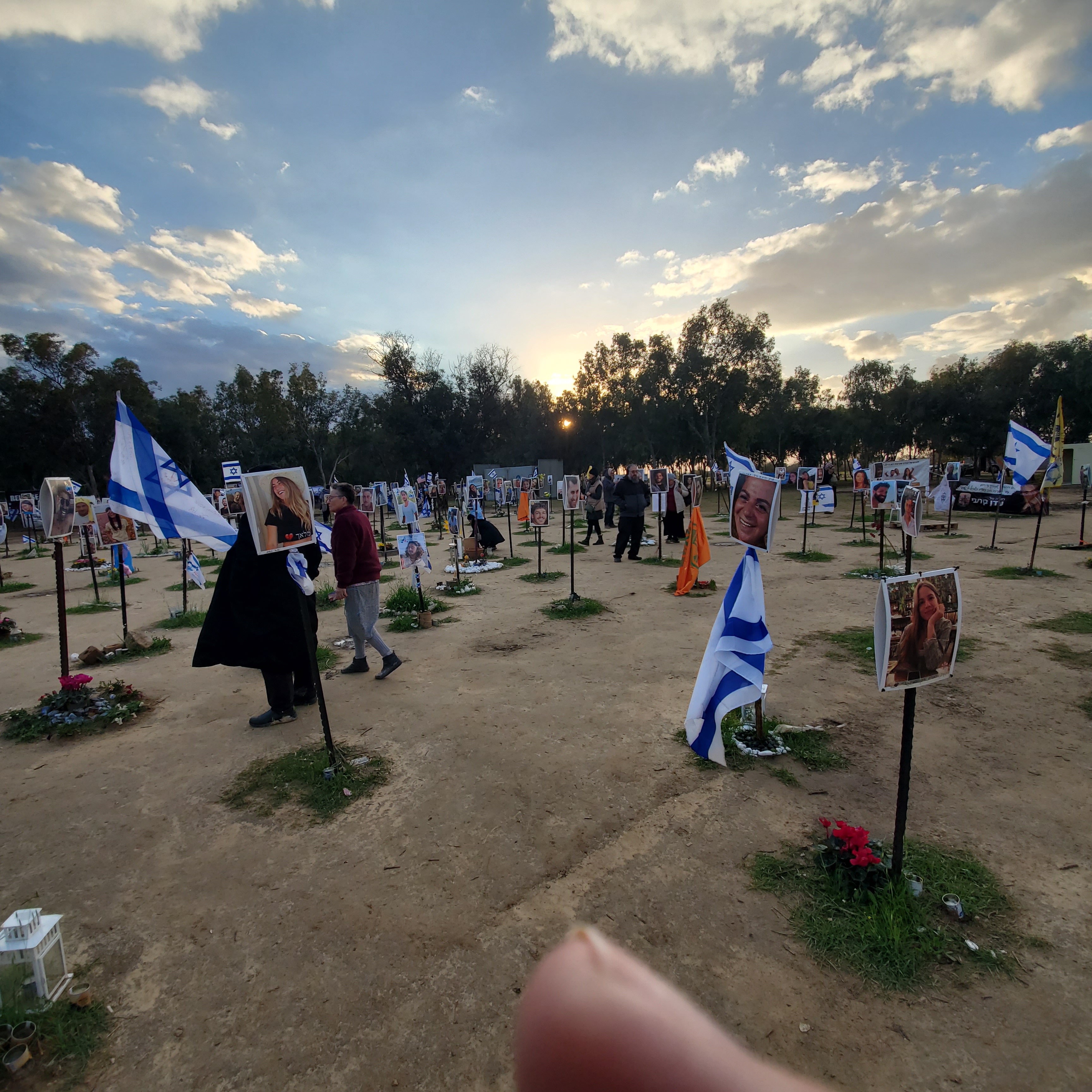
De repente llegamos a un sitio que nos impresionó a todos muy profundamente: el área principal del festival, donde unos trescientos cincuenta jóvenes de 20 a 40 años fueron asesinados a tiros, violados y mutilados sin piedad y otros 40 secuestrados y llevados a Gaza. Había un mar de fotos conmemorativas. Cada imagen era de una persona joven al comienzo de su vida adulta que había sido profanada de maneras que no hay palabras para expresar. Al ver las imágenes, se comprendió todo el horror de las imágenes de la cámara corporal de uno de los policías que llegó a la escena poco después de que ocurriera la atrocidad. Estas personas habían venido a festejar y escuchar su música y, en general, pasar un buen rato, pero sus sueños se vieron frustrados, sus cuerpos cruelmente rotos y sus vidas truncadas por salvajes despiadados que gritaron el nombre de su dios enfermo en sus caras mientras llevaban a cabo su nefasto plan. Cada imagen representaba una vida. Una vida destruida por una supuesta desigualdad nacionalista. Y mientras estaba parado en este bosque de imágenes, me di cuenta de nuevo de que hay imbéciles enfermos y depravados que afirman que nunca sucedió o que los que sufrieron lo hicieron porque eran ocupantes y opresores en algún reino mítico que nunca había existido. Y todo esto es ayudado e instigado por la organización criminal de las Naciones Unidas. Los cuerpos han sido retirados y enterrados y se ha plantado un jardín de flores, una por cada una de las víctimas, pero su sangre grita desde el suelo pidiendo justicia para dar cuenta de la agonía de los familiares y amigos que sufren pesadillas que ni siquiera deberían ser retratadas por Hollywood. ¿Las imágenes, las flores y los árboles nos aplacan o nos mueven a apoyar la lucha contra el mal puro que es Hamas, la yihad palestina, Hezbollah y todos los demás grupos musulmanes radicales desagradables? A ninguno de estos jóvenes se le dio ninguna salida. No se dio cuartel y, de hecho, se encontraron órdenes escritas sobre algunos de los terroristas en las que se pedía explícitamente a los perpetradores que mataran, violaran, decapitaran, quemaran y mutilaran a tantos como fuera posible. Grabaciones de sonido de personas enfermas llamando a sus padres por WhatsApp para jactarse de la cantidad de judíos que acababan de matar y de que sus padres se gloriaban de sus logros. Me viene a la mente el rostro de unos niños corriendo junto a una camioneta con el cadáver semidesnudo y decapitado de una joven que la escupe y golpea su cuerpo destrozado con palos. Y ahora, un mundo enloquecido grita a los caballeros que los vengan por ser los protagonistas de asesinos. La última parada de nuestro recorrido fue en el cementerio de coches. Nos dirigimos al campo a las afueras de Netivot cuando el sol comenzaba a ponerse. Nos dijeron que había unos 3.000 vehículos de víctimas israelíes y de terroristas de Hamás. Fue un final surrealista para un día desgarrador. Había alambre de púas alrededor del campo para mantener alejados a los cazadores de recuerdos. Con el sol ocultándose bajo el horizonte de Gaza y la tranquilidad del propio patio, me di cuenta de que muchos de estos vehículos tenían y aún contienen sangre, cenizas y partes de cuerpos que los increíbles voluntarios de ZAKA no pudieron encontrar o no pudieron limpiar de los cascos quemados y acribillados a balazos que en algún momento habían sido la preciada posesión de alguien. Los vehículos se amontonaban en filas y en el crepúsculo del crepúsculo parecía inquietantemente reminiscente de un cementerio limpio y pacífico, que no daba ninguna pista a la confusión, el ruido y el terror que habían marcado sus últimos momentos.
Según el Jerusalem Post, debido a la imposibilidad de extraer todos los restos humanos, los vehículos serán aplastados o triturados y enterrados en parcelas especiales en todo el país. Es difícil para una persona racional mirar este monumento al sufrimiento humano causado por un odio que no tiene ninguna base lógica. Es difícil imaginar el terror y el sufrimiento que ocurrieron cuando los jóvenes fueron asesinados a tiros, volados por los RPG y quemados vivos dentro de sus vehículos mientras intentaban escapar de la carnicería que estaba ocurriendo a su alrededor. Estoy seguro de que muchos de nosotros ofrecimos oraciones silenciosas por estas víctimas asesinadas y también por aquellos que aún se encuentran entre los secuestrados y los familiares que perdieron a sus seres queridos en ese horrible día o cuyos seres queridos fueron secuestrados violentamente en las madrigueras subterráneas de Gaza. Pienso en los equipos médicos, los socorristas y los voluntarios de ZAKA que tuvieron la repugnante tarea de retirar e identificar los restos humanos casi irreconocibles. Recordamos a las familias, no sólo en la envoltura de Gaza, sino también en las aldeas y pueblos de la frontera septentrional, que no pueden regresar a sus hogares o comunidades debido al continuo lanzamiento de cohetes por parte de los regímenes terroristas que no sólo mantienen, sino que tratan de intensificar la monstruosidad que se está perpetrando contra el pueblo de Israel. Que Hashem bendiga los nombres de los que perecieron ese día. Que Hashem bendiga la memoria de aquellos que trabajan incansable e interminablemente para resolver a quién pertenecen las partes del cuerpo y a nuestros soldados que buscan a los rehenes. Y estar con los que quedan y sufren horribles pesadillas de lo que sucedió ese día.
Que Hashem bendiga la memoria de todos los soldados que han perecido desde que comenzó esta horrible guerra y que devuelva la paz a Israel y digamos “amén”.
Compartido por Benjamin Casey, traducido de Ingles.
Several thousand years ago Abraham, called Abram at the time, rejected the many gods that the people around him had set up. He spoke to Elohim who revealed himself to him as El Shaddai. (see here) He was, according to Scripture, the only one in his day who saw the falsity of strange gods. He was obedient to the One God. We know this because of what the Torah says of him:
Gen 26:5 “…Abraham obeyed my voice, and kept my charge, my commandments, my statutes, and my laws.”
How did he know these things if the law had not yet been given? This is perhaps a mystery that we cannot understand, except that he spoke directly to the Eternal, and as it says above he “obeyed my voice.” He apparently had no human interpreter.
So how can a human understand the voice of the Most High, One and Only God without others to direct him?
By the time Moses came on the scene, there seemed to be a need for someone to guide and lead. Moses heard the Voice at the burning bush and was in direct communication with Elohim. He had no interpreter nor leader. And apparently there has never been another like Moses by whose hand we received the written down “voice” if you care to call it that, or “Words” of God.
Deu 34:10 “And there arose not a prophet since in Israel like unto Moses, whom the YHVH knew face to face,”
Today, several thousand years later, human leaders have overtaken every religion in the world. How do we know that they correctly interpret the written words of Elohim? I say that usually they don’t give it to us as it was given through Moses. And they stand in the middle between us and our Creator, as interpreters or mediators. If we look at the 10 commandments, the very first “Thou Shalt Not” says something very big. Let’s look at the Hebrew for Exodus 20 3, and then look at the meaning in our own language. לֹא יִהְיֶה־לְךָ אֱלֹהִים אֲחֵרִים עַל־פָּנָיַ׃
This is usually translated as “thou shalt have no other gods before me.” But if we look deeper we see “there shall not be to you other gods upon my face or in my presence.” עַל־פָּנָיַ (literally: upon my face or countenance or in my presence).(See Strongs).
Exodus 20:3 does not mean merely to not worship other gods, but rather not even to have them in between us and Hashem. He should not have to work through them to reach us. He would rather have a direct connection with us.
If we look at the word Elohim throughout the Tanakh we will see that it is often used for judges or powerful men as well as false gods.
From Strong’s Hebrew definitions:
אֱלֹהִים “ĕlôhîym, el-o-heem’; plural of H433; gods in the ordinary sense; but specifically used (in the plural thus, especially with the article) of the supreme God; occasionally applied by way of deference to magistrates; and sometimes as a superlative:—angels, × exceeding, God (gods) (-dess, -ly), × (very) great, judges, × mighty …rulers, judges, either as divine representatives at sacred places or as reflecting divine majesty and power.” Strongs.
So anybody that is great enough in our imagination that we look to as an interpreter of God’s laws, or anything to do with Him, anyone who stands between us and the Eternal or in the presence of God as a mediator, is a false elohim or god: as it says: “there shall be to you no other elohim upon my face.”
Moses actually stood in that place for the people of Israel who had just been delivered from Egyptian slavery. But who is as great in our day as Moses? Priests? Rabbis? Are there even any true prophets today? What about all the books that have been written to interpret Torah? Who gave anyone the right to define or reinterpret Torah, let alone add to or take away from it?”
If you are a religious Jew, you probably believe in the Chain of Transmission (See here) which endorses the passing down of the Torah through the generations of Sages and Rabbis who developed the Oral Torah and Tradition which is today’s Judaism. But did you know that not even Joshua was allowed to change even one word that Moses handed over?
Jos 1:7 “Only be thou strong and very courageous, that thou mayest observe to do according to all the law, which Moses my servant commanded thee: turn not from it to the right hand or to the left, that thou mayest prosper whithersoever thou goest. 8 This book of the law shall not depart out of thy mouth; but thou shalt meditate therein day and night, that thou mayest observe to do according to all that is written therein: for then thou shalt make thy way prosperous, and then thou shalt have good success.
So, not even Joshua who was on Mount Sinai at the giving over of the two tablets of 10 commandments, was allowed to reinterpret anything. (See Exodus 24).
How do we get back to hearing the voice of God speak to us in the wilderness like Abraham and Moses? Is it even possible? Perhaps some of us feel that YHVH has withdrawn his face from us. Maybe the question to ask ourselves is: what do we need to turn away from in order to cause His face to look once again upon us? If the literal commandments were not to be altered or added to, then there may be a reason why we are not getting the connection we desire.
Zec 1: 3” Therefore say thou unto them, Thus saith the LORD of hosts; Turn ye unto me, saith the LORD of hosts, and I will turn unto you, saith the LORD of hosts. 4 Be ye not as your fathers, unto whom the former prophets have cried, saying, Thus saith the LORD of hosts; Turn ye now from your evil ways, and from your evil doings: but they did not hear, nor hearken unto me, saith the LORD. 5 Your fathers, where are they? and the prophets, do they live forever? 6 But my words and my statutes, which I commanded my servants the prophets, did they not take hold of your fathers? and they returned and said, Like as the LORD of hosts thought to do unto us, according to our ways, and according to our doings, so hath he dealt with us.”
We can see evidence in the verses above that even in the time of the prophet Zechariah, the people blamed the Eternal for abandoning them. And it is still true today, when troubles come upon God’s people, He often gets the blame, rather than people taking a hard look at their lives and measuring themselves with the only standard of righteousness–the written Torah!
Are we the chosen people just because we once were? Is there any standard at all that we must measure up to in order to qualify? Is there a slim chance that Hashem will or has abandoned us? The prophet Jeremiah serves up a very dire warning to the house of Israel. God forbid that it should be true of us today!
Jer 18:6 “O house of Israel, cannot I do with you as this potter? saith the LORD. Behold, as the clay is in the potter’s hand, so are ye in mine hand, O house of Israel. 7 At what instant I shall speak concerning a nation, and concerning a kingdom, to pluck up, and to pull down, and to destroy it ; 8 If that nation, against whom I have pronounced, turn from their evil, I will repent of the evil that I thought to do unto them. 9 And at what instant I shall speak concerning a nation, and concerning a kingdom, to build and to plant it ; 10 If it does evil in my sight, that it obeys not my voice, then I will repent of the good, wherewith I said I would benefit them.”
So, if we have been following the interpretations of men who set themselves up as leaders who claim to teach the ways of the Creator, and we admit that we really do not understand the Torah and that we somehow cannot connect with the Eternal other than through manmade rituals, then why not begin studying in earnest what the literal Torah says. Is it really that difficult?
Deu 30:10-14: if you obey the LORD your God and keep his commands and decrees that are written in this Book of the Law and turn to the LORD your God with all your heart and with all your soul. 11 …what I am commanding you today is not too difficult for you or beyond your reach. 12 It is not up in heaven, so that you have to ask, “Who will ascend into heaven to get it and proclaim it to us so we may obey it?” 13 Nor is it beyond the sea, so that you have to ask, “Who will cross the sea to get it and proclaim it to us so we may obey it?” 14 No, the word is very near you; it is in your mouth and in your heart so you may obey it.
Ariella Golani
Please subscribe, share, like and or comment! It will help me get the word out!